

The Publius Project’s Special Topics Essays explore the historical, cultural, and philosophical questions surrounding the American experiment. While the Restoration Papers focus on institutions, structure, and civic principles, these essays examine the human realities beneath them - history, leadership, culture, morality, and the enduring tension between ideals and imperfection.
They are not written to provide easy answers, but to encourage serious reflection in an age increasingly hostile to nuance.
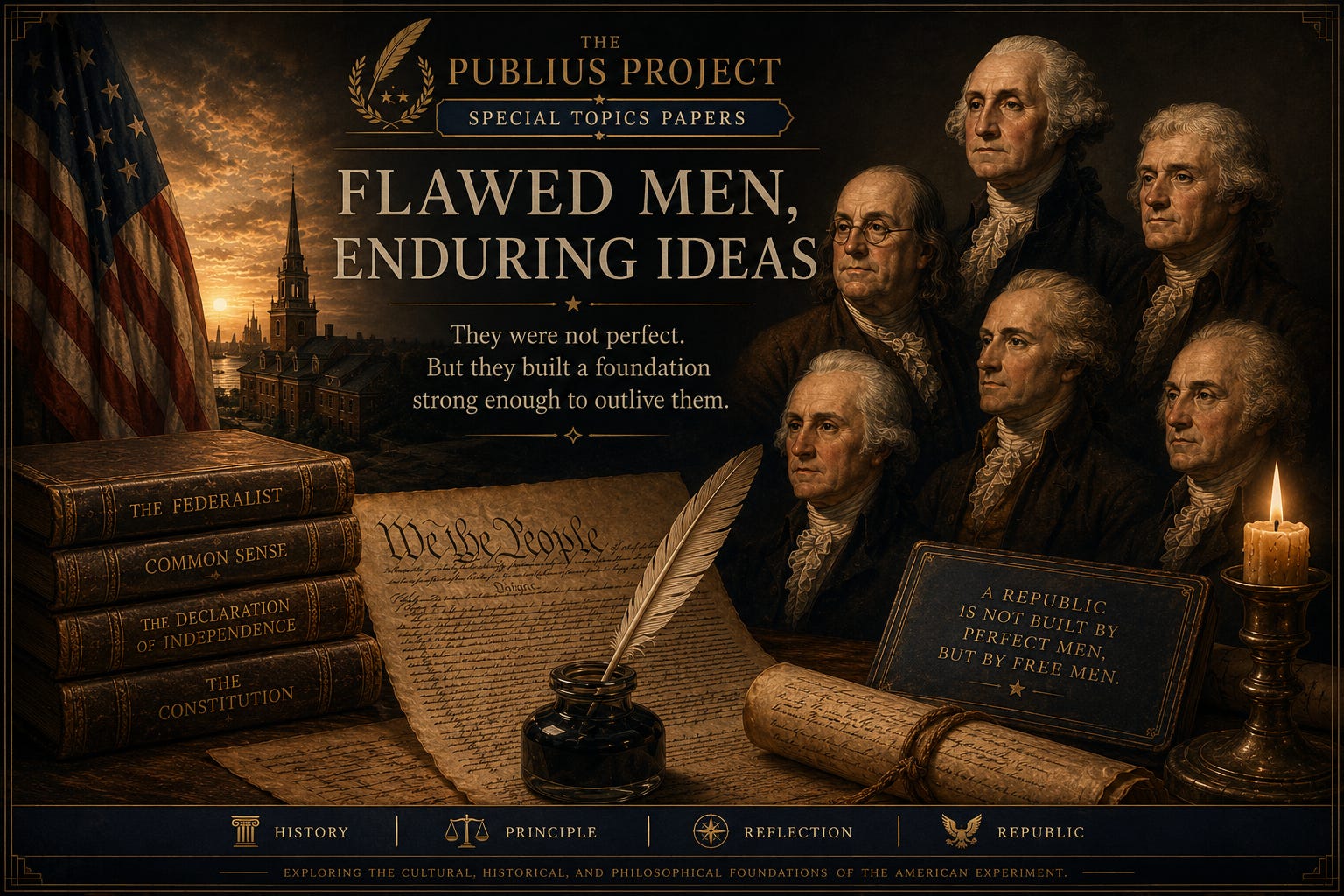
I figured since I’m going to be talking a lot about our founders in the coming weeks, I should address something right up front.
We’ve all seen this growing trend in our modern society; putting the past on trial.
We go digging through history searching for villains or heroes, and when we find that most people were neither, we get frustrated. Some people get genuinely angry and others get cynical.
A lot of that energy has landed squarely on the American founders.
To some, they were simply wealthy white slaveowners who talked about freedom while denying it to others. To others, they are treated almost like untouchable legends that shouldn’t be questioned at all.
But both sides miss what actually matters.
America’s founders were not gods. They were only men.
Ambitious men. Smart men. Prideful men. Courageous men. Men who argued, competed, compromised, and contradicted themselves. Like nearly every generation of leaders throughout human history, the founders carried both wisdom and weakness at the same time.
As a nation, who wants to be considered great again, we must be capable of acknowledging both.
Because here’s the reality: human beings have always been complicated. That’s not a modern discovery. That’s the entire story of civilization. Everything we’ve built – every system, every country, every idea – has come from imperfect people trying to figure things out as they went.
Take slavery. It wasn’t something invented by America. It existed all over the world for thousands of years. Ancient Rome ran on it. Greece practiced it. Parts of Africa, the Middle East, and Asia all had their own versions of it. Even religious texts from the time talk about it like it was just part of life.
None of that makes it right. Not even close.
But understanding that context isn’t the same as defending it. And that’s where people get tripped up. Explaining history is not the same thing as excusing it.
If we can’t do both – if we can’t say “this was wrong” while also understanding the world people were living in – then we’re not really studying history. We’re just judging it from a distance.
And slavery wasn’t the only issue. For most of human history, women had almost no legal rights. Class systems were rigid. Religious tolerance was rare. Punishments were harsh. Violence in politics wasn’t unusual, it was expected. The idea that regular people could govern themselves without a king? That sounded insane to most of the world.
The past wasn’t better. It was just different.
And our founders came out of that world.
Jefferson, Washington, Madison – these weren’t clean, polished figures. Some owned slaves. Many held views we would reject today without hesitation. They fought with each other constantly. They protected their own interests. They played politics like politicians always have.
But at the same time, they built something that hadn’t really been done before.
That’s the part people struggle with.
Because we like our heroes simple. We want them either fully good or fully bad. But history doesn’t work like that. Most progress doesn’t come from perfect people showing up and fixing everything. It comes from flawed people pushing things forward, even if they don’t fully live up to the ideas they’re putting into the world.
The founders are a perfect example of that.
The same men who failed to end slavery also wrote down principles that made ending slavery possible. Ideas like natural rights, individual liberty, and the belief that all men are created equal didn’t stay on paper. Later generations picked them up and used them as arguments against the very system the founders failed to dismantle.
That’s not a clean story. It’s a messy one.
But it’s real.
The American experiment wasn’t finished in 1776. It wasn’t even close. It started as an unfinished project, and in a lot of ways, it still is.
That shouldn’t surprise anyone. No country just “gets it right” all at once. Rights expand over time. Ideas evolve. People push, resist, argue, and fight over what a nation is supposed to be.
The founders planted something, but they weren’t around for the harvest.
And here’s where things get tricky today.
We’ve inherited a lot of progress that we didn’t personally have to fight for. That can make it really easy to look backward and judge people who lived in a completely different world. It creates this quiet sense of moral superiority - like we would’ve obviously done better.
Maybe. Maybe not.
It’s worth remembering that the people we’re judging built the system we’re standing in. The freedoms, the structure, the framework – we didn’t create those from scratch.
That doesn’t mean we excuse their failures. Slavery was wrong. Denying women rights was wrong. Plenty of things in the past deserve clear, direct criticism.
But if we turn history into a simple story of good guys and bad guys, we lose something important. We stop learning from it.
History turns into a tool for outrage instead of understanding.
And it’s not just the founders. Look anywhere.
Marcus Aurelius is remembered as a philosopher-king, but he still ruled an empire built on conquest. Churchill helped defeat Nazi Germany, but also held views shaped by imperialism that people rightly criticize today. Lincoln, Roosevelt, Caesar, Napoleon – pick a name. You’ll find the same pattern.
Strengths and flaws. Side by side.
That’s not a glitch in history. That is history.
If we decide that only perfect people are allowed to have contributed something valuable, then we’re left with nothing. No one qualifies.
The real danger today isn’t that people criticize the founders. Criticism is fine. It’s necessary. The danger is the idea that because someone was flawed, everything they did becomes worthless.
Once we go down that road, we don’t just lose the founders – we lose our ability to learn from anyone.
Every generation inherits imperfect leaders.
Every country inherits unfinished work.
Every society struggles to live up to its own ideals.
That hasn’t changed.
So, the real question isn’t whether the founders were perfect. They weren’t.
The question is whether the ideas they left behind still matter.
Because a free society doesn’t need blind admiration. It needs clear-eyed honesty. It needs people who can say, “This was wrong,” without throwing out everything that was right. It needs people who can hold two thoughts at once without collapsing into cynicism or denial.
The founders were flawed men.
But flawed men can still leave behind ideas strong enough to outlive them.
In Liberty,
Gary Mullins (Libertas)