

Preface: Two Perspectives on the Same Problem
Restoration Paper No. 9 makes the structural case. It explains how the American system drifted - legally, constitutionally, and politically - from a government of laws to a government of processes. If you want to understand the architecture of the problem, that is the place to start.
This essay goes somewhere different. It looks at what that drift actually feels like from the inside. Not the theory, but the experience. The exhaustion of filling out a form for the third time because of a technicality. The small business that never opened. The community that stopped trying to fix its own problems and started waiting for the right agency to show up.
These are the costs that never show up in a budget. They do not have line items. But they are real, they compound over time, and in the long run they may be the most important costs of all. This essay tries to put them into plain view.
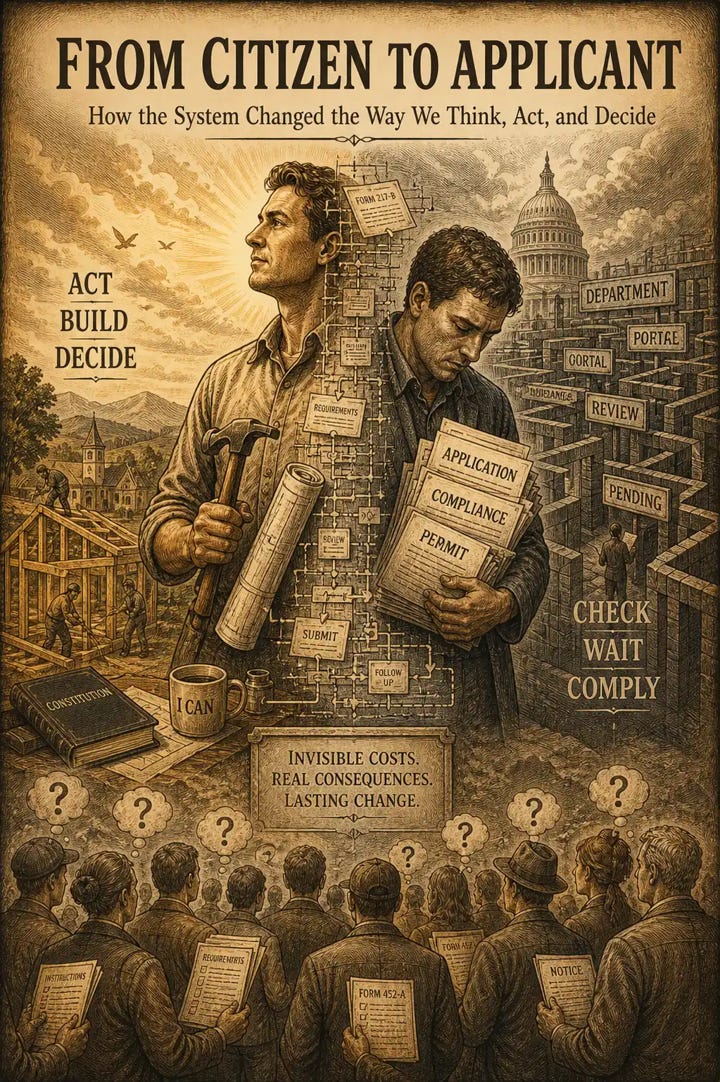
I. The Costs That Don’t Show Up on Paper
When most people think about what government costs them, they think about taxes. That makes sense - taxes are visible, measurable, and argued over constantly. But there is another category of cost that is just as real and far harder to see.
Think about the entrepreneur who sat down to figure out how to get a business license and gave up after three hours of reading requirements that seemed to contradict each other. Think about the family that spent an entire Saturday on hold trying to get a simple answer from a government agency, got transferred four times, and still did not have a clear answer by the end of it. Think about the contractor who decided it was not worth expanding because the paperwork alone would take months.
None of those situations shows up anywhere in the federal budget. The hours lost, the decisions reversed, the ambitions quietly shelved - they are invisible to the standard measures. But they are not invisible to the people who lived them.
Over time, these invisible costs do something more serious than slow things down. They change how people think about themselves and what they are capable of. When people run into enough walls, they stop running. They stop asking. They start assuming the system is not really for them and that the bold move is probably not worth it. That shift in attitude - from active to cautious, from building to waiting - is the deepest cost of all.
II. When Following the Rules Replaced Understanding Them
There was a time when the basic structure of American law was something an ordinary person could reasonably follow. The rules were supposed to be clear enough that a regular citizen could know whether they were inside or outside the law without hiring a specialist. That was not just a nice idea, it was a design principle.
That world is largely gone. Today, when a citizen or a small business owner encounters a government requirement, the pressing question is almost never “Is this rule legitimate?” or “Did my elected representatives actually vote for this?” The question is almost always more practical and more anxious: “What exactly do I have to do, and what happens if I get it wrong?”
That shift - from asking whether a rule is right to asking how to survive it - is more than a change in attitude. It is a change in the nature of the relationship between the citizen and the state. In the original design, the citizen held inherent rights, and the government had to justify any restriction on those rights. In the managed system, the citizen’s main job is to stay compliant with a process they did not create, do not fully understand, and cannot meaningfully change.
When people stop asking whether rules are legitimate and start focusing only on how to satisfy them, something essential has been surrendered.
III. The Mental Tax: The Psychological Burden of Compliance
There is a kind of exhaustion that comes not from hard work, but from managing complexity. It is the feeling of keeping too many plates spinning at once. For millions of Americans, a significant part of that exhaustion comes directly from navigating administrative systems.
Think about what it actually takes to run a small business today. You are not just running the business. You are tracking compliance deadlines, maintaining documentation for potential audits, interpreting guidance that changes without warning, and paying someone - a lawyer, an accountant, a consultant - to explain what all of it means. That is before you have sold a single product or served a single customer.
This mental load does not fall evenly. A large corporation has entire departments to handle it. The small business owner handles it alone, at night, after the kids are in bed. The working family navigating a complex benefits system handles it on their lunch break. The independent contractor handles it on weekends.
Every hour spent managing administrative complexity is an hour not spent building something, teaching something, or caring for someone. The managed state does not just take your money. It takes your attention, your energy, and your time - the things you cannot get back.
IV. The Procedural Burden: When the Process Becomes the Punishment
Any single government requirement, taken on its own, can usually be defended. A health inspection serves a real purpose. A building permit protects real safety. An environmental review can catch real problems. Taken individually, these things make sense.
But the experience of an actual person trying to get something done is not individual requirements one at a time. It is all of them at once, layered on top of each other, each with its own timeline, its own office, its own documentation requirements, and its own definition of what counts as a completed application.
There used to be a human element in this process. A clerk who had seen your situation before. An official who could tell you that you were close, explain what you were missing, and give you a chance to fix it before things escalated. That flexibility, the ability to use judgment in individual cases, was not a loophole. It was a safeguard. It kept the spirit of the law from getting crushed by the letter of the procedure.
Modern systems are increasingly designed to eliminate that flexibility in the name of consistency and efficiency. The result is an environment where a single missed checkbox can trigger a cascade of consequences. Where the system cannot distinguish between an honest mistake and a deliberate violation. Where the process itself becomes the punishment, regardless of whether you actually did anything wrong.
V. Algorithmic Governance: The “Black Box” Problem
The newest and fastest-growing layer of the managed state is automated. More and more decisions that directly affect people’s lives - loan approvals, benefit eligibility, licensing reviews, risk assessments - are now made by algorithms rather than human beings.
These systems can process enormous amounts of information very quickly. From an administrative standpoint, that efficiency is genuinely useful. But from a citizen’s standpoint, automation creates a problem that is harder to name and harder to fight than anything that came before it.
When a human official makes a decision you disagree with, you can ask why. You can present new information. You can make an argument to someone capable of changing their mind. But when an automated system tells you that you have been denied, the question “Why?” often hits a wall. The answer is that the system determined the outcome. The specific reasons, the data inputs, the weighting of factors, all of it is often locked inside what researchers call a “black box”: a process that produces results but cannot be meaningfully examined or challenged from the outside.
This is not a minor legal technicality. One of the oldest principles of fair treatment under the law is that a person has the right to understand the case against them and respond to it. Automated systems, as currently designed and deployed, often make that impossible.
There is also a scale problem. When a human clerk makes an error, it affects one person. When an automated system has a flaw in its logic or a bias in its data, that error is replicated across every decision the system makes, potentially thousands or millions of cases before anyone notices. The same efficiency that makes these systems attractive is what makes them dangerous when they go wrong.
VI. The Cultural Shift: From Builders to Navigators
The effects described so far do not stay in the policy world. Over time, they seep into the culture. They change what people value, what they attempt, and what kind of country we become.
In a society built on a presumption of liberty, where the starting assumption is that you are free to act unless a specific law says otherwise, the cultural orientation is toward action. You have an idea, you try it. You see a problem, you solve it. The burden of justification falls on anyone who wants to stop you.
In a society built on a presumption of permission, where the starting assumption is that you need approval before you act, the cultural orientation shifts toward caution. You have an idea, but first you check whether it is allowed. You see a problem, but first you find out whose jurisdiction it falls under.
These are not just different legal frameworks. They are different ways of being. The first produces builders, risk-takers, and people who believe their initiative matters. The second produces navigators - people skilled at working within the system but with little practice working outside it.
A republic does not run on navigators. It runs on citizens who believe they have the standing, the ability, and the right to shape the world around them. When administrative complexity gradually shifts the culture from one to the other, the republic loses something it cannot easily get back.
VII. The Erosion of Local Agency: The Atrophy of Self-Governance
There is a principle in political philosophy called subsidiarity: the idea that problems should be solved at the most local level capable of handling them. Communities handle what communities can handle. States handle what states can handle. The federal government handles what genuinely requires a national response.
This is not just an abstract principle. It reflects something true about how self-governance actually develops. When people solve problems in their own communities, they learn how to do it. They build relationships, develop judgment, and accumulate the experience of working together. They become better at governing themselves because they are actually doing it.
The managed state tends to work in the opposite direction. When every local initiative requires a federal permit, a state certification, or compliance with a distant agency’s guidelines, the community’s instinct to solve its own problems is gradually replaced by the habit of looking upward. Instead of asking “How do we fix this?”, the question becomes “Which program covers this?” Instead of organizing a solution, people wait for the right authority to show up.
Over time, communities do not just lose the legal authority to handle their own affairs. They lose the confidence. They forget they ever had it. The atrophy of local problem-solving is not just a loss of efficiency. It is a loss of the civic habits that keep a republic alive.
This is not just a loss of authority – it is a loss of habit.
VIII. The Innovation Cost: The Ideas We’ll Never See
Economists have a name for costs that are real but invisible: “the unseen.” It refers to what does not happen because of a policy - the businesses never started, the inventions never built, the transactions that never took place. These losses are genuine, but because the thing never existed, there is nothing to point to.
The managed state produces an enormous amount of “the unseen.” When someone abandons a business idea because the licensing process is too daunting, we never get to know what that business might have been. When a community innovation gets blocked by a zoning rule, we never see what it could have become. When a talented person decides the path to their goal requires too much navigation and chooses a safer, easier route instead, we lose whatever they would have created.
People sometimes defend the current system by pointing to the companies that do succeed and the industries that do grow. But that argument misses the point because it only counts the survivors. It does not count the food truck that never opened because the permitting requirements were too complicated. The community daycare that could not get approved because of a square-footage rule that had nothing to do with child safety. The contractor who decided not to expand because growth would mean more regulatory exposure than it was worth.
Individually, each of these is a small story. Added up, year after year, across the entire economy, they represent something large: the gap between the country we are and the country we could have been. That gap is the true innovation cost of the managed state.
IX. The Global Stake: National Agility in a Competitive World
These costs do not stay inside our borders. They play out on a world stage, in competition with countries making different choices about how to structure their governments.
Capital moves to where it can work. Talent moves to where it can grow. Innovation happens where people are free to try things quickly, fail, adjust, and try again. A country whose regulatory environment requires years of review for projects that a competitor nation approves in months is not just inconvenienced. It is losing ground - real, compounding ground - in the race for the industries and technologies that will define the next generation.
This is what an “agility gap” looks like in practice. One country’s system moves fast. Another country’s system processes. Over time, the fast-moving system attracts investment, talent, and momentum. The processing system ends up managing its own decline, very efficiently, one form at a time.
A nation’s standing in the world is rarely lost all at once. It erodes through the compounding effect of opportunities missed, talent lost to other countries, and innovations built somewhere else. When a country becomes so procedurally burdened that it cannot move at the pace of the problems it faces, that is not just an administrative inconvenience. It is a strategic vulnerability.
But this is not only a competitive issue. It is a philosophical one. A nation that values liberty should not need an external threat to motivate it to restore freedom at home.
X. The Expert Problem: Who Decides, and Who Do They Answer To?
Behind the managed state is an idea that sounds reasonable on the surface: modern society is too complex to be governed by ordinary elected representatives, so we need a permanent class of trained specialists to manage it. This idea has a name: technocracy.
The case for technocracy is easy to understand. Financial markets are complicated. Public health requires specialized knowledge. Environmental science involves data that takes years to learn how to read. The argument is that Congress simply cannot keep up, and that running a modern government through the slow, messy process of democratic debate is inefficient at best and dangerous at worst.
But here is the problem with that argument: the question of how to manage a complex technical system is genuinely a technical question. The question of who decides how it is managed is not. It is a political question. It is a question about power and accountability, and it belongs in the public square, not in an agency memo that nobody voted on.
When technical expertise is used to remove political questions from democratic debate, something important gets hidden. Critics call it “accountability laundering.” A decision that is fundamentally about values, about tradeoffs between economic growth and safety, or between security and liberty, gets dressed up as a neutral, technical determination. Because it looks technical, it seems exempt from challenge. Because it seems exempt from challenge, nobody challenges it. And the choice gets made by people who were never elected and never have to face voters for the consequences.
The answer is not to get rid of expertise. It is to keep expertise in its proper place: advising the people and their elected representatives, not replacing them.
XI. The Psychological Shift: From Active Citizens to Passive Subjects
A free republic depends on a certain kind of person. Not a perfect person. Not an especially educated or wealthy person. Just a person who is in the habit of thinking for themselves, making their own decisions, participating in their community, and believing that their judgment matters.
That habit is not automatic. It has to be practiced. And it can be lost.
The managed state does not require the active, self-directed kind of citizen. It requires the compliant kind. It needs people who fill out forms correctly, meet deadlines, follow procedures, and stay within the defined boundaries of whatever system they are interacting with. In the managed state, compliance is the currency. Initiative is, at best, irrelevant. At worst, it is a liability.
Alexis de Tocqueville, writing in the 1830s, warned about exactly this kind of drift. He described a government that does not openly oppress its citizens but instead wraps them in a dense network of small, complicated rules that degrade them without tormenting them… until it has reduced a free nation to something like a flock of timid animals, with the government as their shepherd. He was not describing a dictatorship. He was describing something that could happen gradually, quietly, inside a democracy.
“Of all tyrannies, a tyranny sincerely exercised for the good of its victims may be the most oppressive.” — C.S. Lewis
The danger Tocqueville described was not dramatic. It was quiet. Quiet dangers are the hardest to fight because it is hard to know when they have arrived. The shift from active citizen to passive subject did not happen in a single moment. It happened one form, one permission, one “the system will notify you” at a time.
XII. The Human Cost: The Transformation of Our Civic Character
Everything discussed in this essay ultimately comes to rest on one person… a real individual, living a real life, trying to build something, raise a family, run a business, or just stay on the right side of rules they cannot fully understand.
The managed state does not typically harm that person in a single dramatic way. It works through accumulation. Each individual requirement is manageable. Each delay is survivable. Each form is fillable. But the sum of all of it, over years and decades, reshapes how that person sees themselves and what they believe they are capable of.
People raised inside a permission culture tend to think first about what they are allowed to do, rather than what they want to do. They have learned, through repeated experience, that initiative requires clearance. That creativity requires approval. That the bold move is probably going to hit a wall somewhere, so it is worth asking permission before you start rather than getting stopped after you have invested everything in it.
This is not weakness. It is a rational adaptation to the environment. But it is also a loss. A person who has internalized the permission culture is less free, in a meaningful way, than a person who has not… regardless of what the law technically guarantees them.
The ultimate cost of the managed state is not measured in dollars or in hours of paperwork. It is measured in the distance between the person someone could have become and the person the system trained them to be instead.
XIII. Conclusion: The Habit of Liberty
This essay has not argued that government is the enemy. Some level of administration is genuinely necessary. Rules protect people. Standards ensure safety. Coordination makes complex societies function. None of that is the problem.
The problem is proportion and direction. It is what happens when the administrative apparatus grows dense enough that it stops being a tool the people use to govern themselves and starts being the environment they must survive. When the system is no longer something you work with but something you work around - or stop trying to engage with at all - the relationship has inverted.
A free society is not a machine. It is a community of people who are capable, responsible, and trusted to run their own lives. The qualities that make such a society work - initiative, judgment, self-reliance, civic participation - are not automatic. They are habits, cultivated through practice and sustained by a political environment that treats citizens as capable adults rather than problems to be managed.
Those habits can atrophy. And when they do, they do not disappear with a bang. They disappear quietly, form by form, permission by permission, until one day a person sits down to try something and realizes, somewhere in the back of their mind, that they should probably check first. So, they check. And they wait. And the thing they were going to build just doesn’t happen.
The most important thing a republic can protect is not its institutions. It is the kind of citizen those institutions are supposed to serve - independent, responsible, and free. When the system begins producing a different kind of person - cautious, dependent, waiting for permission - that is when the real cost has been paid.
The good news is that habits can be rebuilt. The habit of liberty is not gone. But recovering it requires first naming what has been lost… which is exactly what this paper has tried to do.
In Liberty,
Gary Mullins (Libertas)