

The Publius Project is a series of essays called Restoration Papers and other resources exploring liberty, citizenship and the constitutional restoration of the American Republic.
To My Fellow Americans,
The American experiment was founded on a singular, revolutionary premise:
that the people would govern themselves.
This was not a call for direct democracy in every minute decision, but a design for a representative republic. We entrusted representatives with a specific, sacred duty: to carry the public’s will into the halls of power and translate it into law.
In this framework, elections were never intended to be mere ceremonial rotations of leadership.
They were designed to be the primary mechanism of redirection. An election was meant to be the moment where the citizens - peacefully, consistently, and decisively – could grab the wheel of the state and correct its course.
However, a fundamental question now confronts the American citizen:
What if the steering wheel is no longer connected to the tires?
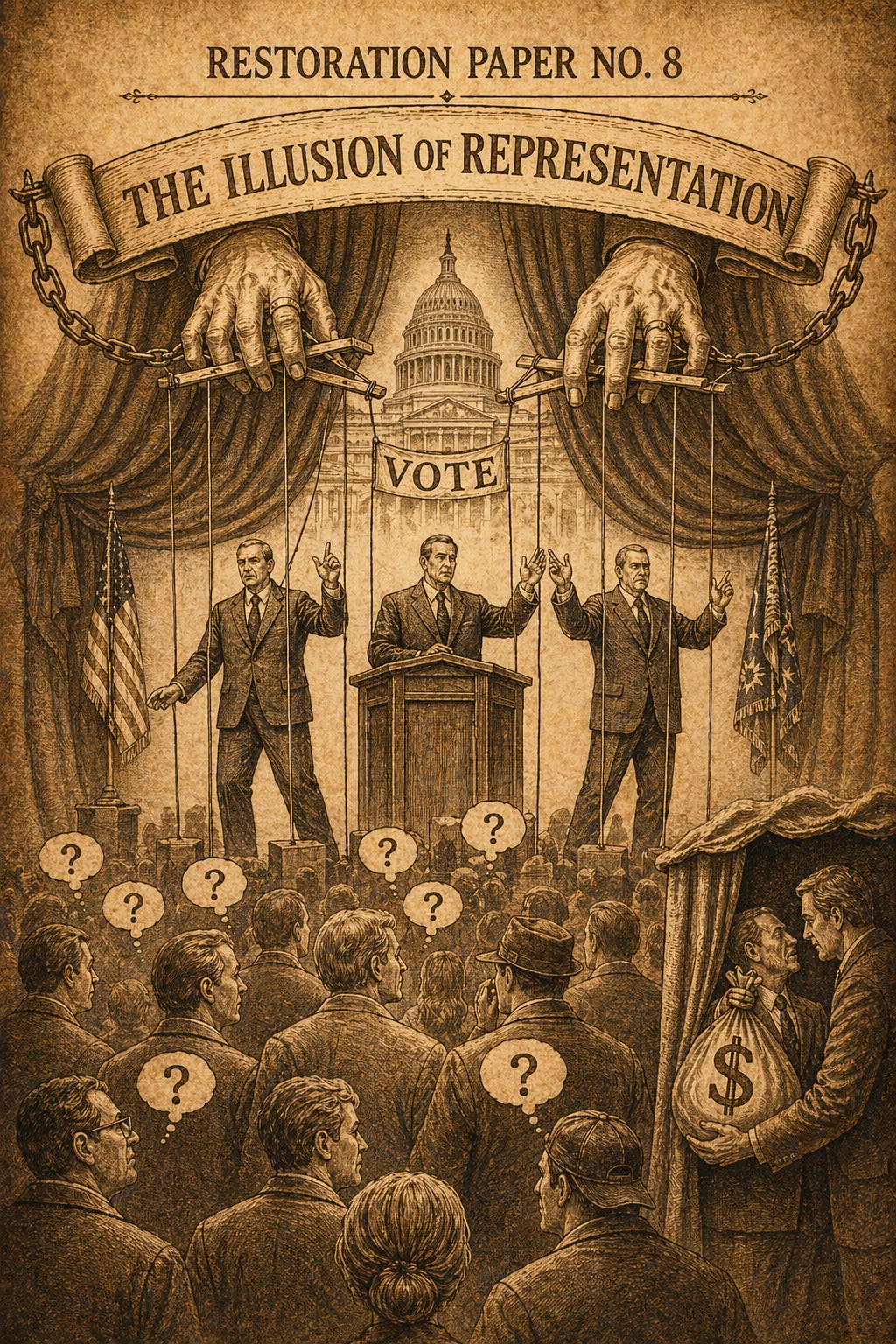
If the system has become insulated from the results of our elections, then the act of voting transitions from an act of governance to a mere “illusion of representation.”
The Evidence: When the Public Speaks—and Nothing Changes
The sense that the system is unresponsive is not merely a feeling; it is an observable reality. A landmark study by political scientists Martin Gilens and Benjamin Page examined 1,779 policy decisions over two decades to determine whose preferences actually shape the laws of the land.
Their conclusion was startlingly direct: Average citizens have “little or no independent influence” on government outcomes.
Instead, the study found that policy outcomes were almost exclusively aligned with two specific groups:
Economic Elites: Individuals at the top of the income bracket.
Organized Business Interests: Powerful lobbying groups and corporate coalitions.
When the desires of these influential groups diverged from the desires of the general public, policy overwhelmingly followed the former. The researchers noted that this pattern resembles an “oligarchic” system – one where power is concentrated within a small, influential segment of society rather than being broadly distributed across the population.
To be precise, this does not mean the public never gets what it wants. It means that the public only “wins” when its interests happen to overlap with those of the elites.
When a conflict arises, the public’s preference is not the deciding factor.
Competing Management Teams, Same System
This disconnection is not the failure of a single party; it is a feature of the system both parties inhabit. While Republicans and Democrats campaign as polar opposites and govern as fierce competitors, they function in practice as competing management teams for the same institutional enterprise: The Administrative State.
Much like a change in corporate leadership, a new administration brings a new “C-suite.” However, the structural reality remains consistent:
One team replaces another: The faces in the briefing rooms change.
Strategy is adjusted at the margins: Priorities shift slightly, but the core objectives are rarely discarded.
Messaging changes: The rhetoric is rebranded for a different “customer base” (the voters).
Despite these superficial shifts, the operating manual of the government remains intact. That manual is bound by the weight of:
Entrenched Agencies: Organizations that exist across decades, regardless of who sits in the Oval Office.
Regulatory Frameworks: Millions of words of code that act as the system’s “hard-coding.”
Funding Pipelines: Budgetary inertia that ensures the machinery continues to hum.
Bureaucratic Continuity: The millions of “permanent” staff who provide the institutional memory that outlasts any elected official.
The result is a profound paradox of modern governance:
Elections change the managers, but the system continues to operate as designed.
The Administrative State: Where Representation is Diluted
If elections are not where outcomes are ultimately decided, where does power reside?
Increasingly, it resides within the Administrative State. In this environment, representation is not necessarily removed – it is filtered, processed, and often neutralized through four primary mechanisms:
1. Information as Leverage
When control of government is divided, bureaucratic agencies often share less information with opposing political actors. This creates a critical consequence: Representatives are forced to act on curated data sets provided by the very institutions they are meant to oversee.
Selective Disclosure: Policy is shaped by what agencies choose to reveal.
Information Asymmetry: Legislators lack the full picture, leading to an incomplete understanding of the laws they pass.
Weakened Oversight: When data is used as leverage rather than a neutral resource, the foundation of legislative oversight crumbles.
2. Back-Channel Governance
Legislators increasingly resolve competing interests through agencies rather than public debate. This allows for a “quiet” version of governance that avoids the friction of the democratic process:
Private Resolution: Regulatory outcomes are negotiated outside the scrutiny of the legislative floor.
Donor Fulfillment: Outcomes can be delivered to interest groups without the accountability of a recorded vote.
The Appearance of Process: To the public, the “show” of representation remains; in practice, the most consequential decisions have already bypassed the public process entirely.
3. The Bureaucracy as a Prize
Because the Administrative State holds such immense power, both parties have stopped trying to limit it and instead focus on capturing it.
Ideological Capture: Appointments are made based on partisan loyalty rather than neutral expertise.
Weaponized Agencies: Regulatory bodies are steered toward partisan priorities and directed to reward political allies.
Systemic Incentives: This behavior is not a result of “bad” individuals but is the natural result of a system that rewards institutional control over constitutional restraint.
4. Structural Control Without Consensus
Through mechanisms like district design and institutional advantages, parties can secure control that is often disproportionate to broad public support. Once secured, this control extends deep into the machinery of the state:
Enforcement Discretion: The power to choose which rules to follow and which to ignore.
Long-Term Direction: Setting a policy trajectory that can take years or decades to reverse, regardless of subsequent election results.
In summary, the voter provides the signal, but the Administrative State provides the noise. By the time the signal reaches the policy outcome, it has been filtered beyond recognition.
The Illusion in Action
Theory becomes undeniable when observed in practice.
Case Study A: The Healthcare Paradox
The theory of “Managed Governance” becomes visible when we examine the Healthcare Paradox. This is perhaps the clearest example of a disconnect between a clear public signal and a deadlocked systemic response.
1. The Public Will: A Rare Consensus
For over a decade, public opinion on prescription drug pricing has remained remarkably stable. Between 80–90% of Americans – spanning all political affiliations – have consistently supported allowing the government to negotiate lower prices. In a healthy representative system, such a massive, sustained consensus would be an irresistible force for change.
2. The Systemic Barrier: The Twenty-Year Stall
Despite this overwhelming mandate, meaningful reform was effectively stalled for nearly two decades. During this period, the “personnel” of government changed multiple times, yet the policy outcome remained frozen.
3. The Filter at Work
How is a 90% consensus neutralized? The system employs three primary filters to dilute the public’s will:
The Financial Barrier (Lobbying Power): While the public’s voice is diffuse, the pharmaceutical industry’s voice is concentrated. By spending hundreds of millions annually on lobbying, industry actors ensure their interests are represented in every room where policy is drafted.
Back-Channel Governance (Regulatory Shaping): Before a bill is even debated, industry actors engage directly with regulators and agency staff. This allows them to shape the “operating manual” of the reform in ways the public never sees.
Administrative Capture (Implementation Delay): Even when a law is passed, the battle merely shifts to the bureaucracy. Through legal challenges, complex rulemaking, and “implementation delays,” the system ensures that the actual impact on the ground is diluted or deferred.
4. The Outcome: Insulation Over Responsiveness
The cycle remains predictable: Party control shifts and oversight leadership changes. However, the underlying pricing structure remains largely intact. The system has successfully absorbed the political energy of the “reform” and returned to its state of continuity.
Case Study B: Omnibus Spending and Invisible Decisions
If Case Study A showed how a clear signal is blocked, Case Study B shows how the “operating manual” is updated without the public – or often their representatives – even reading it. The Omnibus spending bill is the ultimate tool of aggregated representation.
1. The Mechanism: Complexity as a Shield
In a functioning republic, 12 distinct appropriations bills are meant to be debated, amended, and voted upon individually. Today, these are routinely bundled into a single “Omnibus” package.
Volume: These bills frequently exceed 2,000 to 4,000 pages.
The “Time-Squeeze”: They are often released mere hours or days before a shutdown deadline, giving representatives virtually no time for a comprehensive review.
The Frequency: This is no longer an emergency measure; since 1998, the government has been funded by temporary “Continuing Resolutions” or Omnibus packages for an average of nearly 50% of each fiscal year.
2. The Systemic Filter: Diffusion of Accountability
The Omnibus structure acts as a “filter” that prevents the public from holding representatives accountable for specific policy choices:
Bundled Trade-offs: An Omnibus forces a binary choice: Fund the entire government (including thousands of unrelated provisions) or shut it down. This eliminates the ability to vote “No” on a specific policy without being accused of “sabotaging” the nation.
Policy Riders: Because the bills are too large to scrutinize, they become vehicles for “riders” – legislative changes that would never pass on their own. Examples often include multi-billion dollar emergency reallocations or permanent changes to regulatory authority that are “tucked in” on page 1,500.
Administrative Empowerment: These bills often grant broad “discretionary authority” to agencies, essentially handing the bureaucracy a blank check to interpret and implement vague legislative language.
The “Unfunded” Future: These bills often include “budgetary gimmicks” that authorize spending today while pushing the actual fiscal reckoning years into the future, further disconnecting the current representative from the long-term consequence.
3. The Outcome: Aggregated Representation
The result is a total collapse of the “representative-to-voter” link. When thousands of policy decisions are compressed into one vote:
Accountability is Diffused: A representative can claim they “had to vote for it” to keep the government open, effectively insulating themselves from the consequences of any single provision within the bill.
Consensus is Manufactured: The bill reflects the consensus of the “Management Teams” (party leadership and agency heads), not the consensus of the public.
The Public Paradox: Dissatisfaction without Change
Public sentiment consistently reflects a deep awareness of this disconnect. However, when we look at the data, we see a striking contradiction – one that isn’t an accident, but a result of systemic design.
The Metrics of Discontent
The gap between what Americans feel and how the system responds is wider than ever:
Congressional Approval: While the 25-year average is skewed by a brief post-9/11 spike, public approval has settled into a modern baseline of 15–20% over the last fifteen years, rarely rising above one-fifth of the population even as leadership changes.
National Direction: According to the RealClearPolitics Poll Average, the share of Americans who believe the country is on the “wrong track” has averaged approximately 65% over the last fifteen years, creating a persistent majority of dissatisfaction that remains largely unaddressed by subsequent election cycles.
Political Identity: According to Gallup, a record-high 45% of Americans now identify as political independents, surpassing both major parties – a figure that has steadily climbed from 31% two decades ago as voters increasingly distance themselves from the two-party structure.
The Persistence of the Status Quo
Despite this historic level of distrust, the system remains remarkably stable. The “Management Teams” rarely lose their seats:
House incumbents are re-elected at a rate of 90%+.
Senate incumbents are re-elected at a rate of 80%+.
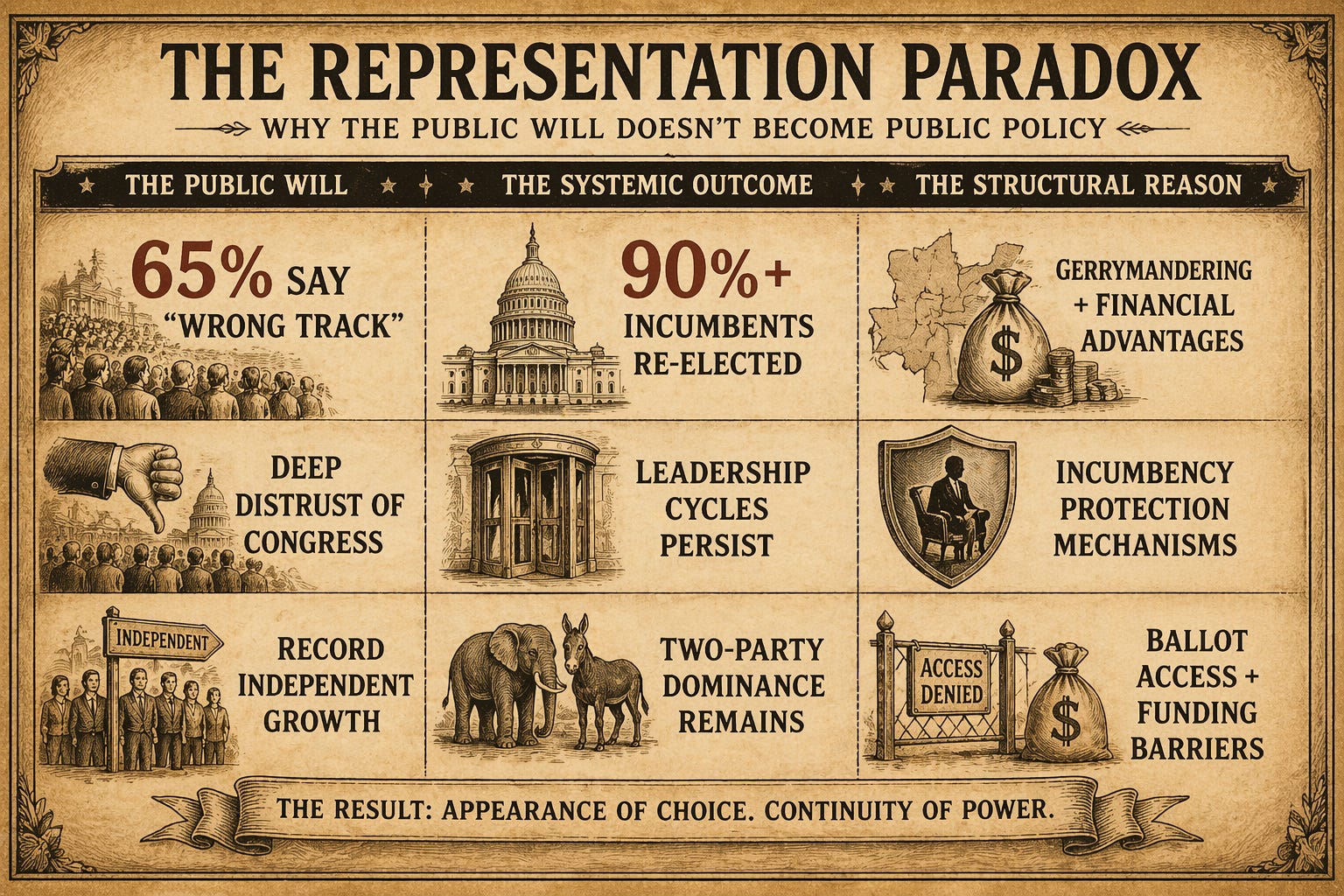
This is not a contradiction; it is evidence that the system is successfully insulating itself from public dissatisfaction.
The Financial Barrier: The Cost of Entry
Modern elections impose a “High-Entry Barrier” long before the first ballot is cast. This effectively privatizes the representative process by requiring a massive financial buy-in.
The Price of Participation
In the 2024 cycle, the total cost of federal elections exceeded $15.9 billion. This staggering figure creates a functional reality where representation is filtered by capital before it is ever confirmed by votes.
The Funding Gap: Incumbents typically out-raise challengers by a ratio of 4-to-1 or higher.
The Viability Filter: To even be considered a “serious” candidate, one must first:
Secure access to concentrated Large Donor Networks.
Gain the approval of Political Action Committee funding pipelines.
Achieve “Financial Viability” before they are ever granted public visibility.
The public eventually participates, but only after the field has been narrowed to those who have successfully navigated the financial filter. In this sense, the election does not choose the representative – it merely ratifies a choice made by the funding structure.
Representation or Management?
When we look across every layer of the modern American state, we see a consistent set of forces that move the seat of power away from the voter and toward the institution. The result is a fundamental shift in the nature of our republic.
Public Opinion is Diffuse: While millions of citizens may share a common desire, their influence is scattered across 435 districts and 50 states, making it difficult to maintain a concentrated signal.
Organized Interests are Concentrated: In contrast, specialized interest groups and economic elites focus their resources on specific levers of power, allowing them to exert a disproportionate and continuous force on the system.
Bureaucracy Translates Policy: Even when a clear legislative mandate is passed, it must be “translated” into the language of the Administrative State. In this translation, the original intent of the voter is often lost in a sea of regulatory nuance and agency discretion.
Money Determines Viability: As discussed, the financial “entry fee” ensures that only those who can navigate the established funding pipelines ever reach the finish line.
The cumulative result of these forces is not pure representation – it is Managed Governance.
In this environment, the two major parties do not compete to transform the system or return it to its constitutional foundations. Instead, they compete for the right to manage it. They battle over the “settings” of the Administrative State while leaving the machine itself untouched.
The appearance of choice remains visible in every campaign ad and televised debate. But the outcomes – the actual direction of the nation’s laws and the growth of its bureaucracy – more often than not, do not reflect a choice at all. They reflect a predetermined continuity.
The Constraint: Why the System Resists Change
If the system produces continuity at the expense of representation, a critical question arises:
Why would it ever allow its own disruption?
The answer lies in the alignment of incentives. In any complex organization, the primary objective eventually shifts from “mission” to “preservation.” In the modern American state, every major actor has a vested interest in maintaining the status quo:
Incumbents benefit from Stability: High re-election rates are not a product of high performance, but of a system that makes challenging the “Manager” nearly impossible. Stability is the incumbent’s greatest asset.
Agencies benefit from Autonomy: The Administrative State thrives on its ability to operate outside the friction of public debate. For the bureaucracy, a “responsive” system is a “disruptive” system.
Funders benefit from Predictability: Large-scale financial interests require a predictable regulatory environment to protect long-term investments. They prefer a system that changes at the margins rather than one that responds to the volatile “will of the people.”
Because of these alignments, reform is not naturally selected. The system is designed to treat fundamental change as a “virus” and deploy institutional defenses to neutralize it.
This is why the Publius Project does not call for mere adjustment or minor policy shifts. It is a recognition that restoration requires a deliberate override of the system’s default settings. We cannot wait for the system to evolve toward accountability; accountability must be intentionally and structurally imposed from the outside.
To override these settings, we must return to first principles.
Restoration Principles: Reclaiming Representation
If representation is to be restored, reform must target the structure, not just the participants. We cannot expect a change in personnel to fix a system designed for continuity. Instead, we must implement systemic overrides that prioritize responsiveness over bureaucratic insulation.
1. Transparency: Breaking the Information Leverage
To end the era of “Information as Leverage,” the data used to govern must be as accessible to the people as it is to the agencies.
Mandatory Disclosure: All internal agency data, modeling, and scientific justifications used in policymaking must be open to public and legislative scrutiny.
Ending Strategic Withholding: Strict legal restrictions must be placed on an agency’s ability to withhold information from congressional oversight committees under the guise of “deliberative process.”
Proactive Public Visibility: Real-time visibility into the regulatory decision-making process, ensuring the public can see who is influencing a rule before it becomes law.
2. Accountability: Reasserting Legislative Authority
Power must return to the individuals who appear on a ballot and can be removed by a vote.
Legislative Supremacy in Rulemaking: Reassert the principle that only elected representatives have the authority to create binding rules for society.
The “Major Questions” Requirement: Require that any administrative decision with significant economic or social impact must return to an elected body for a recorded, public vote.
Reducing Interpretive Dependency: Narrow the scope of legislative language to reduce the “blank checks” given to unelected administrators to interpret their own authority.
3. Financial Realignment: Opening the Entry Barrier
To de-privatize representation, we must lower the “Cost of Entry” that currently functions as a filter for elite approval.
Reducing Incumbent Advantages: Reform the rules that allow incumbents to amass insurmountable “war chests” that effectively end a challenge before it begins.
Increasing Challenger Viability: Structural changes designed to ensure that a challenger’s message can reach the public without first being “cleared” by concentrated funding pipelines.
4. Structural Integrity: Restoring the Constitutional Link
We must repair the legal mechanisms that connect voter preference to policy outcomes.
Addressing District Distortions: Correcting the “safe seat” designs and district imbalances that insulate representatives from the consequences of public dissatisfaction.
Reinforcing the Vote-to-Outcome Link: Ensuring that a shift in the public will is reflected in a shift in policy, rather than being absorbed by institutional inertia.
Restoring Constitutional Boundaries: Re-establishing the clear “firewall” between the act of making law (Legislative) and the act of carrying it out (Executive).
Conclusion: Returning to the Promise
Representation has not disappeared; it has been absorbed. It has been integrated into a sophisticated system that is programmed to prioritize institutional continuity over public responsiveness.
The outward symbols of our republic remain visible:
The citizen still votes.
The parties still compete.
The system still operates.
But the original promise of the American experiment remains unmet. That promise was never “Management” – it was Self-Governance.
The ballot was designed to be the steering wheel of the state, a mechanism to direct the nation’s course and hold its institutions to account. It was meant to be a tool for the people to direct the system, not merely a process to select which management team will operate it for the next four years.
Until the structural link between the will of the voter and the outcome of the policy is repaired, we face a sobering reality:
We do not lack elections. We lack control.
Restoration is not an act of destruction, but an act of reclamation. It is the necessary work of ensuring that the government remains what it was always intended to be: a servant of the public will, rather than its manager.
In Liberty,
Gary Mullins (Libertas)