

The Publius Project is a series of essays called Restoration Papers and other resources exploring liberty, citizenship and the constitutional restoration of the American Republic.
To My Fellow Americans,
Most of us are taught to view the Constitution like a machine. It’s a legal framework that automatically protects our freedom as long as we follow the instructions. Elections happen. Laws get passed. Courts settle fights. Checks and balances keep everyone in their lanes. If we just keep the machinery oiled, the republic survives.
The Founders saw things completely differently.
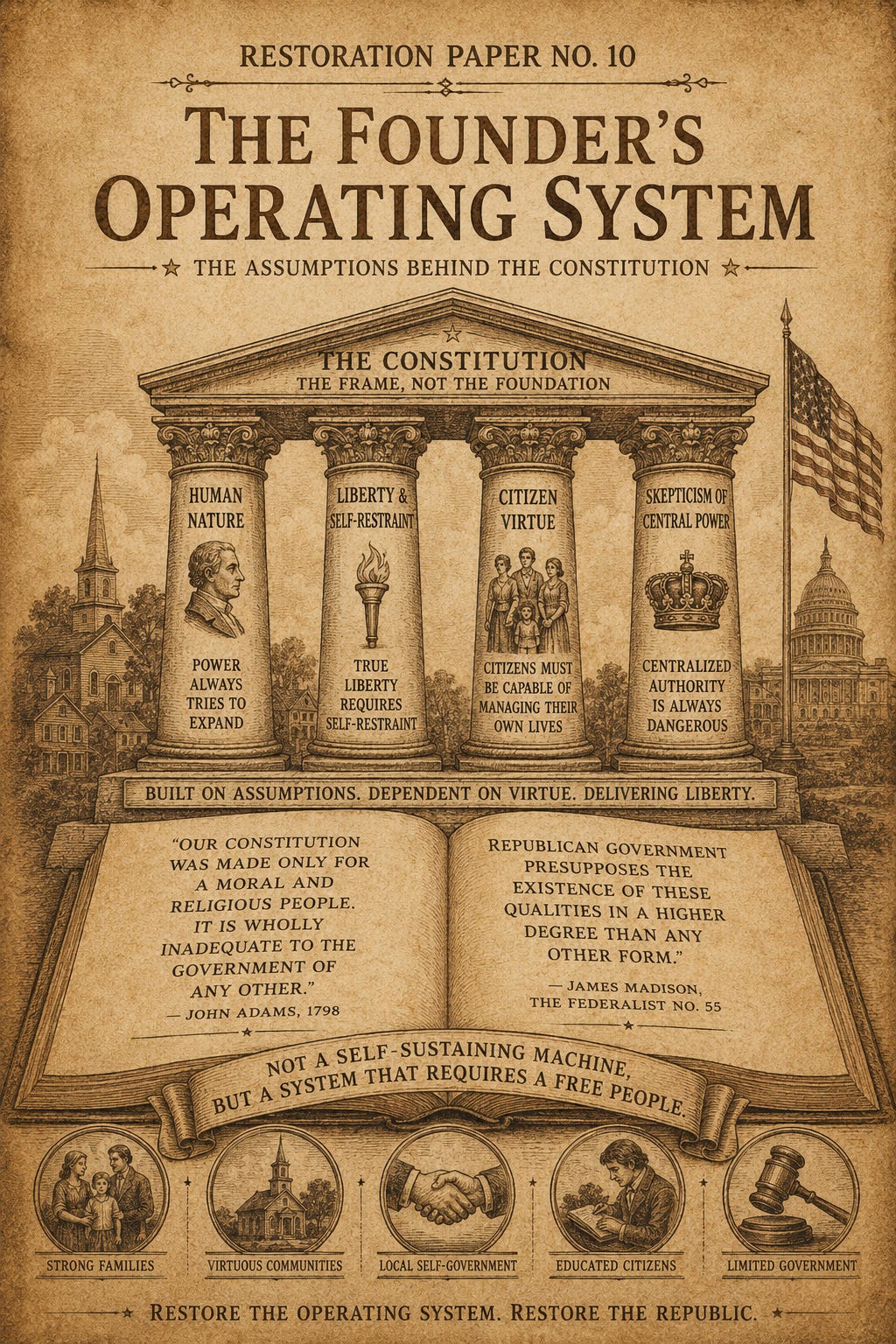
To them, the Constitution wasn’t a self-sustaining machine. It was just the frame of a house. The actual foundation was a deep, shared understanding about human nature, morality, citizenship, and power. The document didn’t create those ideas; it depended on them.
In modern terms, the Constitution was software designed to run on a very specific operating system.
That operating system was built on a few basic rules: power always tries to expand, true liberty requires self-restraint, citizens have to be capable of managing their own lives, and centralized authority is always dangerous. The Constitution reflected these rules in its structure, its limits, and even its intentional slowdowns.
The Founders didn’t believe government could preserve freedom for a people unwilling or unable to look after it themselves.
But over time, our operating system changed.
Today, many Americans view the government not as something to be kept in check, but as the ultimate tool to fix every social, economic, and cultural problem. We often mistake dependency for security. We’ve swapped local responsibility for federal control, and we’ve traded active citizenship for compliance with experts. We talk constantly about our rights, but rarely about our obligations.
Because our underlying assumptions have shifted, the whole system is straining under pressures it was never built to handle.
The text of the Constitution didn’t fundamentally change. The operating system beneath it did.
If we want to restore constitutional government, we have to understand the assumptions that made the whole thing work in the first place.
The Constitution Was Never Meant to Stand Alone
One of the most overlooked facts about the American founding is how much the Constitution leaves unsaid.
The document sets up the rules, powers, and branches of government, but it doesn’t try to micro-manage daily life. It assumes that our communities, families, and culture are strong enough to keep society running smoothly without D.C. looking over our shoulders.
The Founders knew that laws alone couldn’t keep a country free. No piece of paper, no matter how brilliantly written, can save a society that has abandoned self-restraint and personal responsibility.
John Adams famously warned in 1798:
“Our Constitution was made only for a moral and religious people. It is wholly inadequate to the government of any other.”
Today, people often argue over the religious side of that statement, but Adams’ practical concern was civic virtue. To the Founders, virtue wasn’t just about personal faith; it was the willingness to put the common good ahead of our own immediate self-interest.
They understood a basic rule of human history: every society is governed somehow. The only question is whether that restraint comes from the citizens themselves or from a massive police state imposed from above. The Constitution was built strictly for the former.
In The Federalist No. 55, James Madison admitted that human beings have a dark side, but insisted that a republic relies on our better nature:
“As there is a degree of depravity in mankind which requires a certain degree of circumspection and distrust: so there are other qualities in human nature which justify a certain portion of esteem and confidence.”
He then added a crucial point:
“Republican government presupposes the existence of these qualities in a higher degree than any other form.”
That word – presupposes – is everything.
The Constitution assumed certain qualities were already there. It depended on them. It didn’t try to manufacture them through federal laws or endless regulations. The Founders believed that people had to be capable of governing themselves as individuals before they could ever attempt to govern themselves as a nation.
Today, we expect the Constitution to solve cultural problems it was never designed to touch. Institutions can slow down corruption and scatter power, but they cannot manufacture national character.
Human Nature Does Not Change
The Constitution was built on a belief that is incredibly unpopular today: human nature is fixed.
The Founders didn’t believe that politics, new laws, or government programs could perfect humanity. They believed that ambition, greed, self-interest, and the hunger for power were permanent features of human behavior. The goal of the government wasn’t to eliminate these flaws, but to contain them.
This realism shaped the entire system. As Madison famously wrote in The Federalist No. 51:
“If men were angels, no government would be necessary. In framing a government which is to be administered by men over men, the great difficulty lies in this: you must first enable the government to control the governed; and in the next place oblige it to control itself.”
The Founders didn’t assume politicians would become saints just because they won an election. They didn’t trust concentrated power, no matter who was in charge. Their system was built on deep skepticism.
That’s why they chopped power into pieces – horizontally between the branches in D.C., and vertically between the states and the federal government. It’s why the lawmaking process is intentionally slow and repetitive.
Today, critics call government gridlock “dysfunction.” The Founders called it protection. Speed and efficiency weren’t their goals; keeping people free was.
In The Federalist No. 10, Madison warned that conflict is baked into human nature. Therefore, political disagreement isn’t a glitch to be managed by a centralized authority; it’s a natural condition of liberty.
The Founders would have deeply distrusted modern promises to solve permanent human problems through top-down policy or unelected “expert” management. You can’t eliminate selfishness or ambition. The best a free society can do is spread power out so widely that no single group can bully the rest.
The Constitution was built on realism, not utopia.
Liberty Requires Responsibility
The Founders believed that freedom and responsibility are two sides of the same coin.
Today, we often treat freedom as the right to do whatever we want without consequences, or as a list of things we are entitled to receive. The Founders saw it differently. To them, freedom required discipline, self-restraint, and a heavy dose of personal responsibility.
Simply put, self-government starts with the self.
George Washington drove this home in his Farewell Address, calling morality and civic virtue the “indispensable supports” of political prosperity. Free societies require citizens who maintain order voluntarily. When individuals stop managing their own behavior, the state will always step in to do it for them.
The Founders terrified themselves with the prospect of citizen dependency, because dependency always trades away power.
When people look to a central government for their economic security, moral guidance, and daily stability, they hand over the very independence required to be a self-governing citizen. A republic cannot survive if the people view the government as a provider rather than a protector.
This is why they stressed education and civic literacy. As Thomas Jefferson wrote in 1816:
“If a nation expects to be ignorant and free, in a state of civilization, it expects what never was and never will be.”
Liberty requires competence. A republic fails if its citizens don’t know enough to spot an abuse of power, evaluate a policy, or understand how their own government works. Freedom isn’t a spectator sport.
Government Is Dangerous by Nature
The biggest divide between the founding generation and modern America is how we view the state.
The Founders saw government as a necessary evil – useful, but incredibly dangerous. Today, we treat government as society’s primary problem-solver. We expect it to manage the economy, fix social conflicts, steer the culture, and provide a safety net for every part of life.
The Founders would have viewed this concentration of authority as a massive gamble. Jefferson noted the natural gravity of politics in 1787:
“The natural progress of things is for liberty to yield and government to gain ground.”
He didn’t see government growth as an accident; he saw it as an inevitable law of nature. The Federalist No. 48 agreed, warning that “power is of an encroaching nature.”
This distrust explains the architecture of our system. The separation of powers wasn’t made to make things run smoothly; it was made to prevent consolidation. Federalism wasn’t a quirk; it was meant to keep power local.
Today, we get frustrated when government moves slowly or when institutions block big changes. But that frustration comes from misunderstanding the system. The Constitution was designed to make large-scale federal action difficult unless there is massive consensus.
The Founders preferred slow government over unlimited government.
Communities Matter More Than Washington
The constitutional system assumed that strong, local institutions would handle 90% of daily life.
The Founders never intended for Washington, D.C., to be the economic, cultural, and emotional center of American life. Most governance, charity, education, character-building, and community support happened locally – through families, churches, towns, civic clubs, and local governments.
This wasn’t just a practical choice; it was a philosophical one. Free societies need a buffer between the individual and the state. When local institutions crumble, the federal government naturally rushes in to fill the void.
Alexis de Tocqueville noticed this unique American strength in the 1830s. He wrote that the health of our democracy could be measured by the quality of things everyday citizens did for themselves through voluntary associations, without asking the state for help.
Every time a community hands a local problem over to federal bureaucracies and unelected technocrats, it trades away both its duty and its power. We trade active citizenship for the passivity of being managed by “experts.”
When local institutions wither, national politics becomes an all-consuming war. We stop looking to our neighbors for community and start looking to federal institutions for our identity, meaning, and direction. Elections become incredibly toxic because the stakes of who controls Washington are suddenly terrifyingly high.
When everything is nationalized, every election feels like life or death.
What Happens When the Operating System Changes
The structural framework of the Constitution is still standing, but the software running beneath it has been swapped out:
The Founders assumed government should be strictly limited because power always corrupts. We now expect government to manage everything from healthcare and retirement to education and disaster response.
The Founders assumed liberty required responsibility. Our culture now demands rights while rejecting obligations.
The Founders emphasized local control. Modern politics nationalizes every single issue.
The Founders believed civic virtue was essential for self-government. Our culture often treats any kind of moral restraint as a form of oppression.
When the cultural assumptions flip, the legal structures inevitably begin to crack. The Constitution can only restrain power if the citizens still want restraint. Federalism only works if Americans actually value local authority.
A republic always rots culturally long before it collapses legally.
Rebuilding the Foundation
Most Americans know the system is broken. We argue over executive overreach, runaway bureaucracies, judicial activism, and federal meddling. These are all real problems.
But passing a new law or electing a new president won’t fix a philosophical crisis.
The Constitution cannot save freedom for a people who no longer believe in the principles that created it. We cannot restore constitutional government without restoring the culture that makes self-government possible.
And politics cannot manufacture a culture. Washington cannot pass a bill to make people responsible, virtuous, or self-reliant.
True restoration doesn’t drop down from the top; it grows up from the bottom. It happens when we stop looking to Washington to fix our lives and start rebuilding our own families, schools, churches, and neighborhoods. It happens when we reclaim the permanent principles of the original operating system:
That power naturally tries to grow,
That freedom requires personal responsibility,
That centralized authority must be kept small,
And that a society must be capable of governing itself at home before it asks the government to govern everything else.
The Constitution was never the whole machine. It was just the frame.
If we want to save the republic, we have to rebuild the foundation.
In Liberty,
Gary Mullins (Libertas)