

The Publius Project is a series of essays called Restoration Papers and other resources exploring liberty, citizenship and the constitutional restoration of the American Republic.
To My Fellow Americans,
Most of us today judge government by asking some simple, practical questions: Is it effective? Can it solve problems quickly? Can it respond efficiently? Can it get things done?
But the founders? Well, they asked a different question. Before asking what government could accomplish, they wanted to know what government could become. They spent decades living under kings, parliaments, and distant bureaucracies and they learned a hard truth that still holds today: power rarely stays where it begins.
It grows, it expands, and it always wants more.
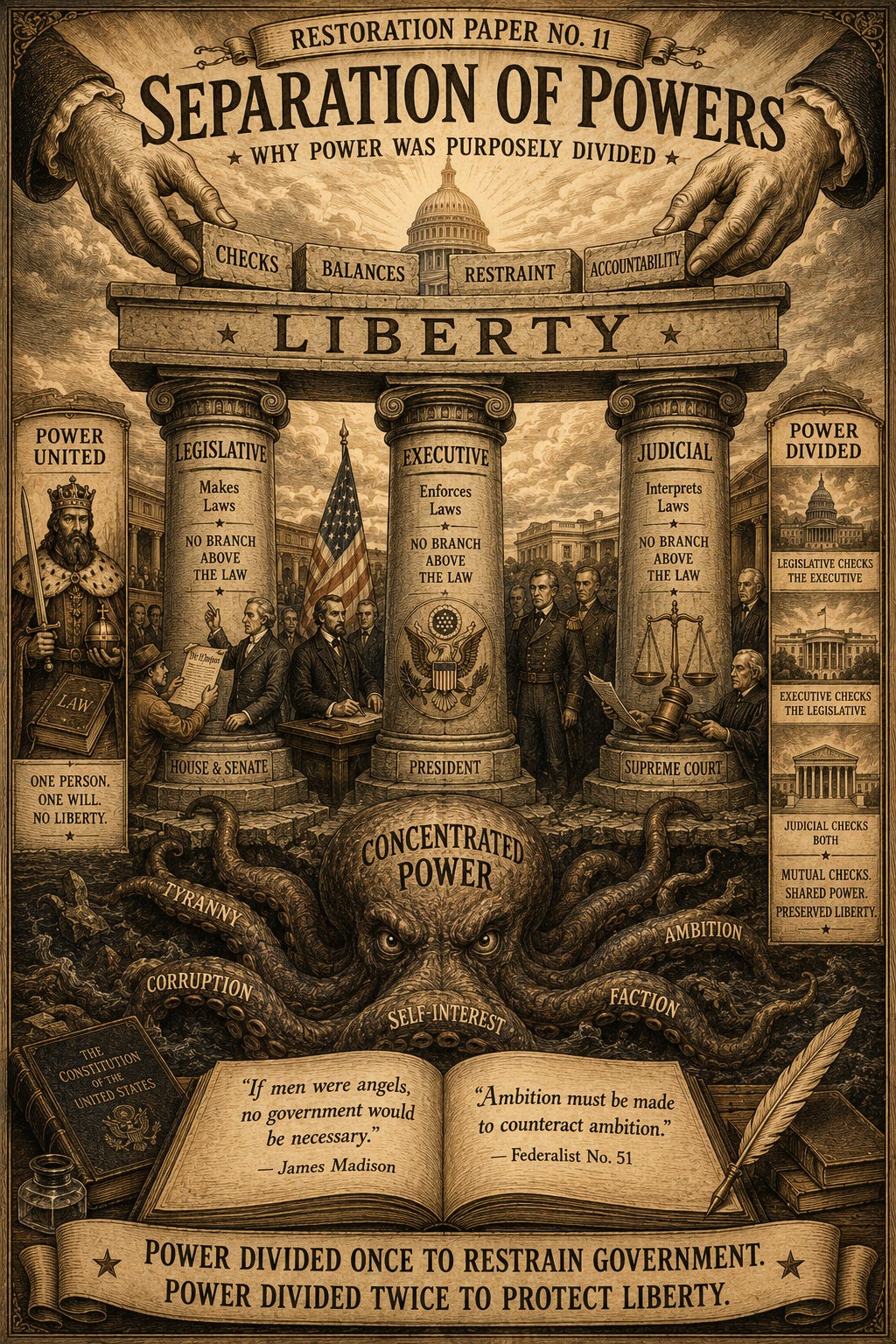
Our Constitution wasn’t written by men who believed power would stay limited on its own. They assumed just the opposite. As James Madison wrote in Federalist No. 51: “If men were angels, no government would be necessary.”
The Founders knew human nature doesn’t change when someone wins an election or takes an oath. Ambition, self-interest, pride, and the desire for control are permanent features of political life. They weren’t looking for perfect leaders. They were building a system that could survive imperfect ones.
That’s why they divided power.
One Government, Three Powers
When we think of the Constitution, we think of three branches: Legislative, Executive, and Judicial. We’re taught what they do, but rarely was it discussed why they exist.
The division wasn’t arbitrary. The legislature writes the laws, the executive enforces them and the courts interpret what those laws mean. Those functions were separated because combining them creates a dangerous concentration of authority. The French philosopher Montesquieu warned the founders: “There can be no liberty where the legislative and executive powers are united in the same person, or body of magistrates.”
If one group can make rules, enforce rules, and decide what those rules mean, citizens lose any real protection from government. The Founders had seen this play out throughout history: Kings issued decrees. Courts served rulers. Legislatures became rubber stamps.
The Constitution was built to prevent those outcomes by ensuring no single institution could control all of government’s power.
Ambition Counteracting Ambition
Our Founders weren’t perfect men, they were flawed like everyone, but they knew that dividing power on paper wasn’t enough. They expected every branch to try to expand its influence so, instead of trying to eliminate that tendency, they used it. Madison famously noted in Federalist No. 51: “Ambition must be made to counteract ambition.”
This is one of the most important ideas in our entire constitutional system. The branches were designed to compete.
Congress passes legislation.
The President can veto it.
Congress can override the veto.
The Senate confirms appointments.
The courts can strike down unconstitutional actions.
Congress can impeach federal officials.
Each branch has tools to resist encroachments by the others. This arrangement frustrates modern observers because government looks slow, decisions take time, and disagreements create stalemates; yet this was largely intentional.
The Constitution was not designed to maximize efficiency. It was designed to prevent domination.
Why Gridlock Is a Feature, Not a Bug
While many Americans often call political deadlock proof the system is broken, but I suspect the Founders would likely disagree. They believed major changes should require broad agreement so passing laws was intentionally made difficult. A bill must pass the House and Senate, survive presidential review, and withstand constitutional scrutiny
That process was not an accident – it was a safeguard.
The Founders worried that temporary passions could become permanent laws. They feared moments of public anger, fear, or enthusiasm leading to government actions that future generations would regret. In Federalist No. 62, Madison argued: “It will be of little avail to the people that the laws are made by men of their own choice if the laws be so voluminous that they cannot be read, or so incoherent that they cannot be understood.”
The constitutional system was designed to slow decisions down – so a bad idea today doesn’t become permanent law tomorrow. The question was never how quickly government could act.
The question was whether government should act at all.
The Modern Drift Toward Consolidated Power
The Founders understood that power naturally accumulates and assumed that tendency wouldn’t disappear after ratification. If anything, it has accelerated. Today, Congress delegates authority to executive agencies, Presidents rely on on executive orders, and federal bureaucracies routinely create regulations carrying the force of law. Often, these agencies write the rules, enforce them, and judge disputes regarding those same rules.
The Founders would likely look on today’s arrangement with tremendous scorn because it mirrors the very concentration of power they sought to avoid. They created barriers against it and when those barriers weaken, the risk isn’t just inefficiency or political disagreement.
The risk is the gradual erosion of self-government itself.
As noted in previous papers, this reflects a broader trend toward the administrative state, the rise of the expert class, and the transformation of governance into management.
Preserving Freedom
At its core, the separation of powers isn’t about organization charts; it’s about liberty. The system assumes that mistakes will happen and bad leaders will emerge. The answer isn’t “better people” – it’s structural restraint. Liberty doesn’t depend on finding the right saints to lead us; it depends on limiting what any person can do once they hold the reins of power.
The friction we feel today – the slow-moving legislation and endless debates – is the safeguard standing between us and an unchecked, concentrated authority.
The Founders didn’t just divide power horizontally through checks and balances; they also divided it vertically through federalism. Power was divided once to restrain government and divided again to protect the people.
That is where the next Restoration Paper takes us. The Architecture of Federalism.
In Liberty,
Gary Mullins (Libertas)
Sources
The United States Constitution
The Federalist Papers No. 51 (James Madison)
The Federalist Papers No. 62 (James Madison)
Montesquieu, The Spirit of the Laws (1748)
The Federalist Papers, Alexander Hamilton, James Madison, and John Jay