

The Publius Project is a series of essays called Restoration Papers and other resources exploring liberty, citizenship and the constitutional restoration of the American Republic.
To My Fellow Americans,
My last paper highlighted the importance of the separation of powers in our government, but power isn’t instantly made safe simply because it’s divided into branches.
That’s only one part of the design. The American power system isn’t only divided horizontally, between Congress, the President, and the courts. It’s also divided vertically, between the national government, the states, local communities, and ultimately, us, the citizens.
That vertical division is what’s known as federalism and it’s one of the most misunderstood parts of our American constitutional structure. Most of the time, it’s treated as a dusty procedural concept, a lawyer’s argument, or a relic from before the modern world became too complex for local decision-making.
But federalism wasn’t a technicality, it’s the architecture of liberty. It was the Founders’ way of answering one of the most important questions in political life: Who should have the authority to decide?
Because not every problem belongs in Washington and not every disagreement requires a national rule. Not every policy question should be settled by distant representatives who neither live among the people affected nor answer directly to them. Federalism was designed to keep as much governing power as possible as close to the people as possible; while giving the national government just enough authority to handle truly national concerns.
That’s an important distinction because when every issue becomes a federal issue, every election becomes a fight for control over everyone else’s life.
A Republic of Divided Authority
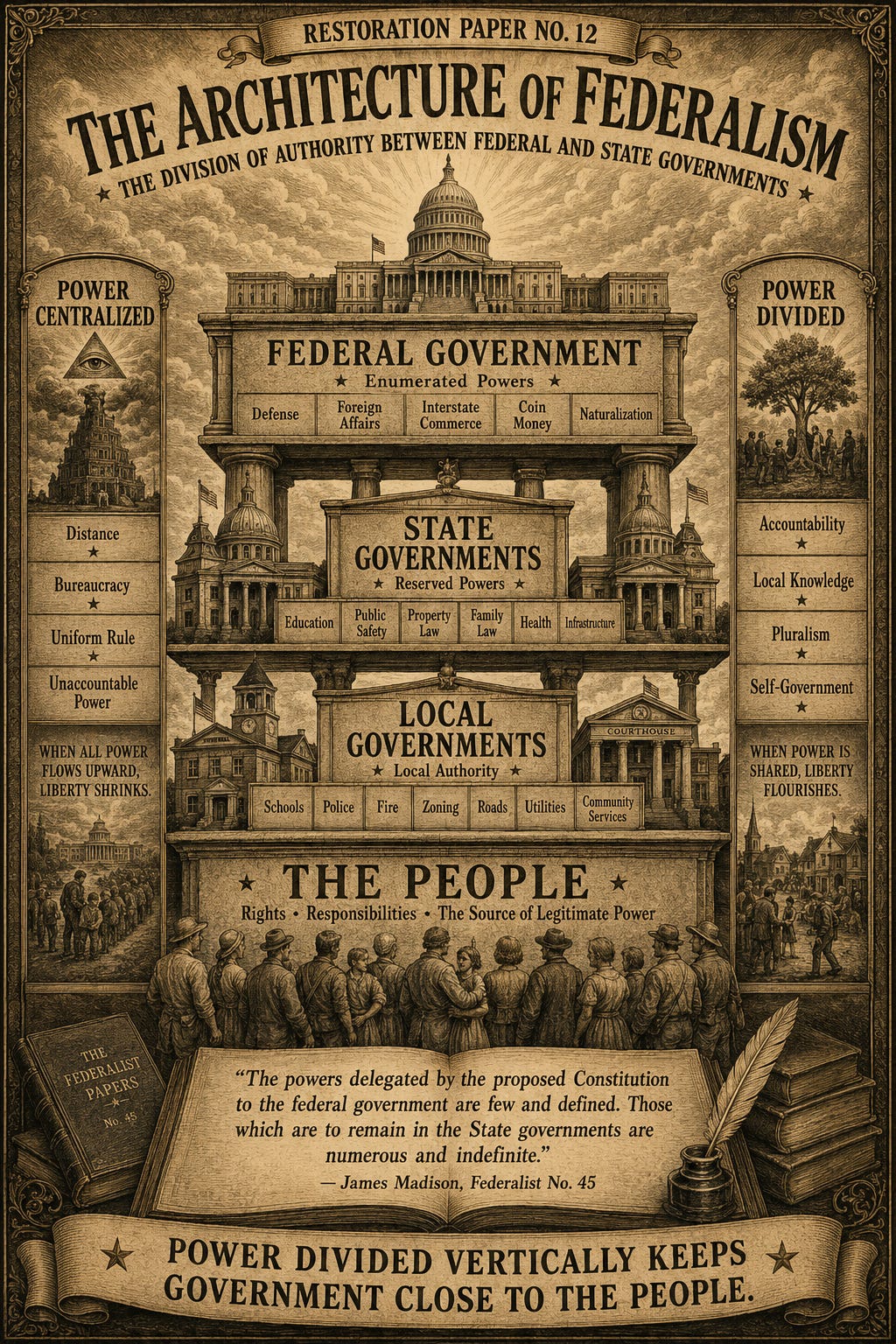
Our Constitution created a federal government of limited, specific powers; which means the federal government wasn’t given a blank check to do whatever it wants regardless of if it’s deemed useful, popular, compassionate, or necessary. It was given a specific, limited to-do list for specific purposes.
Those powers include things like national defense, foreign affairs, immigration and naturalization, coining money, and resolving disputes that cross state lines. These were identified as national responsibilities because they couldn’t be handled effectively by the thirteen separate states acting alone. As a single nation we need a single foreign policy, a single treaty power, a single system for national defense, and a single rule for interstate commerce. And it needs one constitutional framework binding the union together.
But beyond those delegated powers, the states kept broad authority over ordinary American life. That included most criminal law, education, public safety, land use, local infrastructure, health and welfare policy, and countless other areas where the rules of daily life are shaped.
This wasn’t accidental. The Founders didn’t believe liberty was protected by making every decision national. They knew liberty was protected by keeping power divided, limited, and accountable. The federal government would handle the truly national matters, the states would handle the ordinary powers of civil government, and local communities would handle what could be and should be handled locally.
That’s the structure they built. Not one government ruling over administrative districts, but a true republic, where power is divided so that no single level of government can easily dominate the whole.
Federalism Is Not Just “States’ Rights”
One reason federalism is often misunderstood is because it gets reduced to the phrase “states’ rights.” But that phrase is incomplete because states don’t have rights in the same moral sense that people do. Individuals have natural rights; governments have powers.
To be clear, federalism isn’t about treating state governments as sacred. State and local governments can abuse power, be corrupt, or violate liberty just like any other government. History proves that time and again. Federalism isn’t a blank check for states to do whatever they want either. The Constitution remains supreme, and the federal government has a legitimate role in protecting constitutional rights when states violate them.
But acknowledging that doesn’t mean every policy question must be centralized in Washington. The answer to state abuse is not unlimited federal power; the answer is constitutional government at every level.
Federalism protects liberty not because states are always virtuous, but because divided authority makes power harder to consolidate. It prevents one national majority from imposing a single uniform answer on every community in the country.
Divided power is always safer than concentrated power.
Why Local Authority Matters
A government closer to the people is almost always easier to watch, easier to question, and easier to correct.
Now… let’s be honest. Most people will never meet the President, testify before Congress, or influence a federal agency. But we can certainly attend a school board meeting, speak at a town council meeting, call a county supervisor, confront a mayor, and see the results of local decisions up close with our own eyes.
And that proximity matters. The farther power moves away from the people, the harder it is to control. That distance creates insulation. That insulation creates arrogance. And that arrogance creates a ruling class of people who don’t really feel the consequences of their decisions.
The needs of a rural county in Virginia like mine aren’t identical to the needs of New York City, San Francisco, Miami, or a farming town in Iowa. The culture, the cost of living, the geography, and the local expectations are all different. National uniformity may sound clean on paper, but in practice, it means forcing one answer onto millions of people whose lives don’t fit the template.
Federalism allows variation, experimentation, and learning. It allows one state to try one approach and another state to try something else. It allows failure to remain limited instead of becoming a national disaster.
That’s not chaos, that’s self-government in a large republic.
The Danger of Making Everything Federal
When the federal government becomes the default solution to every problem, the constitutional structure collapses.
Congress stops acting like a legislature of limited powers and starts acting like a national management board. Presidents stop enforcing law and start directing domestic life by executive order. Federal agencies begin shaping major questions of economic and social policy, and the courts are left to settle questions that should’ve been resolved through representative government.
And we the people? We just become spectators.
The more power moves to one place, the more every national election feels existential. Does that sound familiar?
And why is that?
Because if Washington controls everything, the reality is that whoever controls Washington controls everything. That’s pretty much where we are now and it’s turned our politics into permanent war. It’s taught us citizens that the only way to protect ourselves is to seize national power before the other side does.
Federalism lowers the stakes and cools emotions by limiting the reach of national power. When decisions are made locally, Americans don’t have to win every federal election to preserve their way of life.
Golden Handcuffs: The Erosion of Federalism
As I’ve written in previous Restoration Papers, federalism hasn’t disappeared all at once; it’s been worn down gradually through expansive interpretations of power, federal mandates, and administrative agencies.
The methods have often been subtle too, so we barely notice. Washington doesn’t always directly command the states. Instead, it uses “golden handcuffs,” offering federal money with strict strings attached. States become dependent on this funding, adjust their policies to comply with federal priorities, and gradually transform from independent states into customers of the national government.
When states depend on Washington for permission and cash, accountability disappears. State officials blame federal requirements, federal officials blame state implementation, and the citizen is left staring at a system where everyone has power, but no one seems to be responsible.
Federalism was supposed to make authority visible. If a decision belongs to the federal government, the state, or the local community, citizens should know exactly who to hold accountable.
What Federalism Is Not
Federalism is not an argument against national unity. The United States is one nation, and the Constitution is the supreme law of the land. States cannot nullify constitutional rights, conduct their own foreign policy, coin their own money, or ignore valid federal law.
The whole point of the Constitution was to create a stronger union than the Articles of Confederation provided. The country needs a national government capable of acting where national action is necessary. But necessary is not the same as unlimited.
A federal republic requires a deliberate balance. It requires enough national power to preserve the country, protect rights, defend the border, and maintain constitutional order. But it also requires enough state and local authority to preserve self-government, reflect regional differences, and prevent national power from swallowing the whole.
Restoring federalism doesn’t mean pretending America can return to the eighteenth century. The economy is integrated, and problems cross state lines faster than ever. But a complex society can’t be successfully managed from one central bureaucracy. The attempt only produces delay, confusion, and resentment.
Restoring federalism simply means recovering the habit of asking the constitutional question before the policy question. Not just: Is this a good idea? But: Who has the authority to do this? Not just: Can Washington force a result? But: Is this actually a national responsibility?
Good intentions don’t make power safe. Structure does.
The Citizen’s Role
Federalism demands more from us as citizens.
It’s incredibly easy to obsess over national politics. Washington is loud, entertaining, and perfectly tailored for 24-hour media combat. It gives people the instant emotional satisfaction of choosing a side in a grand, distant war.
Local government, by contrast, isn’t glamourous. It’s zoning meetings, school board budgets, county sheriff races, and utility decisions that rarely trend online. But this is where real life is governed. If citizens abandon those local institutions, we shouldn’t be surprised when power migrates upward.
A people that only watches Washington will eventually be ruled by Washington. A people that wants liberty must reclaim responsibility at every level.
Conclusion: The Test of Self-Government
Federalism is the vertical separation of power. Separation of powers divides authority within Washington; federalism divides authority between Washington and the rest of the country. Together, they form the architecture of constitutional liberty.
When that architecture is respected, power is limited and citizens remain close to the decisions that shape their lives. When it’s ignored, power flows upward, accountability disappears, and the national government becomes an arena for permanent political warfare.
Federalism is ultimately a test of whether we still believe in self-government. If every problem must be solved in Washington, then the citizen becomes small, the states become mere administrative branch offices, and liberty becomes nothing more than federal permission.
The American system was built on a simple truth: liberty survives only when power is divided, limited, and close enough for the people to see it, challenge it, and correct it.
Your Move: A Call to Action
Restoring this balance doesn’t require a constitutional convention, although I’m a proponent of one, it requires a deliberate shift in our attention.
Turn your eyes downward. This week, look up the date of your next city council, county commission, or school board meeting. Find out who represents your district at your state capitol.
Ask the structural question. The next time a politician promises a grand solution to a societal problem, stop asking “Is this a good idea?” and start asking “Which level of government, if any, actually has the authority to do this?”
We must stop treating national politics as entertainment and start treating local governance as our primary civic duty. If we want a government that is truly accountable, we have to stop electing permanent rulers to manage us from afar.
In the next paper, I’ll confront the primary distortion that allows power to pool in Washington: the rise of the career politician, and why we must restore the vital American tradition of the temporary citizen legislature.
In Liberty,
Gary Mullins (Libertas)