

To My Fellow Americans,
We have a problem.
We have a career politician problem in our republic.
Most Americans already know it, at least in a general sense. We know Washington feels stale. We know the same names seem to stay in power for decades. We know Congress no longer looks like a temporary gathering of citizens sent to represent their neighbors, solve problems, and return home.
But I’m not sure most Americans realize just how bad it is.
As of today, 76 current voting members of Congress have served 20 years or more. Of those, 32 have served 30 years or more. Eleven have served more than 40 years. And two have been in Congress for more than half a century.
That’s not public service. That’s political entrenchment.
The republic we know and love didn’t collapse all at once. It started slowly but began to rot the moment our representatives turned what was supposed to be a temporary civic duty into a lifelong, professional career.
Congress was never meant to be a career. It wasn’t designed to be a ladder for ambition or a comfy landing place for political insiders, party loyalists, and professional fundraisers. It was supposed to be a temp job. You were chosen by your community to go to Washington, D.C., represent your neighbors, and do your duty under the Constitution. Then, you packed your bags and went home to live under the exact same laws you just helped pass.
That last part was the whole point.
Reps were supposed to go home. They were supposed to look their neighbors in the eye and answer for their decisions. They were supposed to be citizens first and lawmakers second.
Instead, we’ve built a permanent, protected, political class. A class that talks constantly about “the American people” on television, but spends most of its days surrounded by consultants, lobbyists, handlers, and donors. Their entire lives revolve less around service and more around preservation – preservation of power, of position, and of the system that sustains them.
And then they ask why the average American feels completely ignored. And they act confused as to why their approval rating sits perpetually in the teens and twenties.
We feel ignored because we are ignored.
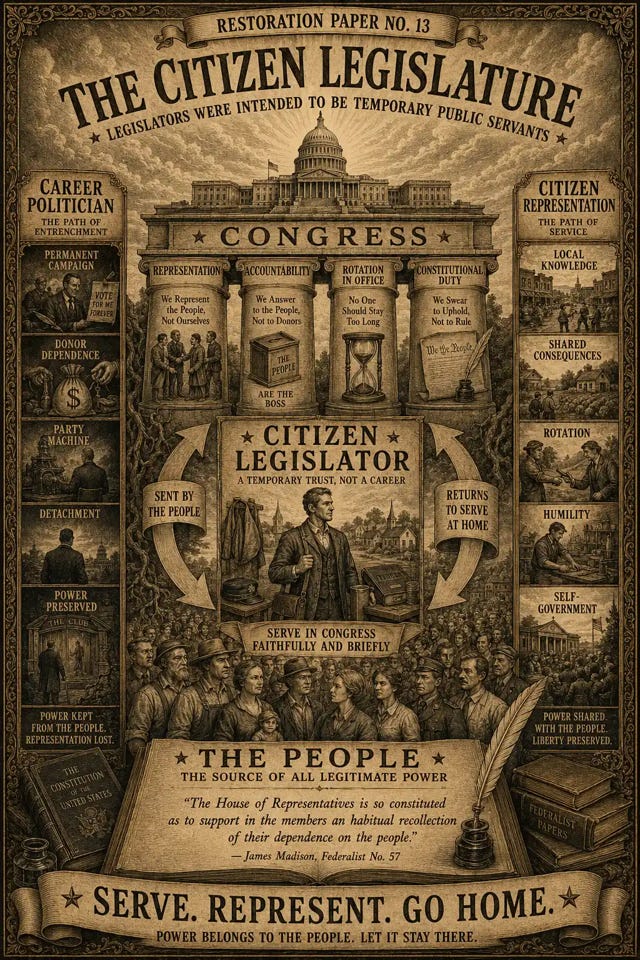
We Didn’t Elect Royalty
Congress was never meant to be a country club with elections.
James Madison made this pretty clear in in Federalist No. 57. The House was meant to be open to regular people. Wealth, pedigree, and profession weren’t supposed to be the gatekeepers. Trust, judgment, and character were supposed to matter more than connections.
But that spirit has long since faded.
Yes, the Constitution calls for members to get paid for their service, and they should be. Public service shouldn’t just be for the independently wealthy. But there’s a clear and substantial difference between paying a regular citizen to serve for a brief period and funding a permanent ruling class that never leaves office.
As discussed in Restoration Paper No. 8, The Illusion of Representation, our Congress is just an incumbency factory. Once elected, the job is to stay elected and the whole system bends over backward to make that happen. Their party protects them. Big money donors invest in them. Lobbyists cozy up to them for favors and influence, and the consultants teach them how to sound authentic while saying absolutely nothing.
The longer they stay, the more the machine rewards them. That’s not representation. That’s permanence.
The Problem Isn’t Experience. It’s Detachment.
Look, I’m not saying experience is evil.
We obviously need people who understand how a budget works, how legislation moves, and what the Constitution actually allows. But experience isn’t the same as entrenchment.
A few years of service can produce wisdom, but decades within the system produces detachment.
A representative who learns how the government works can serve the public well, but one who spends a lifetime learning how the system protects itself will come to serve that system instead.
And the issue isn’t that these people served. The issue is that their service became their identity, their career, their brand, and, in many cases, their path to wealth and influence.
When public office became a career, survival became the priority. Every single vote is now weighed against reelection probability. Every crisis is a fundraising email. Every committee hearing is a performance for the media.
The statesman has faded, but the performer remains.
That’s how we get politicians who spend thirty years or more in Washington voting for trillions in debt they’ll never have to pay back, passing thousand-page bills they don’t read, and approving regulations they’ll never personally feel – only to come back to their districts or states shouting that they’re “outsiders” fighting the system.
And finally, Americans are seeing how insulting that is.
They Don’t Live Like Us
Representation requires more than an address.
It requires shared experience. It requires real connection to daily life in the community.
A true citizen representative understands daily life because he or she lives it. They know the cost of groceries because they buy them. They understand the burden of healthcare because they’re pay the premiums, wait on the same phone systems, and fight for appointments like everyone else. They know the weight of payroll because they’ve actually signed the front of a paycheck, not merely given speeches in front of someone who does.
We need lawmakers who remember exactly what it feels like to be governed.
Farmers. Mechanics. Veterans. Teachers. Nurses. Builders. Small business owners. Regular people with enough wisdom to know that power is dangerous, and enough humility to hand it over to someone else when their time is up.
Instead, we have a credentialed country club that governs from a distance, occasionally allowing the rest of us to choose which members get to stay.
The numbers tell part of the story. Right now, the average tenure in Washington is nearly a decade, but the true issue is the concentration of power over time. Committee chairs, influence, and institutional control accumulate over the years. The median age in the Senate is pushing 65.
Now, I’ll admit it: wisdom matters. Age alone doesn’t make someone unfit for office. But a country can’t stay healthy when its leadership is completely removed from the daily economic pressures, technology, working conditions, family burdens, and cultural reality of its people.
At some point, “experience” is just a polite word for “you’ve been there too damn long.”
These long tenures didn’t happen by accident. They’re primarily the result of two failures. First, we as citizens got too comfortable. We got lazy with our oversight. We stopped watching closely enough, stopped replacing people often enough, and allowed name recognition to be the substitute for accountability.
Second, our representatives turned the job of getting elected into the business staying elected. What was supposed to be temporary is now a permanent campaign operation - one built around fundraising, messaging, party loyalty, and political survival.
That’s how the citizen legislator disappeared and the endless campaign started.
The Endless Campaign Destroyed the Job
We can’t have a citizen legislature when the elections never stop.
Members aren’t just legislating anymore and haven’t been for a long time. Now, they’re constantly fundraising, branding, polling, messaging, posting, and gearing up for the next election cycle. So even when they’re sitting in the Capitol, most of their energy is spent trying to stay there.
So, the question is simple:
Who is truly being served?
It certainly isn’t the guy working two jobs just to keep his head above water. It’s not the parents trying to figure out how to afford groceries this week. It’s not the veteran dealing with red tape at the VA. And it’s not the local shop owner trying to comply with another mountain of federal paperwork.
The attention flows instead to those with permanent guest passes to the club: donors, lobbyists, political committees and corporate interests.
The rest of the country is reduced to photo ops, background for speeches, faces for advertisements and stories for political use – nothing more than props for their performances.
And average Americans are angry because they can see the game now.
They see politicians run on “draining the swamp,” only to jump right in and learn how to swim. They see members rail against debt after voting for it. They see reps condemn bureaucracy after funding it and they see lawmakers complain about a broken system they’re cashing in on.
The contempt members of Congress get from regular Americans is completely earned.
We know the campaigning isn’t on principle. We know it runs on money, access, exposure, and protection. We know who is pulling the strings of our puppet representatives, and it ain’t us.
It’s the party machine. The place where independence is punished and loyalty is rewarded. It’s where our reps stopped being actual representatives of us and became employees of a political corporation.
Employees of the Party Machine
Our citizen legislature died the moment party loyalty came before hometown loyalty.
A representative’s job is to answer to the people who sent them to Washington.
Period.
Not the Speaker of the House. Not the Senate leader. Not the national caucus, the cable news audience, activists on social media and certainly not the donor class.
The people.
But the party machines have turned lawmakers into their corporate shills rather than independent representatives. Leadership controls the money. Leadership controls the committee seats. Leadership controls floor access. Leadership controls public visibility. And leadership controls punishment.
In this system, the lesson is quickly learned:
Align with the machine or be removed by it.
That’s not self-governance – and it hasn’t been for a long time.
A representative who fears their party leadership more than their voters isn’t a representative – they’re a hostage with a title. A Congress that serves the system before the people isn’t an instrument of liberty.
It’s an instrument of decline in desperate need of repair.
What Fixing It Requires
Reform won’t come easily, because those who benefit from the current system are the same ones needed to change it. That reality may require solutions outside ordinary channels, such as an Article V, Convention of States.
Still, the principles are pretty straightforward:
First, we need shorter sessions. Do the work, pass the budget, debate legislation and then get the hell out of Washington. Members should spend less time in the swamp with the flies and mosquitos of D.C. culture and far more time back in their home districts and states. I have suggested a 240-day working Congress, but only about half of that should be spent in Washington. The rest should be spent back home among the people they represent.
Second, we need term limits. We as Americans have proven we can’t be trusted with voting out permanent incumbents, so need a legal mechanism. We need serious, common-sense limits on how long one can hold federal legislative office. I suggest twelve years total for congressional members. That could be any combination of house and senate terms, but twelve years is enough for anyone.
Serve. Represent. Go home.
Lastly, we need age limits. It’s time we recognize that effective governance requires both experience and sustained capacity. I suggest an age limit ceiling of no older than 75 years of age. That doesn’t mean every person 75 or older is incapable. It simply means the republic has a right to set reasonable limits on the age and tenure of those entrusted with power.
Power doesn’t get safer with familiarity. It just gets easier to justify.
I have other suggestions that I’ll put forth in other areas, but it’s important to note that while those three reforms sound procedural in tone, they actually point to something much deeper. Shorter sessions, term limits and age limits aren’t just technical fixes. They’re reminders of a larger truth.
Elected office isn’t property. It’s not a possession and it’s not a personal inheritance. Nobody has a right to a seat in Congress. It’s a temporary trust handed to ordinary citizens by other ordinary citizens.
And when that trust is treated like a lifetime entitlement, the problem is no longer just political.
It’s moral.
A Moral Obligation
At the end of the day, our republic depends on a simple principle:
The people are sovereign and our representatives are temporary stewards.
When office holders remain indefinitely and treat elections as formalities, that principle is lost.
Temporary service preserves perspective. It reminds the officeholder that authority is borrowed, not owned. That seat belongs to the people. That title belongs to the people. And that power belongs to the people.
It is entrusted, not possessed.
And it must be returned.
The Restoration
Restoring Congress means restoring the simple idea of the citizen legislator.
We need representatives anchored to their communities, not absorbed by D.C.
We need leaders who respect the Constitution as a boundary, not an obstacle.
We need people who seek with reluctance, serve with seriousness, and depart willingly.
A healthy republic doesn’t depend on permanent rulers. It depends on responsible citizens.
What now sounds radical was once ordinary and readily accepted.
If restoring temporary public service feels like a revolution, then it’s a necessary one.
Not a revolution of upheaval, but a revolution of return – back to the first principles that those who govern must remain among the governed.
We don’t need better slogans or more polished professional politicians.
We need citizens with the courage to serve, the discipline to act, and the humility to step aside.
That’s how free people stay free.
In Liberty,
Gary Mullins (Libertas)