

To My Fellow Americans,
America’s founders gave us a strong President. What they didn’t do, quite intentionally, was give us an all-powerful one.
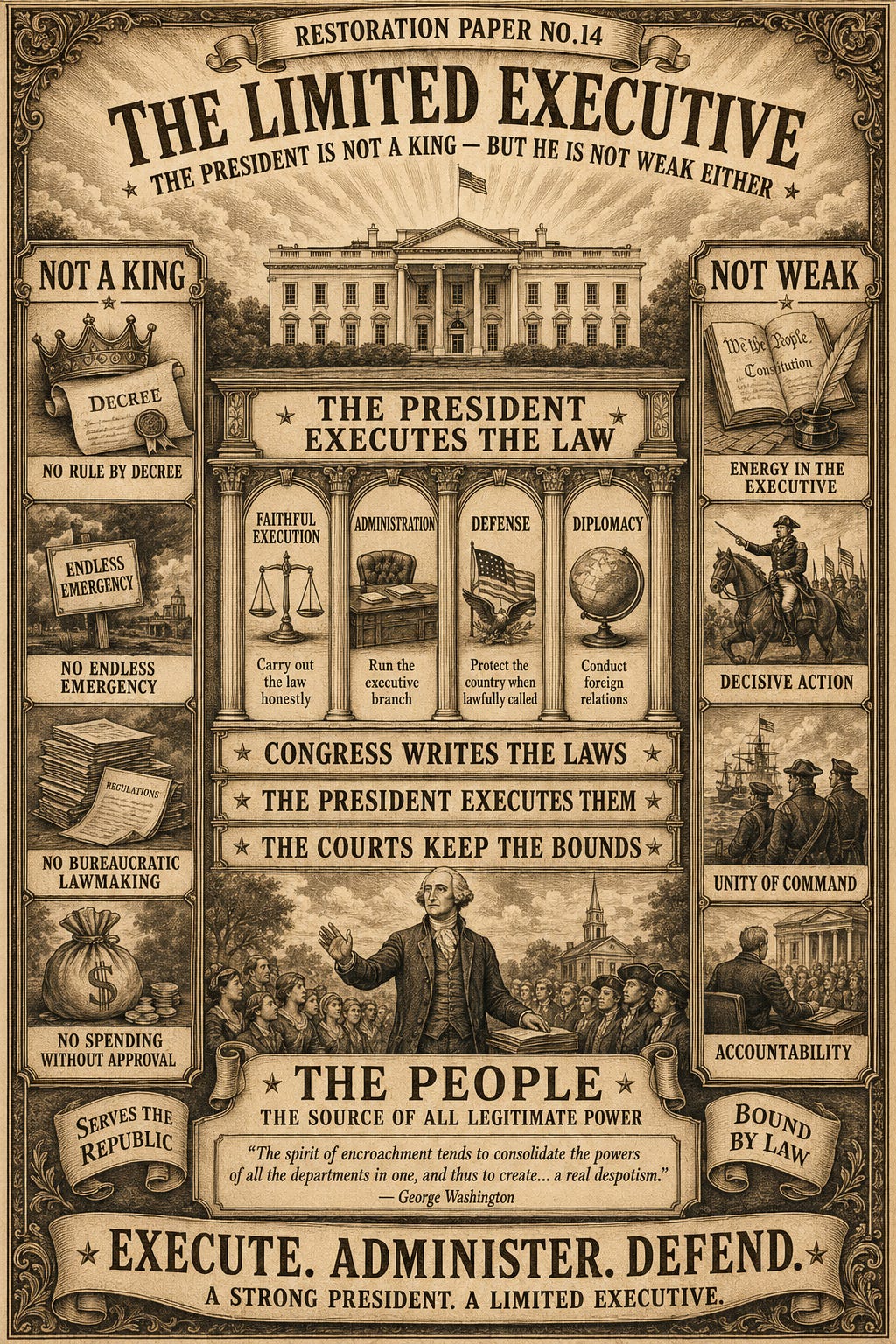
The job is actually pretty simple. Execute laws, run the executive branch, defend the country, handle diplomacy, and act fast when an actual emergency calls for it.
Did you notice what’s not on the list? Making laws. The responsibility was left to Congress alone.
Sure, a president pitches ideas, pushes for a particular policy, negotiates with lawmakers, and even vetoes legislation. But once something actually becomes a law, the job is to execute it. Not ignore it, rewrite it on the fly, or swap it out with something the White House likes better.
Over the decades, we’ve slowly talked ourselves into accepting a completely different paradigm.
We’ve accepted candidates that promise to personally fix healthcare, control prices, cut spending, rebuild the economy, and single-handedly solve every other problem in our lives. And we buy into the promises anyway, knowing full well they don’t have the power to do everything they pledge; and in the process, we let the presidency run us instead of us running it.
And that’s how we got here. We have a presidency that acts more like a one-person lawmaking machine instead of a responsible manager overseeing our executive branch.
The Most Powerful Office in the Country
President Washington saw this very trap coming on his way out the door. He warned us about “the spirit of encroachment;” that slow, quiet tendency of one branch trying to take over the functions of the others, until everything ends up under one roof.
Simply put, when one branch starts doing everybody else’s job, our republic is in trouble.
Just look around today. Every four years, candidates stand on a stage and make grand promises about things they don’t have the legal right to do on their own. And most of us don’t even call them out anymore. We’re so used to presidents setting their own rules and acting like kings that we get angry when they can’t deliver. But if we’re honest with ourselves, that’s on us. We allowed the expectations to shift.
While digging around and researching this, it’s clear a lot of us either forgot what we were taught in school or were never really taught it in the first place: the separation of powers isn’t just a trivia fact. It’s the only reason we don’t have a king or single ruler of any kind.
The President’s Actual Job
So, I’ll break it down.
Congress writes the laws. The President carries them out. The Courts ensure both sides stay inside their Constitutional lanes. And that’s it. That’s the entire system.
Now, Article II of the Constitution does provide some clear, independent powers, particularly in the areas of managing federal agencies, appointing officers, directing foreign policy, and commanding the military. But even those powers aren’t blank checks. Even those powers are checked by the Senate.
Don’t let some academic or political commentator confuse the issue with fancy jargon. They love making this sound more complicated than it is, but that truly is the system.
The president’s job is ensuring the laws are enforced honestly, competently, and consistently. And that power isn’t a political convenience tool either. The President doesn’t get to stretch, bend, or ignore a law just because he or she feels like it.
Think of the President as the CEO of our company, and us, the citizens, are the board of directors.
Strong Doesn’t Mean Unlimited
Now before anyone pushes back on the “CEO” analogy, I’ll clarify what the Founders were trying to do.
They clearly didn’t want another king. They’d lived in that world and just fought a war to be rid of one. But after living under the Articles of Confederation, where the national government was so weak it couldn’t even pay its own bills or keep order, they knew we needed a real leader. They understood that we needed an executive who could act with speed, discipline, and decisiveness when the situation called for it.
That is what Alexander Hamilton meant in Federalist No. 70 when he wrote that “energy in the executive is a leading character in the definition of good government.”
But “energetic” doesn’t mean “unlimited.”
Think about it this way.
Suppose a massive fire breaks out in town. We’d want the fire chief to take control immediately, wouldn’t we? We don’t want him waiting three hours for a committee meeting while half the town burns down.
But that fire doesn’t suddenly give him the authority to rewrite the building code, raise taxes, seize local businesses, or declare himself mayor. He’s got authority to fight the fire because that’s his job. What he can’t do is run the whole town.
The presidency works the same way. The president needs enough power to act quickly and effectively when necessary, but that power still sits inside the Constitutional fence. “Energy” is about how the President does the job; it doesn’t erase the limits of the job itself.
The Rise of the One-Person Lawmaker
Now, over the years, presidents have pushed that fence further and further; far past anything the Founders anticipated.
Our presidents use executive orders to force huge policy changes that Congress never passed and, in many cases, specifically refused to pass. Now, executive orders, on their face, aren’t automatically bad or unconstitutional. Presidents obviously need a way to manage the executive branch and to tell federal employees how to execute the laws Congress passes. The problem is when an order stretches an existing law so far that it starts looking like an entirely new law.
In addition to executive orders, federal agencies issue thousands of rules that have the practical force of law for ordinary Americans and businesses. And to be fair, some of those rules deal with technical details Congress specifically authorized an agency to handle. But plenty of others address major political, economic, and social questions that our elected representatives didn’t have the courage to decide themselves.
Then there are presidential emergency powers.
Temporary emergency declarations stay active for years, sometimes decades. We literally still have national emergencies connected to the Iran hostage crisis in 1979, weapons-of-mass-destruction proliferation in 1994, and the terrorist attacks of September 11, 2001. At some point, we have to admit that any emergency lasting thirty or forty years isn’t really an emergency anymore; it’s just a loophole.
We see it with funding too. Presidents have redirected taxpayer money in ways Congress never approved. We saw it with Donald Trump’s border-wall funding, Barack Obama’s handling of portions of the Affordable Care Act, and Joe Biden’s attempts at student-loan cancellation. Different presidents. Different parties. Different policies. Same abuse of power.
Throw in signing statements, agency “guidance,” broad waivers, selective enforcement policies, creative interpretations of old statutes, and we get an entirely new system where laws are totally reshaped without a single vote being cast. Sometimes whole sections of laws are set aside under the broad umbrella of “enforcement discretion.”
Even our military operations follow this blueprint now. What starts as a quick, limited response turns into a years-long conflict without Congress ever putting its name on an official declaration.
As I’ve written in previous Restoration Papers, none of this happened overnight. It happened piece by piece, administration after administration. Each president inherited the tools left behind by the last one, used them a little more aggressively, and almost always finds a few new tools to add to the box.
And Congress? Most of the time, Congress just sits back and lets it happen.
Congress Built This Problem
Let’s be honest: Congress helped create this monster.
For decades, lawmakers have passed enormous, vague bills filled with broad phrases such as “protect the public interest,” “ensure fair competition,” or “promote public safety.” Then they hand the legislation to federal agencies and tell unelected bureaucrats to figure it out.
It’s a pretty sweet arrangement for politicians. They get to hold a press conference and claim credit for “doing something.” Later, when an agency rule drives up prices, kills local jobs, or makes life miserable for small businesses, those same lawmakers flip around, point at the President and pretend to be just as outraged as the rest of us.
It might be good politics, but it’s terrible governance.
We should always be able to answer three basic questions about any rule that governs our lives: Who made the rule? Who voted for it? Can I vote them out if I disagree?
When the answer’s an unnamed agency official working off vague language Congress passed decades ago, representative government isn’t working the way it should. The president didn’t simply steal all of this power; Congress handed it over on a silver platter because they were too afraid to make the hard decisions themselves.
And what’s worse? We let them do it.
What About Gridlock?
Now, this is usually where someone jumps in with the standard counter-argument.
“Look, Congress is broken. Nothing gets done. The world moves too fast, and we can’t just sit around doing nothing while the country faces serious problems.”
I understand the frustration and sometimes even share it.
Watching Congress argue, posture, stall, and dodge responsibility drives nearly everybody crazy. But our frustration doesn’t change the Constitution, and the fact that passing a law is difficult doesn’t mean the president gets to jump the line and do it on his/her own.
I’ll acknowledge that sometimes a proposal fails because Congress is dysfunctional. Absolutely. But sometimes it fails because the country is truly divided and there’s no genuine agreement about what to do.
When 330 million people are split down the middle on an issue, the answer isn’t to let one person decide for everyone. The answer is to do the hard work of making the case, persuading people, compromising, and building a true consensus.
Yes, that process is slow, messy, and maddening, but it’s supposed to be.
That difficulty – that slow, methodical method of passing national laws protects us from those emotional, temporary majorities or overly ambitious presidents who believe their cause is so important that it justifies steamrolling over everyone.
And let’s be honest; if you can’t get a real majority together on something, maybe that’s a sign the issue shouldn’t be at the national level in the first place. Maybe it belongs with the states, where different communities can try different solutions instead of forcing one umbrella rule over the whole country.
We have to remember that gridlock isn’t always proof the system is failing. Sometimes that gridlock is the system working perfectly.
Defending the Boundaries
People have accused me more than once that I’m suggesting to run the country like it’s 1787 again.
I know the world has changed and I’m not trying to go back to 1787. The Founders obviously could’ve never imagined smartphones, nuclear weapons, drones, artificial intelligence, cyberwarfare, or global financial markets running 24/7.
But they did understand human nature. They understood power, ambition, and fear. And most importantly, they understood how quickly scared people will hand over their freedom to anyone promising to make them safe and fix things.
Modern problems might require faster execution, and the Constitution already gives the president considerable power to handle immediate, real-time emergencies. But reacting to a sudden crisis isn’t the same as inventing permanent regulations for entire industries, shifting billions around without approval, or rewriting immigration rules with a sharpie because Congress wouldn’t do what you wanted.
Then there’s the most dangerous excuse of all:
“The other side will abuse power when they get control, so we better use it first, use it faster, and use more of it.”
That’s another race to the bottom. Every president pushes things a little further and sets new precedents. Every party screams about the abuse when they’re out of power but magically discovers a new appreciation for it once they get the power back.
Where does that road end? Well it ends with something far worse than an elected president.
It ends with a ruler.
We have to remember that if limits only matter when the other party’s in power, they aren’t real limits. They’re simply temporary political conveniences.
What Restoration Looks Like
Putting the presidency back in it’s constitutional cage is how we restore the limited executive we were promised. It doesn’t mean wrecking it or putting the nation at risk, it just means putting it back where it belongs.
Executive orders should direct the executive branch and explain how existing laws will be carried out. They shouldn’t impose new legal obligations on us unless Congress explicitly agrees.
Federal agencies should work out technical details, but major political and economic issues need actual votes in Congress.
Emergency powers should automatically expire unless Congress openly debates and extends them.
Taxpayer money shouldn’t be spent or redirected unless specifically authorized by Congress.
Guidance documents should be just that - guidance, and never turned into backdoor laws enforced through threats and penalties.
Enforcement discretion should be used for individual, unusual cases or when resources are limited - not as loopholes to ignore whole sections of laws.
Military operations shouldn’t run on autopilot for years without Congress putting its vote on the record.
None of this creates a weak presidency; just an accountable one.
A Simple Test
If you wan to check for yourself to see if a President has taken things too far, try this test:
Think of a presidential action or executive order you strongly support right now.
Now imagine that exact same power in the hands of a politician you trust the least, aimed directly at something you care deeply about.
Do you still support the power? Not the policy. The power itself. Would you be comfortable letting the other side keep it?
If the answer is no, then the answer is also very clear. If a power only feels safe when “your guy” has it, then it’s a power no president should have - ever.
Constitutional limits have to apply to everyone. Every president. Every party. Every time. Otherwise, they aren’t limits at all.
The Bottom Line
The president isn’t our ruler, our national boss, or our collective therapist.
The president is a public servant with a defined job, specific powers, a limited term, and a duty to enforce laws he or she didn’t write.
We don’t want or need a powerless presidency. We need a constitutional one. And we won’t get it until we, the voters, stop demanding that presidential candidates promise to solve every problem in our lives. We have to stop rewarding candidates for promising powers the office doesn’t have and start demanding they respect the boundaries the Constitution set.
Congress decides. The president executes.
That’s not a weak executive. That’s a free republic.
In Liberty,
Gary Mullins (Libertas)