

Phase II: The Founder’s Framework
To My Fellow Americans,
Our courts were created to interpret the law, resolve legal disputes, protect individual rights, and enforce the Constitution’s boundaries. And, for the most part, that’s the job. It’s pretty straightforward like that.
What they weren’t built to do is govern the country. We already have two elected branches for that. But somewhere along the way, that distinction has gotten pretty murky.
Today, we follow Supreme Court nominations with the kind of intensity we once reserved for presidential elections. Advocacy groups spend years looking for the right plaintiff, the right judge, and the right courthouse to turn a political goal into a constitutional ruling.
Our presidents push executive power until a court tells them they’ve gone too far. And members of Congress duck difficult constitutional questions knowing there’s a good chance the courts will eventually settle the issue for them.
And before anyone starts yelling about political parties, let’s be clear on this point: both major parties play the same game. They condemn “judicial activism” when they lose and praise the “rule of law” when they win. The unspoken rule seems to be that judges should stay in their lane unless they can deliver something “our side” couldn’t get through Congress or the normal political process.
As you might imagine, that’s not a healthy way to run a constitutional republic. When more and more political questions are settled through litigation because our elected officials simply avoid them, self-government starts giving way to government by lawsuit.
Our Founders wanted an independent judiciary because they knew elected officials couldn’t always be trusted to restrain themselves. They knew that fear, anger, faction, political pressure, and plain old ambition can push presidents and legislatures beyond the limits of the Constitution. They knew any judicial system they created had to be independent enough to tell Congress it had exceeded its authority, strong enough to tell a president he couldn’t simply invent a power, and courageous enough to protect an individual whose rights had been trampled by a popular majority.
But independence was never meant to mean supremacy.
The judiciary wasn’t supposed to be an unelected council with the final word on every political, moral, economic, and social dispute in American life. Judges were given authority over cases, not ownership of the Constitution. They were given judgment, not the power to rule.
This paper seeks to restore that line.
The Quiet Branch
Most government power is pretty loud.
Congress taxes, spends, borrows, passes laws, and creates programs that reach into our everyday lives. The president commands the military, directs the Executive Branch, appoints officials, issues orders, and dominates the news cycle.
The judiciary is quieter, or at least it’s supposed to be.
Judges don’t command armies. They don’t collect taxes. They don’t run federal agencies. Their power usually arrives in the form of written opinions, often long, technical, and mostly unread by the people whose lives are the most affected by them.
That quietness can make judicial power look smaller than it really is.
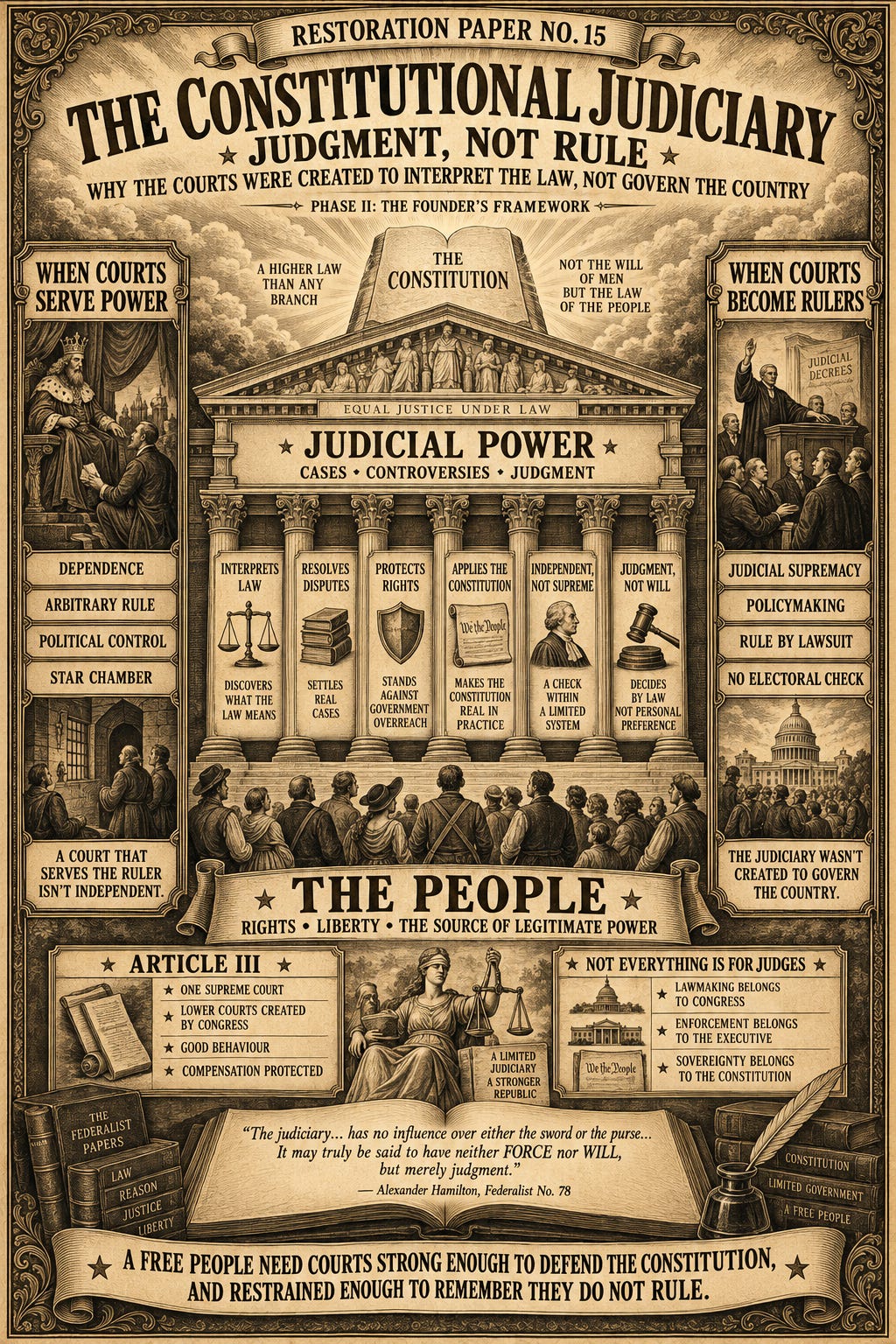
In Federalist No. 78, Alexander Hamilton called the judiciary the “least dangerous” branch because it possessed “neither FORCE nor WILL, but merely judgment.” It had neither the sword of the executive nor the purse of the legislature. Courts had to wait for disputes to come to them, decide them according to law, and then depend on the Executive Branch to carry out their judgments.
I don’t believe Hamilton was saying the courts were unimportant. He was explaining why they were supposed to be limited.
Courts aren’t supposed to roam the country looking for laws or policies they dislike, and they aren’t supposed to offer general advice about how America should be governed. Their job is to hear real disputes between real parties, apply the law, and issue judgments that resolve them.
Let’s compare that with the role the courts often play today.
A single federal district judge can halt a major national policy. A five-justice Supreme Court majority can resolve a question Congress has avoided for decades. A single Supreme Court vacancy can become a national political emergency because one appointment may influence constitutional law for a generation.
I’ll submit that some of that power is absolutely necessary. An unconstitutional law doesn’t become constitutional because Congress passed it. An unlawful executive order doesn’t become lawful because the president calls it an emergency. And a state government doesn’t get to violate someone’s constitutional rights just because a majority approves.
But when nearly every major national dispute eventually becomes a lawsuit, something’s broken.
Our courts are increasingly being asked to settle political questions that elected officials have refused to settle themselves. And Congress and our presidents have found that arrangement pretty convenient because it lets them avoid responsibility for some of the hardest decisions.
That’s not good for the courts, and it isn’t good for self-government.
Why the Founders Built Article III
Like the other branches I’ve discussed in Phase II of the Restoration Papers, the Judicial Branch wasn’t created out of thin air. The Founders drew on lived experience under British rule, centuries of English law, political philosophy, and warnings from ancient republics.
They asked a basic question of themselves: how do we build courts strong enough to protect liberty without letting them become another source of unchecked power?
Lessons From the Ancient World
The ancient republics didn’t give the Founders a judicial system they could simply copy. Greece and Rome had very different political and legal institutions. What they did offer, however, were lessons about human nature.
The Founders read histories filled with faction, political revenge, popular passion, ambition, instability, and the collapse of republican government. Hamilton wrote in Federalist No. 9 about the small republics of Greece and Italy, where faction and disorder repeatedly pushed governments between instability and tyranny.
The lesson wasn’t that self-government was impossible. It was that self-government needed structure. A republic can’t survive for long if temporary majorities can turn legal institutions against their enemies. And it can’t survive if public anger replaces due process or if officials can bend the law to whatever result they want in a particular moment.
The law has to mean something even when following it is inconvenient.
The English Inheritance and Colonial Experience
Our legal tradition came much more directly from England. We inherited common-law courts, jury trials, habeas corpus, legal precedent, rules of procedure, and the principle that government should operate through known laws rather than rulers’ personal commands.
But English history also brought warnings, most famously the Court of Star Chamber. It began as a way to deal with powerful offenders who might otherwise evade ordinary justice. Over time, however, it became closely tied to the Crown’s political power.
That transformation offered a lesson the Founders understood well: a court that ultimately serves the ruler isn’t truly independent.
It’s another arm of executive power, dressed up in legal language.
Their colonial experience made that concern even more personal. The Declaration of Independence specifically accused King George III of making judges dependent on his will “for the tenure of their offices, and the amount and payment of their salaries.”
The Founders didn’t want an American president who could fire judges for ruling against him. They didn’t want Congress threatening a judge’s livelihood because members disliked a decision. A judge who has to worry about losing a job every time the government loses a case isn’t independent.
That’s why Article III protects federal judges in two important ways: they hold office during “good Behaviour,” and their compensation can’t be reduced while they remain in office.
The traditional understanding of those protections has been lifetime tenure unless a judge resigns, retires, dies, or is impeached and removed. Judges must be able to rule against the political branches without fearing retaliation.
The Founders wanted independence without dependence on anyone else. They also rejected the idea of parliamentary supremacy inherited from Britain. America wouldn’t have a sovereign Congress, a sovereign president, or a sovereign court.
The Constitution would be supreme.
What Article III Actually Created
Article III created one Supreme Court and allowed Congress to establish lower federal courts. It gave the federal judiciary authority over specified “cases” and “controversies.” It didn’t give judges a general license to supervise every political dispute in America.
Courts generally don’t issue advisory opinions. A president can’t simply ask the Supreme Court whether a policy he might adopt next year would be constitutional. Congress can’t send a bill over before passage and ask the justices to approve it. A real legal dispute must involve parties with an actual stake in the outcome.
That requirement isn’t just lawyerly procedure. It helps define the judicial role. The judiciary is supposed to be a constitutional safeguard, not the first branch we consult every time the country has a political disagreement.
Judicial Review Isn’t Judicial Supremacy
Many of our arguments about the courts get confused because we treat two different ideas as the same: judicial review and judicial supremacy. They are not the same.
Judicial Review
Judicial review is straightforward. When a court decides a legitimate case and an ordinary law conflicts with the Constitution, the court must follow the Constitution. If Congress passes a statute that violates the Constitution, a judge can’t faithfully apply both. The Constitution is the higher law.
Hamilton defended that principle in Federalist No. 78. Chief Justice John Marshall later explained it in Marbury v. Madison. A written Constitution wouldn’t mean much if courts were required to enforce ordinary statutes that contradicted it. That is judicial review, and it belongs in our constitutional system.
Judicial Supremacy
Judicial supremacy goes further. It’s the idea that the Supreme Court’s interpretation of the Constitution isn’t simply controlling in the case before it, but becomes the final constitutional answer for the rest of the government as well. Under that view, once the Court has spoken, Congress, the president, the states, and everyone else are expected to treat that interpretation as controlling unless the Court later changes its mind or the Constitution is amended
That doesn’t automatically follow from judicial review.
A lawful, final court judgment binds the parties before the court. Government officials can’t simply ignore an order because they dislike the outcome or disagree with the reasoning. If courts could issue judgments that nobody had to obey, judicial review would be meaningless, and constitutional rights would become little more than words on paper.
Lower courts must follow higher-court decisions, and Supreme Court decisions inevitably shape future cases. But none of that means every constitutional interpretation announced by the Supreme Court becomes the Constitution itself.
Every branch has constitutional responsibilities. Members of Congress swear an oath to support the Constitution. The president swears to preserve, protect, and defend it. Federal judges swear to uphold it. Each has a responsibility to take that oath seriously instead of outsourcing constitutional judgment to somebody else.
Congress shouldn’t pass laws its members believe are unconstitutional and then shrug, expecting the courts to clean up the mess later. Presidents shouldn’t push their authority as far as possible and treat a federal lawsuit as the only meaningful boundary on executive power. And states shouldn’t violate constitutional rights until a judge finally orders them to stop.
The courts have an essential role in interpreting and enforcing the Constitution, but they aren’t the only institution responsible for it. The Supreme Court is the highest court in the country, but it’s not the highest authority in our constitutional system.
The Constitution is.
Judgment and Political Will
Hamilton’s distinction between judgment and will remains one of the clearest ways to understand the proper role of the judiciary.
Legislatures exercise political will. They weigh competing interests, make compromises, allocate money, impose taxes, create programs, and decide public policy.
The Executive Branch carries out those laws. It administers programs, enforces the law, conducts foreign relations, and commands the military within its constitutional authority.
Judges have a different job. They examine constitutional text, statutes, facts, legal arguments, and relevant precedents. They determine what the law requires in the dispute before them.
That work isn’t simple or mechanical.
The Constitution was written before radio, airplanes, smartphones, digital banking, social media, cloud storage, and modern surveillance. Applying enduring constitutional principles to new circumstances requires real judgment.
The Fourth Amendment can protect digital information even though the Founders never held a smartphone. The First Amendment can protect speech on the internet even though the Founders only knew printing presses, pamphlets, newspapers, taverns, churches, and public meetings.
Applying an old principle to a new set of facts isn’t the same as inventing a new principle.
A judge should be able to explain where the rule comes from. What constitutional or statutory text governs? What did that language mean when it was lawfully adopted? What precedent applies? How do the facts fit the rule?
The reasoning shouldn’t start with the result the judge believes would make society kinder, safer, more modern, more traditional, more equal, or more efficient. Those might be worthy goals or terrible goals, but citizens and their elected representatives choose which policy path the country should pursue.
When judges decide what the law ought to be instead of what the law is, they move from judgment into political will. The robe they wear doesn’t change the nature of the power being exercised.
Cases, Controversies, and Federalism
Courts work best when they have real parties, real facts, opposing arguments, an identifiable injury, and a remedy connected to that injury. That structure is a baseline safeguard that keeps judges focused on resolving legal disputes instead of issuing broad pronouncements about how the country should be governed.
Today, individual lawsuits have increasingly become vehicles for national policymaking. A plaintiff files suit in what they believe is a favorable district. Their chosen judge issues an injunction. And suddenly, a federal policy affecting millions of people is halted across the country, including for people who were never parties to the case.
Now, admittedly, broader relief is sometimes necessary. If a policy injures thousands of people in the exact same way, it may be unrealistic or unfair to require each of them to file a separate lawsuit. Properly certified class actions and representative cases remain important tools for protecting rights. But the other side of the problem matters too: a single district judge shouldn’t automatically possess the power to suspend national policy everywhere before other courts have considered the question.
The Supreme Court confronted this issue in Trump v. CASA, Inc. (2025). The Court concluded that universal injunctions – orders extending relief to non-parties – likely exceed the traditional equitable authority Congress granted federal courts, except where broader relief is necessary to protect the actual plaintiffs before the court. The Court addressed the remedy’s reach, not the underlying policy.
That points toward a sensible rule: judicial remedies should ordinarily be tied to the injury proven by the parties before the court. Broader relief should remain available when genuinely needed – such as certified class actions, indivisible harms, or express statutory authorization – but a local courtroom shouldn’t automatically become national policy headquarters.
That’s where federalism matters. The Constitution didn’t eliminate state governments or state courts. Most criminal prosecutions, family disputes, property cases, and contract matters are still primary issues of state law.
At the same time, federalism isn’t a permission slip for states to violate rights. The Reconstruction Amendments altered the relationship between citizens, the states, and the federal government. A restrained federal judiciary must enforce due process, equal protection, voting protections, and every other constitutional guarantee that applies against state governments.
Dividing governing power between Washington and the states protects liberty. Dividing basic constitutional rights according to ZIP code doesn’t.
The Path to Restoration
Restoring the constitutional judiciary doesn’t mean abolishing judicial review, subordinating judges to presidents, or authorizing Congress to violate rights. It means rebuilding structural boundaries around judicial power while preserving the independence necessary for courts to do their job.
1. Constitutionally Fix the Supreme Court at Nine Justices
Federal law already sets the Supreme Court at one Chief Justice and eight Associate Justices. The problem is that another Congress can change that number through ordinary legislation. If we want to take expansion or contraction of the Court off the table as a partisan weapon, the number nine should be fixed in the Constitution, ideally as part of the same amendment establishing eighteen-year terms.
2. Establish Fixed, Non-Renewable 18-Year Supreme Court Terms
Active service on the Supreme Court shouldn’t depend on mortality, strategic retirement, or political timing. The cleanest reform is a constitutional amendment creating staggered, non-renewable 18-year terms of active Supreme Court service.
Eighteen years is long enough to insulate a justice from ordinary political pressure without requiring reelection or renomination. Staggered appointments would make the process predictable and dramatically lower the political stakes of unexpected vacancies.
The amendment should include a neutral transition schedule established in advance, with one active Supreme Court seat turning over every two years, beginning with the longest-tenured active justice. Justices leaving active Supreme Court service would retain their Article III status and could serve in retirement as provided by the amendment and implementing law. The transition should establish the new system, not manufacture an immediate partisan majority.
3. Enforce Clear Ethics, Disclosure, and Recusal Standards
Judicial independence can’t mean judges are accountable only to themselves. While the Supreme Court’s adoption of a Code of Conduct in 2023 was a positive step, standards require objective administration.
Congress should establish clear, prospective disclosure and recusal rules applying across the federal judiciary. These rules must address financial conflicts, gifts, and circumstances where impartiality might reasonably be questioned. They must apply equally to all judges, regardless of appointing party, and operate as neutral safeguards rather than political weapons.
4. Tailor Judicial Remedies to Proven Harm
Federal courts should continue moving away from universal, nationwide injunctions issued by single district judges. The baseline rule must be direct: the remedy must fit the injury the parties prove in the courtroom. Universal relief should remain an exceptional tool limited to properly certified class actions, indivisible harms, or explicit legislative authorization. Additionally, major constitutional challenges to federal policy should receive expedited appellate review to prevent national paralysis.
5. Reclaim Congressional Article III Responsibilities
Congress frequently criticizes judicial overreach while ignoring its own constitutional tools. Under Article III, Congress possesses clear authority to structure the lower courts and regulate appellate jurisdiction. Congress should exercise this power to reform random case assignments, curb judge-shopping, establish expedited review channels, and clarify remedial boundaries. Jurisdiction should never be manipulated to shield unconstitutional acts, but Congress must take active responsibility for the system it created.
6. Restore Multi-Branch Constitutional Duty
Judicial restraint can’t succeed if Congress and the president treat courts as the sole guardians of constitutional boundaries. Members of Congress must identify the constitutional authority for legislation before voting. Likewise, Presidents must ground executive claims in constitutional or statutory authority. A representative who votes for a bill he believes is unconstitutional fails his duty, regardless of whether the Supreme Court ever reviews the statute.
The Necessary Guardrails
Any serious proposal to reform the judiciary will draw criticism. If we are serious about restoration rather than partisan advantage, we must address these concerns directly.
Addressing Concerns About Structural Integrity
Critics will argue that term limits or jurisdictional reforms represent court-packing or legislative overreach. That would be true if these measures were applied selectively to alter current ideological majorities. That’s precisely why structural reform must occur prospectively through a constitutional amendment and neutral statutory rules.
Congress’s Article III powers over jurisdiction and structure must remain general, prospective, and bound by due process. Congress can’t close every judicial forum to valid constitutional claims or dictate outcomes in pending cases. The objective isn’t to replace judicial supremacy with legislative supremacy; it’s to restore constitutional balance.
Addressing Concerns About Rights and Remedies
Others worry that limiting nationwide injunctions or enforcing judicial restraint will leave citizens unprotected against illegal policies or state overreach.
Restraint doesn’t mean abandoning constitutional guarantees. Class actions, representative suits, and expedited appeals ensure that widespread illegal policies can still be halted efficiently. Furthermore, restoring federalism doesn’t weaken the Reconstruction Amendments. Federal courts maintain full authority to strike down state actions that violate due process, equal protection, or religious liberty.
Restraint simply requires anchoring rights in constitutional text rather than judicial policy preferences. A strong court must tell a majority when the Constitution forbids its actions, but it must also tell itself when the Constitution leaves a decision to the people.
Addressing Concerns About Modern Application and Executive Power
Skeptics suggest that adhering to original public meaning freezes the law in 1789, or that restraining the judiciary will create an imperial executive.
Original public meaning doesn’t restrict principles to eighteenth-century technology. Enduring principles apply naturally to modern realities. Fourth Amendment principles can apply to data stored in the cloud just as they apply to papers and effects in the physical world, and the First Amendment protects speech communicated digitally just as it protects speech distributed through a printing press. When the underlying principles themselves need changing, Article V provides the amendment process.
Furthermore, judicial reform doesn’t operate in isolation. As part of Phase II of the Restoration Papers, judicial restraint sits alongside a revitalized Congress reclaiming its legislative role and a disciplined executive returning to its enforcement mandate. A restrained judiciary remains fully empowered to strike down unlawful executive actions; it simply refrains from assuming the executive’s policy duties.
Judgment, Not Rule
Any reform of the judiciary should pass four simple tests:
Does it preserve the ability of judges to decide cases free from political coercion?
Does it protect individuals from unconstitutional government action?
Does it prevent judges from exercising powers that belong to the legislative or executive branches?
Does it return constitutional responsibility to Congress, the president, the states, and the people instead of simply moving power from one institution to another?
A judiciary that bows to presidents or legislatures isn’t a safeguard of liberty. But a system in which nine unelected justices are treated as final policymakers on many of the major questions in American life isn’t self-government either.
The Founders created an independent judiciary because liberty couldn’t survive if judges served at politicians’ pleasure. But they didn’t create a council of legal rulers standing above the republic either. They intentionally didn’t give judges command of the military, control of the purse, or authority to write laws. They were given judicial power, exercised through actual cases and controversies, with a duty to follow the Constitution as the highest law.
The courts must be strong enough to protect individuals from government power. They must be independent enough to issue unpopular judgments. They must be restrained enough to recognize when the Constitution leaves a question to the people and their elected institutions.
And they must remember that wearing a robe doesn’t make anyone sovereign.
The Constitution belongs to the American people.
The judiciary’s proper role is judgment.
Not rule.
In Liberty
Gary Mullins (Libertas)
Sources & Further Reading
Founding Documents and Constitutional Text
The Constitution of the United States.
Particularly Article III, establishing the federal judiciary; Article V, establishing the amendment process; Article VI, including the Supremacy Clause; and the Reconstruction Amendments, particularly the Fourteenth Amendment.
The Declaration of Independence (1776).
Especially the grievance against King George III for making judges dependent upon his will “for the tenure of their offices, and the amount and payment of their salaries.”
The Federalist Papers
Alexander Hamilton, Federalist No. 9, “The Union as a Safeguard Against Domestic Faction and Insurrection” (1787).
Hamilton’s discussion of faction, instability, and the experience of the ancient republics of Greece and Italy.
Alexander Hamilton, Federalist No. 78, “The Judiciary Department” (1788).
The principal Founding-era defense of judicial independence and judicial review. Hamilton describes the judiciary as the “least dangerous” branch, possessing “neither FORCE nor WILL, but merely judgment.”
Major Supreme Court Decisions
Marbury v. Madison, 5 U.S. (1 Cranch) 137 (1803).
Chief Justice John Marshall’s foundational explanation of judicial review and the principle that the Constitution takes precedence over an ordinary statute when the two conflict.
Cooper v. Aaron, 358 U.S. 1 (1958).
An important modern statement of the Supreme Court’s authority in constitutional interpretation and a central case in the debate over the distinction between judicial review and judicial supremacy.
Trump v. CASA, Inc., 606 U.S. ___ (2025).
The Supreme Court’s examination of universal or nationwide injunctions and the traditional principle that equitable relief ordinarily should not extend further than necessary to provide complete relief to the parties before the court.
Federal Statutes and Judicial Structure
28 U.S.C. § 1, “Number of Justices; Quorum.”
Current federal law establishing the Supreme Court as one Chief Justice and eight Associate Justices.
28 U.S.C. § 294, “Assignment of Retired Justices or Judges to Active Duty.”
Provides for the continued judicial service of retired Supreme Court justices and other federal judges under specified circumstances.
28 U.S.C. § 455, “Disqualification of Justice, Judge, or Magistrate Judge.”
Federal law governing judicial recusal and conflicts of interest, including circumstances in which a justice or judge’s impartiality might reasonably be questioned.
Judicial Ethics
Supreme Court of the United States, Code of Conduct for Justices of the Supreme Court of the United States (November 13, 2023).
The Supreme Court’s formal statement of ethical principles concerning impartiality, outside activities, financial interests, recusal, and preservation of public confidence in the judiciary.
Congressional Research and Constitutional Interpretation
Constitution Annotated, Congressional Research Service and Library of Congress.
Particularly the following essays:
“Historical Background on Judicial Review”
“Marbury v. Madison and Judicial Review”
“Exceptions Clause and Congressional Control over Appellate Jurisdiction”
“Overview of the Supremacy Clause”
Essays concerning Article III’s Good Behavior Clause, judicial independence, federal jurisdiction, and the Cases or Controversies requirement
English Legal History
The National Archives of the United Kingdom, “Court of Star Chamber Records, 1485–1642.”
Historical overview of the Star Chamber, its origins, procedures, jurisdiction, relationship to the King’s Council, and eventual abolition in 1641.
J. A. Guy, The Court of Star Chamber and Its Records to the Reign of Elizabeth I. Public Record Office Handbook No. 21. London: HMSO, 1984.
A detailed history of the development and operation of the Star Chamber.
K. J. Kesselring and Natalie Mears, eds., Star Chamber Matters: An Early Modern Court and Its Records. London: University of London Press, 2021.
Modern scholarship examining the Star Chamber, its operation, surviving records, and historical reputation.
Additional Historical and Constitutional Reading
William Blackstone, Commentaries on the Laws of England (1765–1769).
One of the most influential explanations of English common law available to the Founding generation and an important source for understanding the legal tradition inherited by early Americans.
Montesquieu, The Spirit of the Laws, Book XI, Chapter 6 (1748).
A major influence on the Founders’ understanding of separated governmental powers and the dangers of combining legislative, executive, and judicial authority.
The Records of the Federal Convention of 1787, edited by Max Farrand.
The principal documentary collection of the Constitutional Convention debates and proposals, including discussions surrounding the creation and structure of the federal judiciary.