

The Publius Project is a series of essays called Restoration Papers exploring liberty, citizenship, and constitutional restoration in the American republic.
To My Fellow Americans,
Every system has a baseline, a set of assumptions about how something functions at its most basic level.
The American republic was built on such a baseline. It assumed a society composed of citizens capable of governing themselves, cooperating voluntarily, and resolving most problems within their own communities.
Government existed not to manage this system, but to preserve the conditions that allowed it to function.
The founders designed a framework for a society that already possessed the habits of self-government.
Over time, however, that baseline quietly shifted. Responsibilities once carried out by citizens and communities were gradually transferred to centralized institutions. What had once been a society that governed itself slowly became a society increasingly governed by systems.
America was designed for a society that governs itself, not for a system that governs society.
Today, most Americans navigate a world filled with permissions.
· Licenses to drive
· Licenses to work
· Permits to build
· Permits to alter one’s own property
Regulations govern everything from commerce to education and because most Americans have grown up within this framework, many assume it is simply the normal structure of a modern society.
But the American system was not originally designed to function this way.
The Original Baseline
The early American system assumed that society itself would do most of the work. Families, churches, civic associations, and local communities were expected to solve the majority of problems people faced in their daily lives. Government played a supporting role, providing order, protecting rights, and resolving disputes when necessary.
The American system worked not because government solved every problem, but because society itself carried most of the load.
Local knowledge, personal responsibility, and voluntary cooperation formed the operating system of the republic.
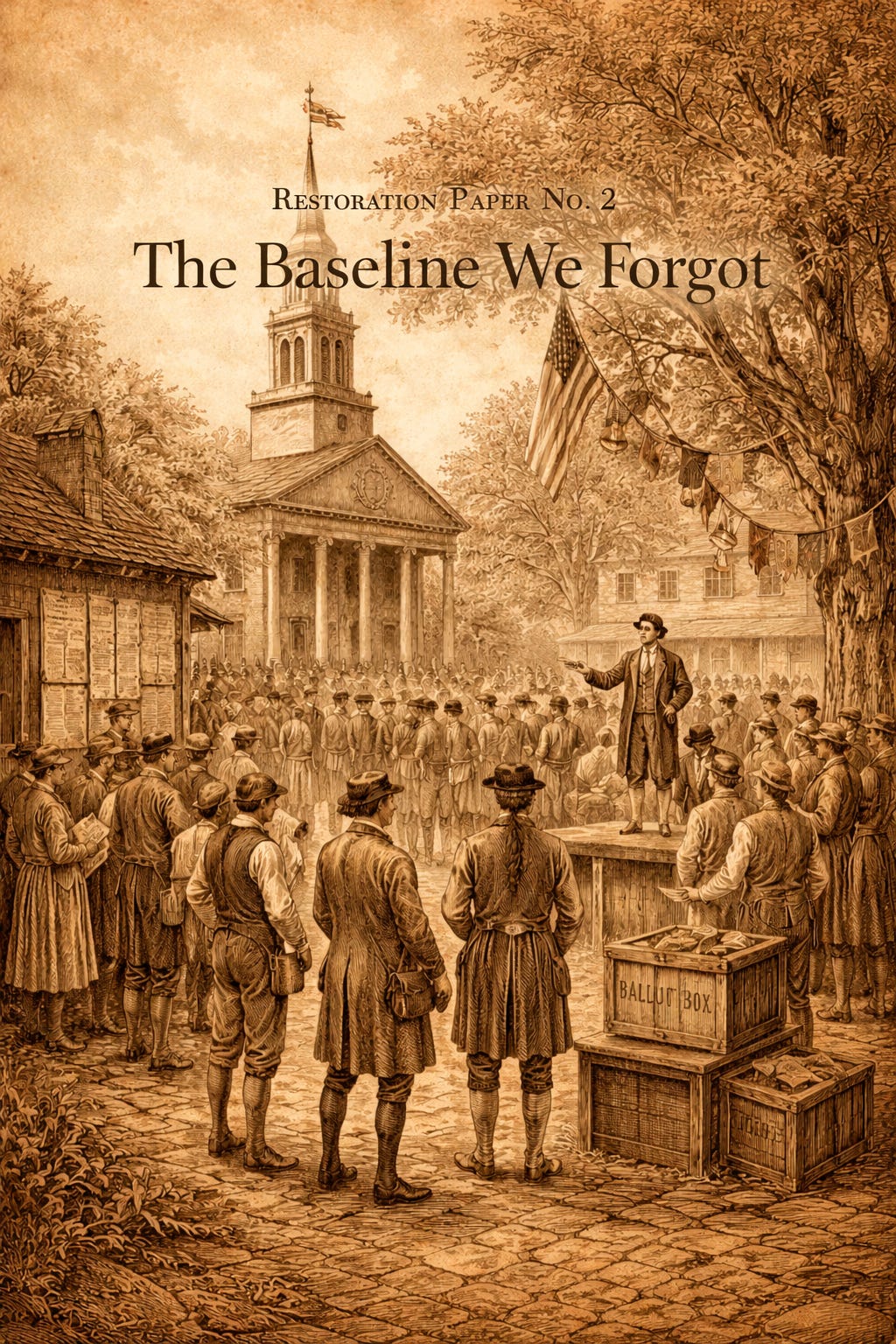
In practice, most social and economic life unfolded without centralized supervision. Town meetings governed local affairs. Churches organized charity and mutual aid. Businesses formed and operated with minimal licensing or regulatory oversight. Disputes were often resolved within communities long before they reached distant courts or agencies.
The system assumed that citizens were capable of managing their own affairs and cooperating with their neighbors when problems arose. Government was designed to protect the framework of liberty, not to replace the functions of society itself.
How the Baseline Faded
The transition away from this model did not happen overnight. It emerged gradually as the scale of institutions expanded and administrative solutions increasingly replaced local deliberation.
As new regulatory bodies developed, more decisions moved from communities to distant agencies. Over time, Americans began to view complex problems as requiring professional administration rather than civic participation.
Economic life provides a clear example of this transformation. Activities that once required little more than agreement between individuals gradually came to require layers of permits, licenses, and regulatory approval. In many professions today, citizens must receive formal permission from the state before practicing a trade or start a business.
Each individual requirement may appear reasonable in isolation. Yet taken together they represent a profound shift in the baseline of American life—from freedom of action to permission by authority.
This shift was often justified in the name of efficiency, expertise, and stability. Yet it also had an unintended consequence: the gradual weakening of the habits and institutions that sustain self-governance.
A society accustomed to management slowly forgets how to manage itself.
The Restoration Principle
A free society depends on citizens who govern themselves before they are governed by institutions.
To restore the baseline, authority must reside at the most local level possible. The restoration principle is simple:
· No function that can be performed by the individual should be assigned to the community
· No function that can be performed by the community should be assigned to the state
· No function that can be performed by the state should be assigned to the federal government
Restoration is not merely about reducing government. It is about reassuming the responsibilities that free citizens once carried naturally.
We cannot demand the removal of the scaffolding if we have forgotten how to support the building ourselves.
Closing Reflection
America was intended to be a society of citizens, not clients.
Over time we have grown accustomed to asking, “What will the government do about this?”
A healthier question may be: “What have we stopped doing ourselves?”
The baseline we forgot is still present, buried beneath layers of code, regulation, and administrative habit. It lives in the instinct to help a neighbor without a program, to build something new without excessive permission, and to take responsibility for the institutions closest to our daily lives.
Thomas Jefferson understood this principle well. Writing in 1816, he argued that liberty is best preserved when authority is divided down to the smallest practical level, until citizens govern their own affairs.
“The way to have good and safe government is not to trust it all to one, but to divide it among the many… by subdividing from the general government down to every man’s farm.”
The first step of reconstruction is remembering that we are the architects, not the tenants.
It begins with each individual citizen. Identify one place in your life where you have become a client of the system rather than a citizen within it and peacefully find a way to take back that ground.
The scaffolding only comes down when the building can once again stand on its own.
In Liberty,
Gary Mullins (Libertas)
If you found this paper valuable, consider sharing it with someone who cares about the future of the American republic.