

The Publius Project is a series of essays called Restoration Papers exploring liberty, citizenship, and constitutional restoration in the American republic.
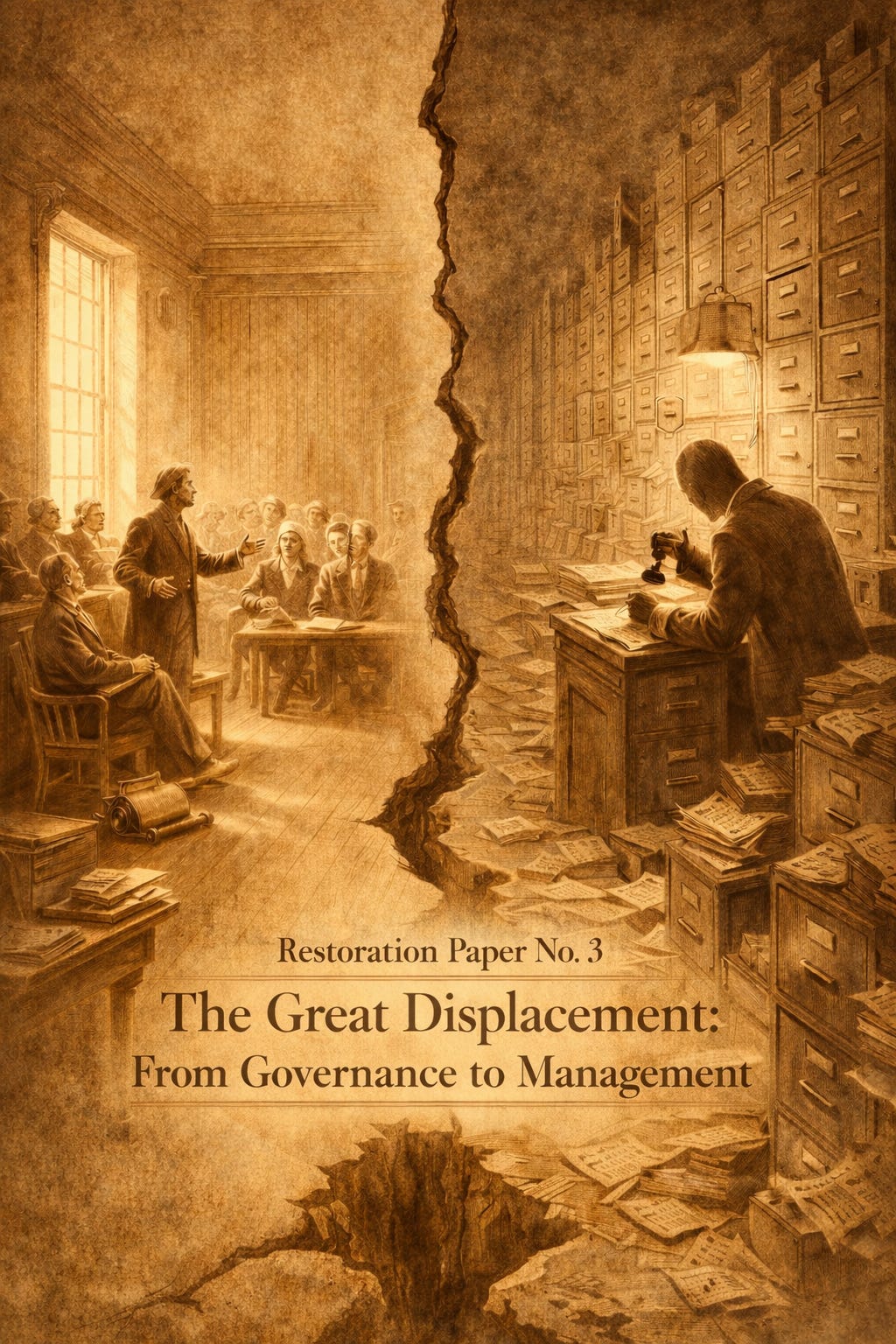
To My Fellow Americans,
Today, we live in a strange paradox.
The rituals of our Republic remain intact: elections are held, speeches are delivered, and Congress still convenes beneath the same marble dome. Yet beneath those familiar forms, the mechanics of power have shifted. We are no longer a people solely governed by our representatives; we are a population increasingly managed by a system.
Most major decisions that shape the texture of our daily lives – from the lightbulbs we buy to the way we run our small businesses, are not debated in legislatures or voted on by the people we elect. Instead, they are issued as rules, “guidance”, or directives produced by a vast, permanent administrative layer.
These institutions do not merely implement the law; they write the rules, enforce the rules, and often interpret the rules themselves. To many, this feels normal because it is the only system they have ever known. But it is not the system the American Republic was designed to be.
1. The Design vs. The Drift
The Constitution forged a covenant of representation. It was designed to be friction-heavy, making lawmaking difficult so that only the most necessary and debated rules would survive. Power was deliberately divided so that no single institution could dominate the others.
Over time, however, a different model emerged – one that prized efficiency over consent.
Legislatures began delegating their broad constitutional authority to administrative agencies. These agencies did not merely enforce laws; they began to construct detailed regulatory frameworks governing vast areas of our economic and social life. What was once a legislative decision has become an administrative one. What once required public debate became a “regulatory process.”
In effect, governance gave way to management. This transformation accelerated as the state promised that “expertise” and “technical competence” could solve the complexities of modern life better than the messy process of self-rule. But in gaining efficiency, we lost proximity. Decision-making was moved further away from the citizens those decisions actually affected.
2. The Philosophical Principle
A constitutional republic depends on a simple, unbreakable principle: Those who write the rules must remain accountable to those who live under them.
Administrative governance alters this relationship. When rulemaking authority shifts from elected legislators to permanent bodies, the connection between the citizen and the law begins to wither. The people still vote, but they increasingly vote for representatives who no longer write the rules that govern their daily existence.
Governance requires consent; management requires compliance.
3. The Consequences of the Shift
The result was not a tyranny of the boot, but a tyranny of the binder…a soft, desk-bound despotism that didn’t break the spirit so much as it exhausted it.
· Concentrated Authority: Agencies often combine rulemaking, enforcement, and adjudication within a single institution, the very “accumulation of powers” the Founders feared most.
· Reduced Transparency: Decisions are hidden behind technical jargon and complex frameworks, distant from ordinary public scrutiny.
· The Subject vs. The Citizen: This shift changed our identity. Citizens became less like participants in a republic and more like subjects navigating an expanding network of permissions.
The result is a society that is increasingly administered rather than governed.
4. The Question for the Republic
If the machinery of modern life now operates through administrative systems rather than constitutional processes, we must ask:
How much authority can move from the people’s representatives to administrative institutions before a Republic ceases to be a Republic?
Understanding this requires us to examine the rise of what we now call the “Administrative State.” That will be the subject of our next Restoration Paper.
5. Closing Reflection
The Founders understood that liberty doesn’t always disappear through conquest or revolution. It can fade gradually as power moves from visible, accountable institutions to quieter, professionalized mechanisms of control.
When governance becomes management, we may still believe we are participating in a constitutional system even as the structure beneath us transforms. The first step toward restoration is recognizing when the machinery of governance has been replaced by the machinery of administration.
Only then can we ask whether the balance intended by the Constitution still exists—and what must be done to reclaim it.
“The accumulation of all powers, legislative, executive, and judiciary, in the same hands… may justly be pronounced the very definition of tyranny.”
- James Madison, Federalist No. 47
In Liberty,
Gary Mullins (Libertas)