

The Publius Project is a series of essays called Restoration Papers exploring liberty, citizenship, and constitutional restoration in the American republic.
To My Fellow Americans,
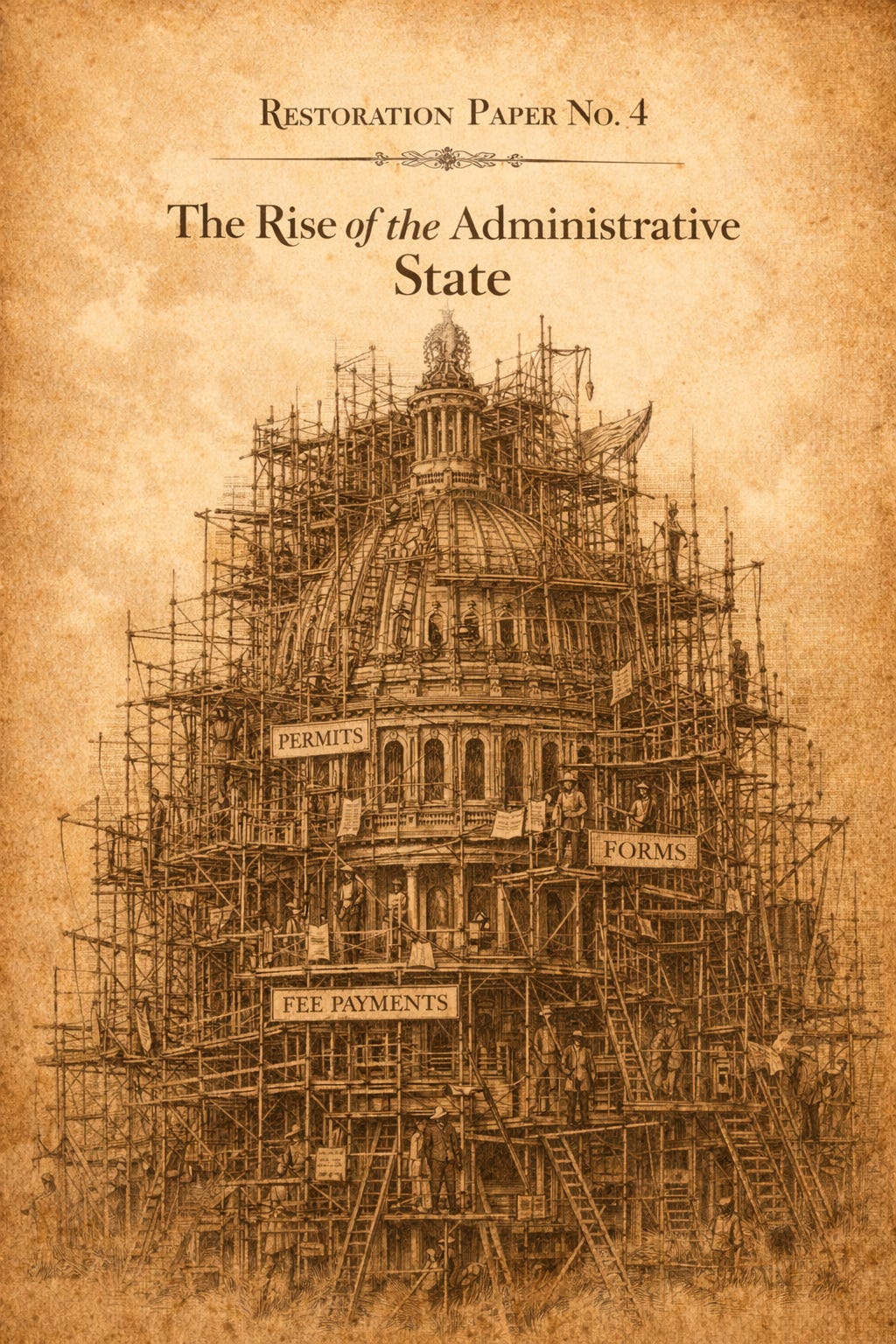
No system transforms overnight; it evolves quietly until the unrecognizable feels normal. The administrative state did not replace the American system in a single moment. It emerged incrementally…first as an experiment, then as a response to crisis, and finally as the permanent machinery of modern governance.
The First Shift: From Politics to Administration
This transformation began not as a law, but as an idea.
In the late nineteenth century, as America industrialized, a belief took hold that the deliberate processes of republican governance…debate, compromise, and accountability, were too cumbersome for a modern age.
Foremost among these reformers was future president, Woodrow Wilson. In his 1887 essay, The Study of Administration, Wilson proposed a fundamental divorce in government: Politics would set the goals, while Administration, a sphere “removed from the hurry and strife of politics,” would execute them through expert management.
This was a quiet revolution. Governance was no longer a process rooted primarily in public consent, but a technical function to be managed by a professional class. Its first institutional anchor was the Interstate Commerce Commission (1887), the first federal agency empowered to oversee an entire economic sector.
What began as oversight soon became the blueprint for the modern state.
The Second Shift: Crisis and Expansion
If ideas create possibilities, crisis creates momentum.
The Great Depression transformed administrative governance from a theoretical experiment into a national necessity. Under Franklin D. Roosevelt, the New Deal rapidly expanded the federal government’s scope, moving beyond market stabilization to the management of entire economic sectors.
The creation of the Securities and Exchange Commission, the National Labor Relations Board, and the Social Security Administration signaled a profound structural change. These institutions were granted authority not merely to enforce laws, but to define and interpret them. For the first time, the federal government became a continuous regulatory presence in American life…not as a temporary adjustment, but as a permanent structural transformation.
The Third Shift: Legal and Constitutional Permission
Expansion alone does not create permanence; it must be ratified by law.
Though the courts initially resisted the New Deal, that defiance was short-lived. In 1942, the Supreme Court decided Wickard v. Filburn, ruling that even local, non-commercial activity could be federally regulated if its aggregate effect touched the national economy. By redefining “commerce” so broadly, the Court removed one of the final practical limits on federal regulatory scope, leaving the reach of administrative agencies functionally unbounded.
This era of expansion was soon institutionalized by the Administrative Procedure Act of 1946, which provided the formal framework for agency rulemaking and enforcement. For decades, this structure was further anchored by “Chevron deference,” a judicial doctrine that required courts to defer to an agency’s own interpretation of ambiguous laws…effectively granting the administrative state the power to define the limits of its own authority.
However, the foundation has recently cracked. In 2024, the Supreme Court’s decision in Loper Bright Enterprises v. Raimondo ended the era of deference. By restoring the duty of the courts to “say what the law is,” this ruling represents the first significant challenge to administrative power since the New Deal, forcing a fundamental reconsideration of how much authority can be constitutionally delegated to unelected experts.
The Fourth Shift: The Permanent System
By the late twentieth century, administrative governance had become the American default.
With the creation of the Environmental Protection Agency, the Occupational Safety and Health Administration, and the Department of Education, federal authority expanded into nearly every dimension of daily life. Congress increasingly favored broad, aspirational statutes, leaving the granular rules that govern society to be developed by the agencies themselves.
Today, the federal regulatory code spans tens of thousands of pages. Though these rules carry the force of law, they are rarely the product of legislative debate. Instead, they are drafted by specialists and enforced through institutional mechanisms largely insulated from electoral accountability.
What began as a tool has become the system.
Complexity, however, does not grant a waiver from the Constitution. While modern society requires technical expertise to inform our laws, expertise is no substitute for the consent of the governed.
We have confused the role of the advisor with that of the ruler. In a Republic, experts may provide the data, but the people’s representatives must provide the decree. To allow a professional class to both draft the rule and enforce it is to trade our status as citizens for that of subjects in a managed state.
The Structural Reality
The administrative state did not arise from a single decree, but through a calculated sequence: a belief in expert management, a crisis justifying expansion, judicial permission, and decades of institutional normalization. The common thread through every shift, from Wilson’s theories to the New Deal’s response, is the erosion of traceable authority.
In the original American design, a citizen could trace every rule back to a representative subject to the ballot. Today, that line of accountability has been obscured by a web of procedures. We have traded the “hurry and strife” of politics for the quiet permanence of the bureau, moving from a system of public consent to one of technical management.
Each step appeared reasonable in isolation, but together, they produced a system fundamentally different from our founding design.
The evolution was not a series of radical ruptures, but a sequence of pragmatic adaptations…each defended as a sensible solution to a modern problem. Yet the cumulative result was a slow-motion migration of power away from the transparent process of representation and into the opaque machinery of administration.
This is not a question of intent, but of structure.
The debate is not over the desirability of clean air or stable markets, but whether a free people should have their lives shaped by rules they did not write and officials they cannot fire.
While Congress retains the power to fund or theoretically override an agency, oversight is not authorship.
By shifting from authors to overseers, Congress has traded its constitutional duty for political convenience, leaving the citizen to navigate a world of rules that no elected official ever actually wrote.
The Founders’ Warning
Long before the administrative state took form, Thomas Jefferson observed in 1788 that the ‘natural progress of things is for liberty to yield, and government to gain ground’…a progress the Constitution was explicitly designed to arrest.
In Federalist No. 51, James Madison argued that “ambition must be made to counteract ambition” through a strict separation of powers. They did not merely fear the size of government; they feared its concentration.
They understood that when the powers to write, enforce, and interpret the law are held in the same hands, liberty is lost. Today, the administrative state functions essentially as a “Fourth Branch” that frequently performs all three roles at once; effectively bypassing the “auxiliary precautions” built to protect the citizen.
This was not a prediction of sudden tyranny, but a recognition of a quieter, more corrosive process.
It is a progression where power accumulates gradually, justified by necessity, until it becomes the default condition.
The administrative state reflects this reality: not a deliberate abandonment of the Constitution, but the cumulative result of generations choosing convenience over constitutional structure.
The Consequence
The result is a system where governance no longer operates through representation, but through administration. Though the citizen and the election remain, the connection between the ballot and the rules of daily life has been severed. Authority has not disappeared; it has relocated beyond the reach of the electorate, fundamentally altering the character of our system.
Critics contend that the system has merely adapted…that as long as Congress sits, the Republic survives. But a Republic is not defined by its architecture; it is defined by the source of its authority.
When agencies produce nearly twenty rules for every single law passed by our elected
representatives, the system has not adapted; it has been bypassed.
The institutions of the Founders retain the appearance of representation, while the primary pulse of American governance now beats within the administrative machinery.
The Question for the Republic
If the administrative state is now the primary engine of American governance, a fundamental question emerges: Can a system built on representation endure when its rulemaking occurs outside of it? Or more simply: Can a Republic remain a Republic when its laws are dictated by institutions the people cannot control?
Restoration is not a retreat into the past, but a return to responsibility. It begins by reclaiming the legislative heart: Congress must cease passing vague aspirations and resume writing specific laws. It requires judicial courage to ensure that courts, not agencies, remain the final arbiters of legal meaning. And it demands structural transparency—specifically, a REINS approach that requires elected representatives to affirmatively approve any administrative rule with a major economic impact before it carries the force of law.
To restore the Republic, we must reconnect the power of the state to the consent of the governed. Once governance becomes mere management, a society is born where permission replaces presumption—and the citizen’s right to act is no longer inherent but granted.
The Choice Before Us
This transition from presumption to permission was not the result of a single moment of abandonment, but the cumulative effect of a thousand small concessions made in the name of efficiency and necessity. Yet systems are not defined by their intentions; they are defined by their operations.
The American design ensures that those who write the rules remain accountable to those who live under them. The administrative state has not removed the structures of our Republic, but it has built around them, creating a parallel system that bypasses the constitutional guardrails.
Our task is not merely to manage the system we have inherited, but to restore the one we were promised. The choice is no longer between different policies, but between two different forms of political life: one where power is granted by the governed, and another where liberty is a gift from the state.
In Liberty,
Gary (Libertas)
What makes this especially difficult is that nothing in this shift feels dramatic.
It’s gradual. Procedural. Normal.
Which is exactly why it’s so easy to miss.
A question that kept coming up while working through this:
At what point does administration stop supporting governance… and start replacing it?
Most systems grow layer by layer—each one justified at the time.
Efficiency. Consistency. Risk reduction.
But taken together, they can fundamentally change the relationship between citizens and decision-making.
That’s the tension at the center of this paper.