

The Publius Project is a series of essays called Restoration Papers exploring liberty, citizenship, and constitutional restoration in the American republic.
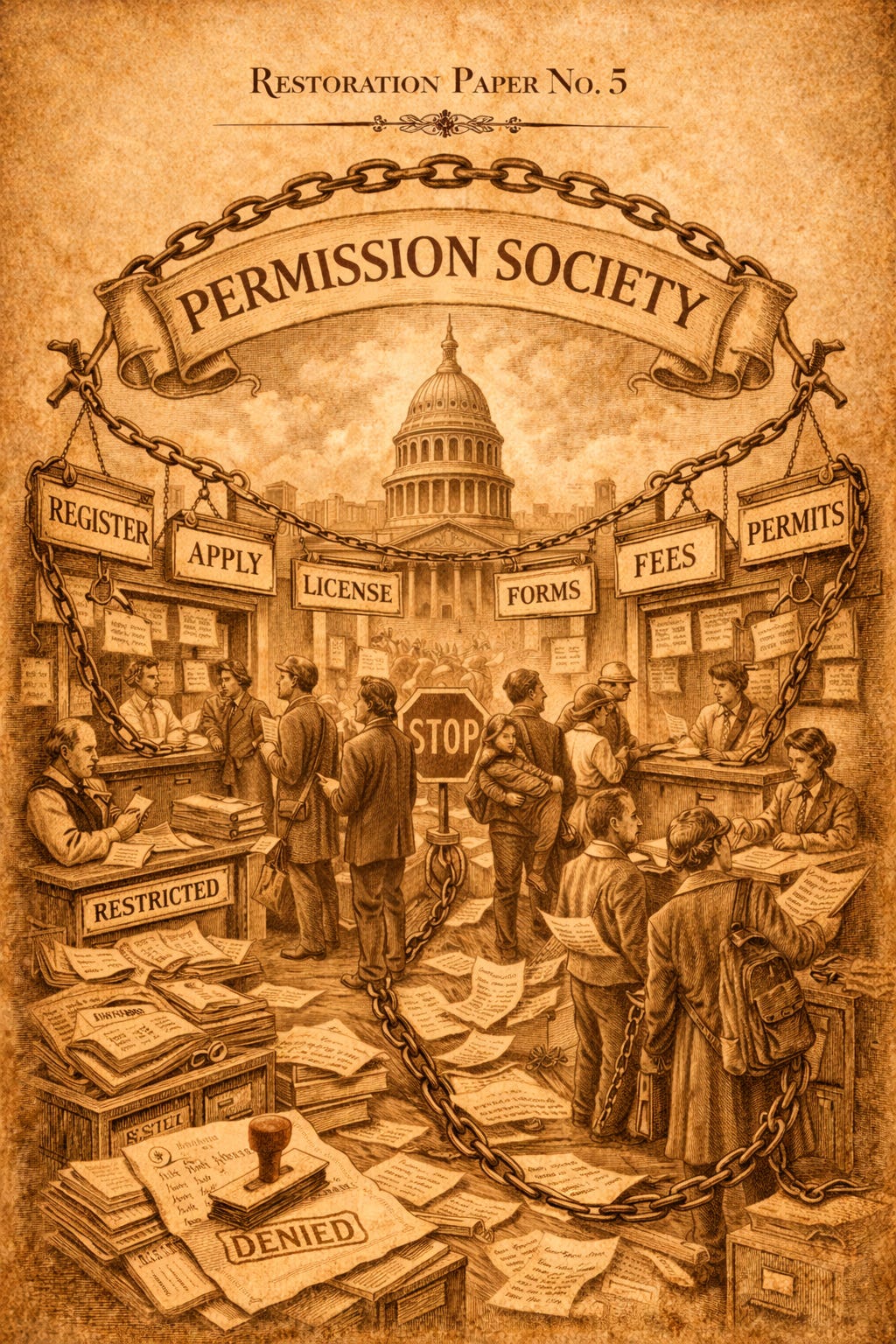
To My Fellow Americans,
Here in America, we are living through a quiet revolution that nobody voted for, yet it has fundamentally changed our way of life.
For most of our history, the default setting of our society was freedom of action, but today, it is conditional permission.
In today’s America, you don’t just act, you have to ask.
You do not build… without approval.
You do not work… without certification.
You do not open… without inspection.
You do not operate… without compliance.
And increasingly, the answer depends on someone else.
We have moved from a society that punishes actual harm to one that regulates potential risk into exhaustion.
The Original Assumption: Freedom First
The original assumption was very simple: You are free to act unless your actions violate someone else’s rights.
The government’s role was reactive – meaning it stepped in to address harm after it occurred. You didn’t need a license to practice a trade or a permit to use your own land; you simply held yourself accountable for the results.
This distinction is everything as it defines who holds authority first: The citizen…or the system.
Today, a new logic has taken hold: “What is not approved is not allowed.” This wasn’t a sudden takeover; it was a slow accumulation of “reasonable safeguards” that eventually reshaped the system itself.
When every sector of life, from occupational licensing to small business compliance, is conditioned on permits and approvals, the system holds more authority than the citizen.
The Rise of the Permission Structure
The “Permission Society” operates on a subtle shift in governance: the transition from a default of freedom to a default of conditional allowance. This structure emerged incrementally through a series of “reasonable safeguards” and administrative requirements that, over time, transformed exceptions into the standard operating procedure.
Today, this web of permission affects several core areas of daily life:
Labor: Occupational licensing requirements now govern a significant portion of the workforce, determining who may legally practice certain trades.
Property: Real estate development and home improvements are subject to extensive local zoning and permitting processes.
Commerce: Small businesses must navigate a complex landscape of local, state, and federal compliance regimes to remain operational.
Services: Personal trust is increasingly replaced by formal, third-party certifications and regulatory seals of approval.
While individual regulations are often introduced as solutions to specific problems, their cumulative effect creates a “regulatory thicket” so dense it often takes months or even years, in come cases, to navigate. This overlapping stack of mandates effectively shifts the burden of proof onto the citizen, requiring prior authorization for actions that were previously self-directed.
The Logic Behind It
“Those who would give up essential liberty, to purchase a little temporary safety, deserve neither liberty nor safety.” – Benjamin Franklin, 1755
Proponents of licensing and regulatory systems argue that these measures protect consumers, ensure quality, and reduce risk, particularly in complex or high-stakes industries. But when applied broadly across ordinary economic activity, this logic shifts the burden of action from the citizen to the system.
The “Permission Society” is rooted in the principle of preemptive harm prevention. While designed to enhance safety, this framework fundamentally alters the relationship between the individual and the state by shifting from a model of post-action accountability to one of prior authorization.
This shift introduces several systemic consequences:
Economic Stagnation: Innovation is constrained when new ideas require external approval before implementation, often leading to artificial scarcity and increased operational costs.
Centralized Control: Initiative is transferred from the individual to gatekeepers who determine the timing and conditions of allowed actions.
Risk Displacement: Rather than eliminating risk, these structures often consolidate it. The responsibility of the individual is replaced by the systemic fragility of a centralized regulatory body.
Ultimately, the trade-off is reduced individual autonomy. By making “permission” the default starting point, the system prioritizes administrative control over the personal initiative typically found in a self-directed society.
The Hidden Costs
The cost of this system is not just economic, it is structural.
1. Barriers to Entry: Today, nearly one in four Americans require a government license to do their job – an increase of more than 20% since the 1950’s. This means that a system once reserved for a narrow set of professions now governs a significant portion of the workforce. Starting a small business now can involve dozens of permits and regulatory steps, often taking months before operations can begin. This favors large corporations that can afford compliance teams, while crushing the individual entrepreneur.
2. The False Sense of Safety: The system promises to eliminate risk, but it actually just transfers it. It creates artificial scarcity and higher costs while slowing down our ability to adapt to new challenges.
3. Erosion of Initiative: When people have to ask for permission for everything, they eventually stop trying. The process itself becomes a deterrent to innovation.
From Citizen to Applicant
The most dangerous change is cultural. We are no longer treated as self-governing citizens; we are treated as applicants. We are conditioned to submit, wait, and be evaluated. Over time, this changes our behavior. We stop thinking, “I have the right to do this,” and start thinking, “I should probably check if I’m allowed.”
Restoration: Reversing the Default
“Still one thing more, fellow-citizens—a wise and frugal Government, which shall restrain men from injuring one another, shall leave them otherwise free to regulate their own pursuits of industry and improvement, and shall not take from the mouth of labor the bread it has earned.” - Thomas Jefferson’s first inaugural address, March 4, 1801.
To restore the balance, we don’t need to burn the rulebook, we need to flip it. We must reclaim the original American principle: Freedom first. Accountability second.
This is a battle for our default settings. We must replace the “must be approved” sign and with a simple truth: You are allowed to act unless you cause harm. We have traded the responsibility for our outcomes for the permission to begin and that is a losing trade. It is time to replace the gatekeeper with the open door.
The path back is clear:
Remove the pointless licenses that guard ordinary work.
Simplify the red tape that turns a simple permit into a year-long siege.
Protect the small operator from the compliance weight meant for giants.
Look for actual harm, rather than policing the mere ghost of potential risk.
We don’t need a system that pre-clears our lives; we need a society that trusts its citizens to build, then holds them to account if they break the peace.
The Core Question
Make no mistake: this isn’t a debate about paperwork. It is a battle for authority.
The question is as old as our nation itself: Who owns the right to your next move? Do you… or does the system?
The moment we accept that we must ask before we act, we have already lost. In that moment, freedom ceases to be a birthright and becomes a favor. It is no longer something you possess; it is something you are granted.
And what the state can grant, the state can take away.
Time For Choosing
The Permission Society didn’t arrive with a grand announcement; like everything else discussed in previous Restoration Papers, it quietly took root through a series of “reasonable” compromises. It was built incrementally, piece by piece, layered by systems originally designed to help us, until those very solutions began to reshape the boundaries of our daily lives.
The conversation is no longer about whether we need rules because most of us agree that we do. The real question is more fundamental: Has the act of seeking permission quietly become our new starting point?
We’ve reached a moment where we must reexamine the systems meant to serve us. It’s time to consider whether we are comfortable with a world where our default state is “waiting for approval,” or if we want to reclaim the personal initiative that defines a truly free society.
In Liberty,
Gary Mullins (Libertas)