

The Publius Project is a series of essays called Restoration Papers and other resources exploring liberty, citizenship and constitutional restoration of the American Republic.
To My Fellow Americans,
A free society is defined less by its laws than by the posture of its people. For most of our history, Americans understood themselves as participants – citizens who helped sustain, shape, and govern our nation.
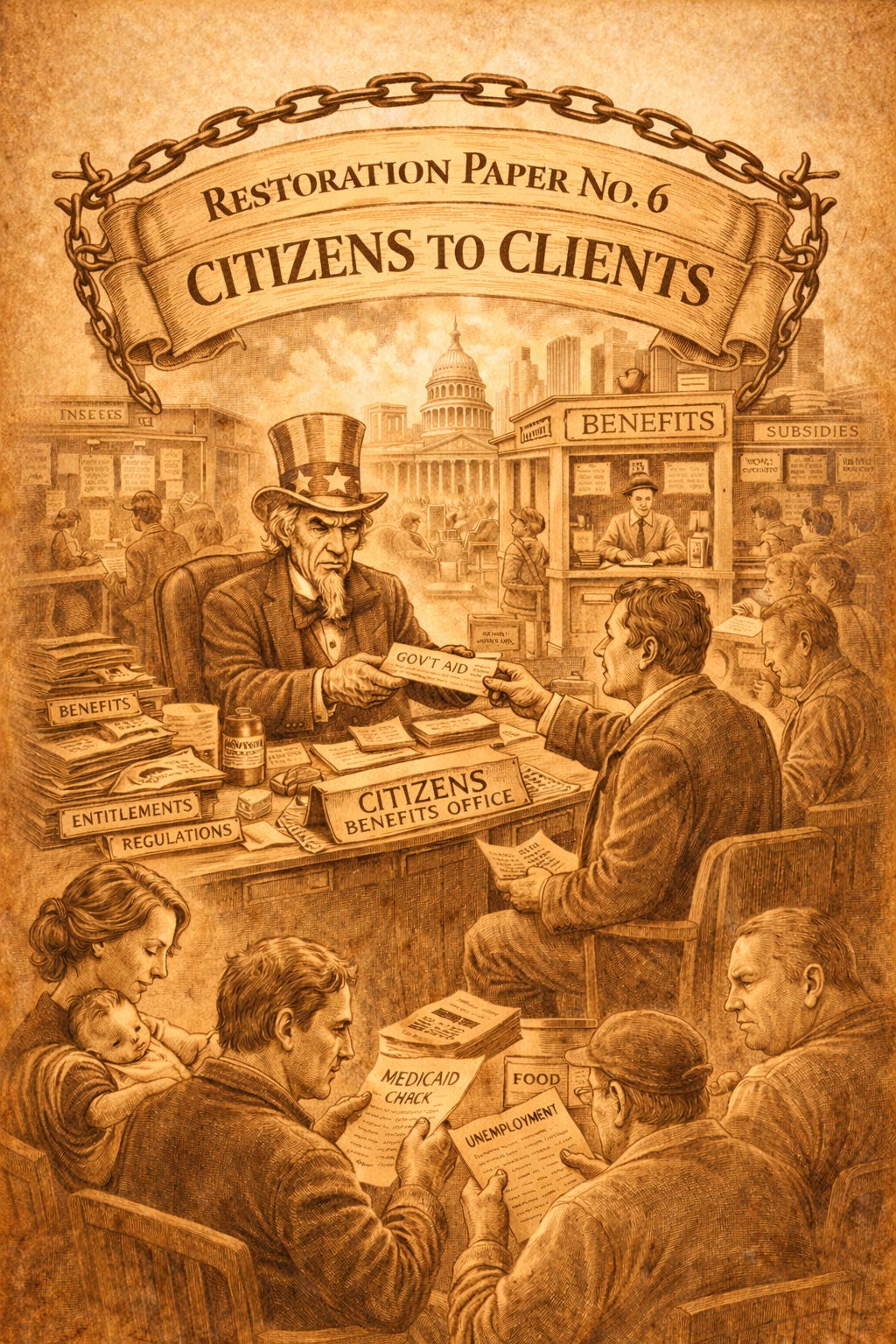
Today, that experience has fundamentally shifted. We no longer see ourselves as participants, but as clients. We have become clients of programs, agencies, and processes designed not to protect liberty, but to administer the growing complexities of daily life.
This transformation did not occur by a single declaration or a grand design; it accumulated through a thousand small decisions. Each layer of structure introduced in the name of stability, safety, or efficiency gradually redefined the relationship between the individual and the state.
The result is not simply a larger system… it is a different kind of society.
The Original Posture: The Citizen
The American system was built on a foundational assumption: that society would be composed of individuals capable of self-direction. Citizens were expected to provide for their own families, participate in local institutions, and take responsibility for solving problems within their own communities.
Government existed to secure the conditions in which this behavior could flourish… not to replace it.
As discussed in previous papers, authority was meant to begin with the individual and extend outward only as necessary. Samuel Adams captured this expectation clearly:
“The natural liberty of man is to be free from any superior power on Earth, and not to be under the will or legislative authority of man, but only to have the law of nature for his rule.”
This was not merely a philosophical ideal; it was a structural requirement for a self-governing republic.
The Gradual Transition
The movement from citizen to client did not begin as a sudden philosophical shift; but as a series of practical responses. A program to solve a problem. An agency to manage complexity. A safeguard to reduce risk. Each step, viewed on its own, appeared reasonable… and many were responses to real, justifiable challenges.
Yet, while complexity may justify coordination, it does not justify the permanent transfer of responsibility. Over time, these responses accumulated into a new operating model.
Problems once handled locally were elevated; responsibilities once carried by individuals were absorbed by institutions; and decisions once made through active participation were replaced by automated processes.
As governance gave way to management, and management expanded into administration, the citizen’s role was quietly redefined. This shift eventually became more than just a philosophical change… it became a measurable, structural reality.
The Scale of the Shift
What began as targeted intervention has grown into a defining feature of modern life. Today, nearly 71 million Americans are enrolled in Social Security, while Medicaid coverage extends to over 68 million individuals. When combined with other programs, roughly one in five Americans receive some form of government assistance at any given time.
The critique here is not of the existence of a safety net. A compassionate society provides for its most vulnerable and ensures a baseline of dignity for its elderly.
The concern is the transition from a “safety net” to a “default framework.” When a significant portion of the population begins to view these institutional systems as their primary source of security rather than a supplemental backstop, the relationship between the citizen and the state is fundamentally altered. We have moved from a system that catches those who fall to one that manages those who stand.
This shift is exacerbated by the erosion of the “contributory” model. Historically, Americans distinguished between social insurance… like Social Security and Medicare, which require a lifetime of “paying in”, and social assistance, or income security.
While the former was viewed as a collective savings account for the industrious, the latter has roughly doubled as a share of the economy since 1975. Programs like SNAP, housing assistance, and refundable tax credits are non-contributory; they are funded by general tax revenue and accessed based on current need rather than past participation.
When a system moves from rewarding participation to merely administering provision, the psychological tie to “earned” citizenship is severed. The individual is no longer a stakeholder in a mutual insurance pact; they are a client of a needs-based bureaucracy.
The scale of this transition is staggering. In 1975, total mandatory government spending (excluding interest on the national debt) accounted for roughly 8.5% of GDP; today, that figure exceeds 18%.
While these programs address real needs and prevent genuine hardship, support that stabilizes is not the same as a system that substitutes.
This is not merely growth; it is a rebalancing of responsibility that recalibrates our internal compass. We do not just change how we are funded; we change how we think. This is the final transition from the agency of the participant to the reliance of the client.
The Logic of the Client System
A citizen operates from a position of agency; a client is a subject who must comply. This distinction is not merely about whether systems are used, but whether they become the default framework through which individuals understand their role.
In a citizen-centered system, you act first and answer for the results. In a client-centered system, you apply, request, qualify, and receive.
It is vital to distinguish the client of the state from the customer of a business.
A customer holds the ultimate power: the power of exit. If a service is poor, the customer takes their resources elsewhere. A client of a state system, however, is often a captive.
There is no competitor to the agency, no alternative to the process, and no escape from the bureaucracy. While a customer is a sovereign actor who chooses, a client is a subject who complies. The former is served; the latter is managed.
This shift in civic posture mirrors the rise of the Permission Society, but with a critical psychological difference. While the Permission Society dictates what you are allowed to do through external rules, the Client System dictates how you view yourself within those rules.
If the Permission Society is a fence that stops you from moving, the Client System is a crutch that makes you forget how to walk. It replaces the citizen’s default question of “What can I do?” with the client’s default expectation: “What is available to me?”
The Cultural Consequences
This transformation is not merely administrative; it is behavioral. Alexis de Tocqueville warned of this exact pattern nearly two centuries ago, describing a power that “covers the surface of society with a network of small, complicated rules… until the most original minds and the most energetic characters cannot penetrate it.” Crucially, he noted that such a system “does not break wills, but it softens, bends, and directs them.”
The rise of the client mindset produces four primary effects that erode the foundation of a republic:
1. The Outsourcing of Responsibility
As systems expand, individuals increasingly defer decisions upward. A 2023 Pew Research survey revealed a striking paradox: a majority of Americans believe the federal government should do more to solve major problems, even as trust in that same government remains at historic lows. Dependence grows even as confidence declines. In this model, responsibility does not disappear – it simply relocates upward.
2. The Atrophy of Civic Muscle
Self-governance is a skill that weakens without use. As Robert Putnam documented in Bowling Alone, the collapse of community-based engagement has tracked closely with the rise of institutional reliance. A republic designed for the active exercise of citizenship cannot survive a population whose civic muscles have atrophied through disuse.
3. The Expectation of Provision
In a client system, outcomes are viewed as services to be delivered rather than results to be pursued. Milton Friedman captured the danger of this shift: “A society that puts equality before freedom will get neither. A society that puts freedom before equality will get a high degree of both.” When outcomes are guaranteed by a system, individual initiative becomes optional.
4. The Redefinition of Rights
Perhaps most significantly, the nature of rights is redefined. In a citizen framework, rights are inherent and exercised; in a client framework, benefits are accessed and administered. James Madison famously warned against this expansion of federal authority, noting, “I cannot undertake to lay my finger on that article of the Constitution which granted a right to Congress of expending… for the general welfare.” When rights become mere claims on a system, the state becomes the final arbiter of access.
The Cycle of Dependence
The transition from citizen to client was not a one-time event; it was a self-reinforcing cycle. As dependency increased, the demand for more expansive systems grew alongside it. In the process, individual accountability contracted and the inherent capacity for self-governance began to decline.
This erosion of civic agency then became the justification for further institutional expansion… creating a loop where what began as targeted support eventually became a permanent substitute.
The Cycle of Dependence:
1. Increased Dependency: Reliance on a system became the baseline.
2. Expanding Demand: As the baseline shifted, expectations for the system grew.
3. Contracting Accountability: Individual responsibility was deferred to the institution.
4. Declining Agency: The skills of self-governance weakened through disuse.
5. Justified Expansion: This weakened state invited further administrative management.
The Structural Reality
When viewed alongside the previous papers in this series, a clear and sobering pattern emerges. We have witnessed a systematic dismantling of the traditional American posture:
Governance became Management.
Management became Administration.
Action became conditioned on Permission.
The final stage of this evolution is the most personal: the Citizen has been reframed as a Client within the system itself. This is no longer just a shift in how our government functions; it is a shift in who we are.
The Core Question
Every system produces a specific type of person. The American system was designed to produce citizens… individuals of independent character and active agency.
We must now ask: What kind of person does our current system produce?
And more importantly: Can a society of clients sustain a republic designed for citizens?
Closing Reflection: The Choice of the Citizen
The transition from citizen to client was rarely enforced; it was accepted. It accumulated through a long series of quiet surrenders, where we chose to defer rather than to decide, to request rather than to act, and to rely rather than build.
While these choices probably seemed rational for us as individuals in the moment, their collective weight has reshaped the character of our nation.
Our republic does not require perfect citizens, but it does require active ones.
The Publius Project was founded to restore our republic, but the work of restoration does not begin in the halls of Washington. It begins in the mirror. If the Client System thrives on our passivity, it can only be dismantled by our participation. We must stop asking, “What is available to me?” and start asking, “What is required of me?”
In the coming papers, I will move from diagnosis to action, outlining the structural reforms necessary to transition from a managed society back to a self-governing one.
Yet, these reforms can only succeed if they are met by a people ready to inhabit them… citizens who would rather bear the weight of their own responsibilities than the hollow comfort of a bureaucrat’s crutch.
The Restoration starts with the decision to be a participant once more.
Time for Reconsideration
Thomas Jefferson’s warning now feels less like theory and more like a diagnosis: “The natural progress of things is for liberty to yield, and government to gain ground.”
The question is no longer whether these systems will grow because they have – and they will continue to. The question is whether we as American citizens will shrink alongside them.
Structural reform alone cannot restore a free society; it requires a cultural turn back toward ownership, participation, and self-direction.
Ultimately, a system reflects the posture of its people. A society that views itself as dependent will inevitably build systems that reinforce that dependency.
To the Founders, a “safety net” was a trampoline… a temporary tool designed to bounce the citizen back into the arena of life. Today, we have replaced the trampoline with a hammock, and we should not be surprised that so many of us have fallen asleep in it.
In Liberty,
Gary Mullins (Libertas)