

The Publius Project is a series of essays called Restoration Papers and other resources exploring liberty, citizenship and the constitutional restoration of the American Republic.
To My Fellow Americans,
If you have read the previous Restoration Papers, you may notice a pattern. A familiar refrain:
- No vote.
- No amendment.
- No clear moment of choice.
This is not accidental; it is a clinical observation of a system in drift. Because the transformation we are examining did not occur through a single act – one that could be easily identified or resisted – it unfolded through the quiet normalization of administrative power.
And so, the language must repeat. Not for emphasis alone, but for recognition. Repetition is how the mind sees the scaffolding of the “Expert Class” where it once saw only “neutral management.” These phrases are meant to stay with you because the most significant changes to a system of self-government rarely announce themselves – they simply settle in until they feel so normal, you never give them a second thought.
I. Introduction: The Quiet Transfer of Authority
There was no vote. No amendment. No formal declaration. And yet, a profound transformation has occurred: authority – once rooted in the judgment of the citizen – has steadily migrated to a class of credentialed experts.
Decisions that were once debated in the town square and the legislative hall are now issued through regulatory guidance, technical memoranda, and institutional consensus. We have witnessed a linguistic sleight of hand. We no longer speak of “Law,” but of “Policy”; not of “Representation,” but of “Management.”
As an example, we see this today in the rise of the “White House Czar” - positions like the Border Czar, Drug Czar, or AI Czar. These appointees wield power comparable to cabinet secretaries yet bypass the constitutional “advice and consent” of the Senate. They do not answer to the people’s representatives; they answer only to the Executive, moving the levers of national policy through “coordination” and “oversight” that the public can neither check nor balance.
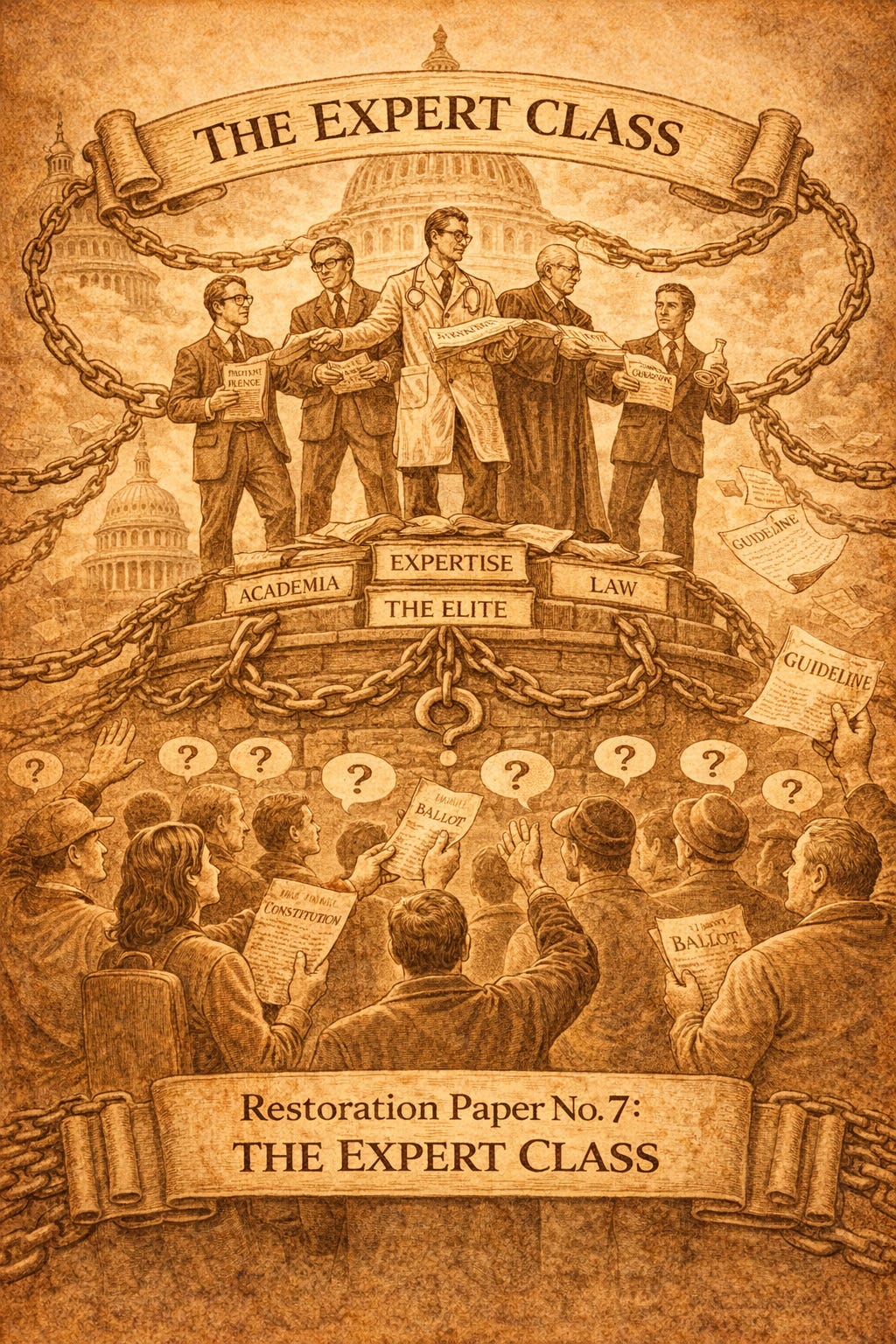
This is not the sudden abolition of democracy; it is something more subtle, and therefore more difficult to extract. It is the rise of the Expert Class – a system that replaces the messy, accountable judgment of the people with the quiet, insulated administration of the specialist.
II. The Founders’ Design: A Republic of Citizens, Not Specialists
The American system was not built on the assumption that citizens would be experts; it was built on the conviction that they did not need to be.
As Thomas Jefferson warned, the moment we are directed from a central authority on the basic tasks of life – when to sow and when to reap – we “should soon want bread”.
Jefferson did not argue against the existence of specialized knowledge, but he vehemently argued against its rule. He understood that the only “safe depository” of power is the people themselves. This reveals a fundamental truth of the Founders’ design: a free society does not require perfect decision-making; it requires accountable decision-making.
When authority migrates to those who cannot be meaningfully checked, corrected, or removed by the ballot, the Republic does not just change its methods, it begins to lose its soul.
III. The Justification: Complexity as a Gateway to Control
The rise of the expert class was not a sudden seizure of power either. It was justified – often persuasively – on the grounds of necessity. Modern life is undeniably complex: healthcare, financial markets, and environmental science require specialized skill and long-term planning.
From this complexity, a dangerous argument formed: The public cannot understand these issues. Therefore, experts must decide. At first glance, this appears to be a practical response to a technical world.
But embedded within it is a fundamental betrayal of the Republic. It marks the shift from experts advising the public to experts replacing them. When we allow complexity to serve as a gateway to control, we trade the judgment of the citizen for the management of the specialist – and in doing so, we forget that while experts can provide the data, only the people can provide the consent.
Consider the role of the White House AI Czar for example. The argument is familiar: “AI is too technical for the average voter or even the average Congressman to grasp.” Under the banner of managing this complexity, a single unconfirmed advisor can shape the federal framework for the most transformative technology of our era, effectively deciding the rules of the digital road while the citizen is told to simply “trust the process.”
IV. The Mechanism: From Representation to Administration
The expert class does not govern through elections; it governs through institutions. By operating within the autonomy of agencies, boards, and commissions, it has created a parallel system of authority that is insulated from direct voter control.
While this power is often described as “delegated” by the legislature, its practice is far more expansive. These bodies now function as a closed loop: they draft the rules, interpret their meaning, enforce compliance, and adjudicate disputes within their own internal frameworks.
This consolidation represents the exact “accumulation of all powers” that James Madison warned was the “very definition of tyranny.”
The traditional structure of our Republic has not collapsed, but it has been fundamentally reconfigured – replacing a system of checks and balances with one of administrative command.
This parallel system is perfected by the White House Chief of Staff and Deputy Chiefs of Staff. These appointees operate the ‘closed loop’ of the administrative state from within the West Wing. They determine which data reaches the President and which policies are prioritized, acting as the ultimate architects of the “Policy” that has replaced “Law.” They are the engineers of the machinery, yet they remain entirely insulated from the ballot box.
V. The Cultural Shift: Deference Over Judgment
Beyond the structural changes lies a more profound cultural shift: the conditioning of the citizen to defer rather than judge. Modern life is now punctuated by slogans that demand submission: “Trust the experts,” “Follow the science,” and “The data is settled.”
These phrases carry a heavy, implicit message: Your judgment is insufficient.
This is not an argument against the value of expertise; it is an argument against unquestioned authority. True expertise seeks to inform and illuminate. However, when expertise is stripped of accountability and used to bypass public debate, it ceases to be a resource and becomes a form of power. In this shift, the citizen is no longer an active participant in a Republic, but a passive recipient of institutional decrees.
VI. Modern Examples: When Expertise Becomes Policy
We can observe this shift across multiple domains, each following a predictable pattern: Complex issue → Expert authority → Reduced public input → Expanded institutional control.
1. Public Health Policy: During times of crisis, agencies like the CDC issued ‘guidelines’ that effectively functioned as mandates – altering the operations of businesses and schools without direct legislative approval or meaningful public debate.
2. Monetary Policy: The Federal Reserve wields immense power over interest rates and the money supply. These decisions shape the economic life of every American, yet its leadership remains insulated from direct electoral accountability.
3. Regulatory Expansion: Agencies such as the EPA establish complex rules that carry civil and even criminal penalties. By doing so, they effectively create law through regulation, bypassing the transparent process of legislation.
4. Enforcement by Decree: The role of the “Border Czar” demonstrates how enforcement priorities are shifted without legislative debate. By coordinating multiple agencies (Immigration and Customs Enforcement and Customs and Border Protection) under a single, unconfirmed lead, the administration can execute mass operations that fundamentally alter the social and economic fabric of communities, bypassing the transparent process of Congressional authorization.
In each instance, the result is the same: the technical complexity of the issue is used to justify the removal of the decision from the hands of the people.
VII. The Consequence: The Erosion of Self-Governance
A system cannot simultaneously expand the reach of the expert class and maintain the sovereignty of the citizens. Eventually, that tension resolves – and it does so not through a sudden rebellion, but through a slow, quiet resignation.
When the fundamental levers of society are moved behind a veil of technical complexity, citizens begin to see governance as something done to them, rather than by them. They become spectators in their own Republic.
In this shift, we see the transformation explored in our previous paper: the citizen is demoted to a client. The client does not participate; they receive. The client does not judge; they consume. And in that transition from active participant to passive recipient, the very foundation of self-governance erodes.
VIII. The Counterargument: Expertise Is Necessary
To restore the proper balance, we must acknowledge a fundamental truth: Expertise is not the enemy. No modern society can navigate the complexities of the 21st century without specialized knowledge.
However, the question is not whether experts should exist – it is whether they should rule. There is a profound difference between informing a decision and making it. The former strengthens a republic by providing the people with the best possible data to exercise their judgment; the latter replaces the republic by removing the people from the process entirely.
In a healthy system, the expert is a servant of the public interest, not the master of the public’s will.
IX. The Restoration Principle: Authority Must Remain Accountable
The corrective to the rise of the technocracy is not radical; it is foundational. Expertise must be returned to its proper role: it must be advisory, not authoritative. This restoration requires four essential shifts:
1. Reasserting Legislative Responsibility: Elected representatives must reclaim the duty of lawmaking, ending the practice of delegating their constitutional power to unelected agencies. Restoration requires an end to “Shadow Cabinets.” If a position exercises the authority of a high officer – directing agencies, shaping national standards, or overseeing enforcement – that position must be subject to Senate confirmation and public testimony. We must stop allowing the “Czar” model to shield the exercise of power from the light of accountability.
2. Limiting Administrative Scope: Agencies should be restricted to executing clearly defined laws – they must not be permitted to create them.
3. Restoring Transparency: Any decision affecting the public must be presented in a way that is understandable to the public, stripping away the “complexity” used to shield authority.
4. Rebuilding Civic Confidence: We must encourage, not dismiss, the exercise of citizen judgment.
Self-government is not sustained by perfect knowledge; it is sustained by active participation.
X. Conclusion: The Choice Before Us
The rise of the expert class was not the result of a hidden conspiracy; it was a response to the overwhelming scale and complexity of modernity. But in our attempt to manage the challenges of a technical age, we have inadvertently created a system where authority is exercised by those the public can no longer meaningfully direct.
We must remember that the Founders did not design a nation of specialists; they designed a nation of citizens. That distinction is the bedrock of our liberty.
As we look toward restoration, the question is no longer whether experts are necessary – we know that they are. The only question that remains is the one upon which the entire American experiment rests:
Who governs?
In Liberty,
Gary Mullins (Libertas)