

The Publius Project is a series of essays called Restoration Papers and other resources exploring liberty, citizenship and the constitutional restoration of the American Republic.
To My Fellow Americans,
The eight papers before this one all circled the same question: does the American government still work the way it was designed to? I looked at representation, how incentives get twisted, the role of expertise, and why the average citizen feels so far removed from the people and institutions that are supposed to serve them.
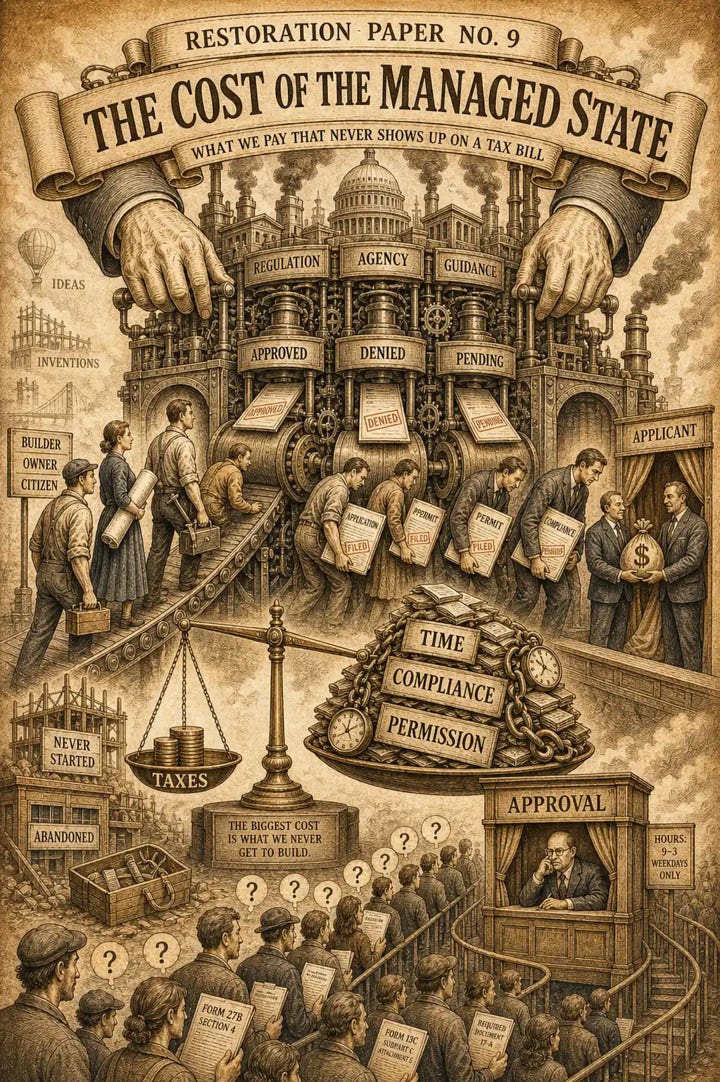
This final paper in Phase I pulls all of that together. When we look at the problems one at a time; a permit that takes six months, a form only a lawyer can fill out, a rule buried in a memo nobody voted on, they each seem like minor annoyances. But when we step back and look at the whole picture, a pattern shows up.
What has been built around our republic is not the republic itself. It is a thick layer of administrative machinery; rules, agencies, processes, and paperwork, that has grown so large it now hides the actual government underneath.
This paper names that pattern, explains what it costs us, and points toward what we can do about it.
I. Introduction: The Price We Rarely Count
Every government cost money. We all know about taxes. But there is another kind of cost that never shows up on our tax returns… one that is harder to see and, in some ways, harder to bear.
Think about the last time you dealt with a government form, a permit, a license, or a regulatory requirement. Think about how long it took, how confusing it was, and how much it cost you in time, money, or sheer frustration. Now imagine that same experience playing out for every small business owner, every farmer, every contractor, every parent trying to start a daycare. That friction, multiplied millions of times across the country, is what I’m calling the cost of the managed state.
Some level of administration is necessary. A modern country of 330 million people needs rules. The problem is not that rules exist. The problem is what happens when the rules take over, when navigating the system becomes more important than the work itself, and when the people who make the rules are not the people you elected.
When government stops being about following clear laws and starts being about managing your way through a maze of agencies and approvals, something important changes. This paper argues that what changes is the very idea of citizenship. And the cost of that change is economic, legal, and deeply personal.
II. The Big Shift: From Laws to Management
The Founders had a straightforward design. Citizens elect representatives. Representatives write laws. The executive branch carries out those laws. The courts settle disputes. Everyone can see who is responsible for what. If we do not like a law, we vote out the people who passed it.
“The accumulation of all powers… in the same hands… may justly be pronounced the very definition of tyranny.” — James Madison, Federalist No. 47
Over the past century, that clean design has gotten blurry. Congress still passes laws, but those laws are often written in broad strokes, frameworks that leave all the real details to be filled in by federal agencies. This is where the shift happened.
Those agencies do not just carry out the law. In many cases, they write the specific rules, investigate whether you broke them, and then hold the hearings to decide your punishment. In other words, they act as the lawmaker, the police officer, and the judge… all at once. Madison called that arrangement tyranny. We have just grown so used to it that we stopped noticing.
It gets more complicated. A lot of what actually governs our daily lives is not in any official law. It lives in memos, guidance documents, agency FAQs, and policy letters. Technically, these are not laws. But if we ignore them, we risk fines, audits, and enforcement actions. So, they function as laws, they just were never voted on by anyone.
The result is a system of government that is very hard to challenge, very expensive to navigate, and nearly impossible to understand without hiring a professional. That is the foundation on which every other cost we are about to discuss is built.
III. The Three Costs We Are All Paying
1. The Economic Cost: A Tax on Getting Started
Imagine you want to open a small restaurant. Before you serve a single meal, you need a business license, a health permit, a fire inspection, a zoning approval, and possibly a liquor license. Each one involves paperwork, fees, waiting periods, and inspections. By the time you get through all of it, you have spent thousands of dollars and months of your life… and you have not sold a single plate of food yet.
That is the economic cost of the managed state. It is not just a tax on what you earn; it is a tax on the act of trying. And it does not fall equally on everyone. A large corporation has an entire legal and compliance department to handle all of this. A person starting a small business out of their garage does not. The rules end up protecting big, established companies from new competition, because the cost of entry is too high for the little guy to climb over.
Federal estimates suggest Americans spend over nine billion hours a year on government paperwork. Think about what that number means. Nine billion hours is not just time wasted. It represents engineers who could have been inventing, teachers who could have been teaching, and small business owners who could have been growing. The biggest cost is not what we pay… it is what we never get to build because the barrier was too high.
2. The Legal Cost: Nobody Can Read the Rulebook
In a fair legal system, a regular person should be able to understand the rules they are expected to follow. That used to be the standard. It is not anymore.
Today, the actual rules that govern our businesses, our property, our professions, or our families are often buried in agency guidance documents, interpretive memos, and pages of administrative code that experts spend careers trying to understand. This is not an accident… it is what happens when you hand broad authority to agencies and let them fill in the details forever.
The burden of proof has also shifted in a troubling way. In our legal tradition, the government is supposed to prove that we did something wrong. Under the managed state, we are increasingly expected to prove, constantly, with documentation and certification, that we are doing everything right. We are guilty until proven compliant.
When the law becomes so complicated that we need to hire a specialist just to stay out of trouble, the law is no longer protecting us. It is managing us. The citizen is no longer standing on clear legal ground, we are walking on a shifting surface of administrative rules that can change without a vote.
3. The Civil Cost: From Sovereign Citizen to Applicant
This is the cost that matters most, because it changes who we are as a people.
In a free country, the starting assumption is simple: we can do what we want unless a law says otherwise. That is the presumption of liberty. Under the managed state, that presumption has quietly flipped. Now the starting assumption is: we may not act until a system has approved us. We need a license to work. A permit to build. A certification to practice. An application to participate.
The difference between a citizen and an applicant is not just a word choice. A citizen asserts a right. An applicant requests a privilege. Over time, being treated as an applicant changes how people think and act. We hesitate before starting something new. We look to the government for permission before exercising our own judgment. We stop trusting that our instincts and initiative are enough.
It also creates a quiet divide. Some people have the money, the connections, and the know-how to “work the system.” Everyone else gets worked by it. That divide is not fair, and it is not accidental.
“The natural progress of things is for liberty to yield, and government to gain ground.” - Thomas Jefferson
IV. The Pattern Underneath: Permission Has Replaced Liberty
When we look at these three costs together, we start to see the same thread running through all of them: somewhere along the way, America shifted from a culture built on liberty to a culture built on permission.
The old American idea was that we are free to act, build, and take risks on our own judgment unless a specific law tells us otherwise. The new operating assumption is the reverse: we wait for approval before we do anything significant. We file, we wait, we comply, we certify, and then… maybe… we are allowed to proceed.
This shift has changed the national character in a way that is hard to put your finger on but easy to feel. It has made us a nation of navigators instead of builders. People spend their energy learning how to get through the system instead of learning how to create something new. The most important question is no longer “What can I build?” It is “What am I allowed to do?”
That inversion, the individual asking permission from the state rather than the state asking justification from the individual, is the invisible cost running through every single administrative burden we have discussed. It is not just a policy problem. It is a problem of national identity.
V. What Can We Do About It
If the primary cost of the managed state is the loss of clarity and citizenship, then the solution must focus on restoring the “burden of proof” to the government. This requires a three-part approach focused on legal reform, structural simplification, and a renewal of civic habits.
1. Legal Accountability: Make Elected Officials Own the Rules
The most direct fix is also the most obvious: if a rule is going to have the force of law, it should be voted on by the people we elected. Right now, Congress passes broad laws and agencies fill in the details however they choose, with very little public input or accountability.
The solution is to require Congress to actually vote on major agency rules before they take effect. This is not a radical idea. It just means that if a regulation is important enough to enforce, it is important enough for your representative to take a public stand on it. That restores the chain of accountability the Founders designed.
Courts should also stop automatically siding with government agencies when a law is unclear. If the rules are confusing, the benefit of the doubt should go to the citizen, not the bureaucracy.
2. Structural Simplification: Clearing Out the Overgrowth
Regulations accumulate. Once a rule is written, it almost never goes away, even when it has outlived its purpose or when new rules have made it redundant or obsolete. The result is a massive tangle of overlapping requirements that even experts cannot keep straight.
Two simple tools can help fix this. First, sunset clauses: regulations automatically expire after a set period unless they are specifically reviewed and renewed. This forces the government to regularly ask whether a rule is still actually needed. Second, a regulatory budget: for every new rule an agency creates, it has to remove an old one. This creates a real incentive to prioritize what matters instead of just piling on more.
3. Civic Restoration: Rebuild the Habit of Self-Government
The deepest change has to happen in how we see ourselves. For decades, the managed state has trained Americans to look upward to institutions for answers, permission, and solutions. That habit is hard to break, but it can be broken.
Communities, families, churches, local businesses, and civic organizations have always been the real engines of American life. The goal is not to get a better manager. It is to need fewer managers. That means solving problems at the local level when possible, relying on community and voluntary cooperation, and reclaiming the confidence that ordinary people are capable of running their own lives.
The republic was not built on experts managing a passive population. It was built on citizens who believed they were capable of governing themselves and acted accordingly.
VI. Addressing the Counter-Argument: “But We Need Experts”
The most common pushback to everything in this paper goes something like this: “Sure, the Founders’ system was fine for a small farming country in 1787. But modern life is complicated. We have global financial markets, new diseases, advanced technology, and threats the Founders could not have imagined. We need professional experts running these agencies, because senators and representatives simply do not have the technical knowledge to manage all of it.”
That argument sounds reasonable. But it gets the question wrong.
Nothing in this paper argues that we do not need experts. Of course we do. The question is whether those experts should be unaccountable. There is a big difference between an expert who advises elected representatives and an expert who replaces them. We can absolutely benefit from specialized knowledge without giving that knowledge the power to write and enforce its own laws without a vote.
There is also something worth noting about where a lot of the complexity actually comes from. Much of the difficulty in modern American life is not created by the world being complicated… it is created by the administrative state itself. Thousands of pages of conflicting rules, overlapping jurisdictions, and changing guidance documents generate confusion that then requires more experts to manage. In other words, the system creates the problem it claims to be solving.
The goal is not to kick out all expertise. The goal is to make sure that expertise serves the public rather than rules over it.
VIII. Conclusion: The Price of Being Managed
The cost of the managed state is not a line item you can find in any budget. It is something more fundamental: a gradual shift in the American civic condition.
We pay it in economic stagnation – nine billion hours of paperwork, barriers that protect big incumbents and shut out new competitors, and a nation that innovates less than it should because the cost of trying is too high.
We pay it in legal uncertainty – a world where the rules change without votes, where compliance is assumed guilty until proven innocent, and where only professionals can navigate what used to be common-sense law.
But the price that matters most is the one paid by the individual citizen. The managed state asks us to trade the mindset of authors, people who take initiative and build something, for the mindset of applicants, people who wait for the system to approve them. That is not just a policy failure. It is a failure of national character.
The good news is that none of this is permanent. These are not forces of nature. They are choices… choices made by people over generations, and choices that can be reversed by people in future generations. By reclaiming the lawmaking power for elected officials, by clearing out the regulatory overgrowth, and by rediscovering the habits of local self-government, we can start to lower the price of being managed.
The most tragic entries in the ledger of modern government are the invisible ones: the businesses never started, the inventions never built, the risks never taken. The blank pages are the ones that matter most. And we get to decide whether those pages stay blank, or whether we finally start writing on them again.
“A government big enough to give you everything you want is strong enough to take everything you have.”
— Thomas Jefferson
Epilogue: From Diagnosis to Design
Everything in the first nine papers has been a diagnosis. I have tried to name the problem clearly: a government that drifted from a republic of laws into a system of managed processes, and a citizenry that drifted along with it… trading the identity of self-governing people for the identity of compliance-managing applicants.
But a diagnosis, on its own, does not cure anything. It just tells us what is wrong. The harder and more important work is figuring out what to build in its place.
The Limitations of Reform
It is tempting, when faced with problems this large, to look for quick patches. Simplify a form. Replace the officials in charge. Make the process a little more efficient. But if the diagnosis is right, those patches miss the point entirely. You cannot restore a republic by making the machinery that replaced it run a little smoother. The managed state is not a broken version of the Founders’ design. It is a different design.
That means the solution cannot just be reform. It must be restoration… a return to the first principles that made self-government work in the first place.
Phase II: The Founders’ Framework
The next phase of the Restoration Papers shifts from diagnosing the problem to understanding the original design. Before we can rebuild, we need to understand what was actually built, not just as a set of historical documents, but as a working system of ideas about human nature, power, and liberty.
I begin that work in Paper No. 10: The Founders’ Operating System. This paper will look at why the Founders chose to limit power rather than concentrate it, and why they trusted the responsibility of the citizen over the management of the expert. The managed state did not happen because the original design failed. It happened because we gradually stopped believing in the ideas that made the design work.
Phase II begins by recovering those ideas.
In Liberty,
Gary Mullins (Libertas)