

Phase I of the Restoration Papers was a diagnosis.
I traced the growth of the administrative state, the erosion of local control, the collapse of institutional trust, and the expansion of a bureaucracy that feels increasingly unresponsive to the people it serves.
But diagnosis only revealed what is broken. It doesn’t explain the original design.
That is the purpose of Phase II: The Founders’ Framework.
This is not an exercise in blind nostalgia or an attempt to “recreate 1787.” It’s about recovering the architecture of the American system before it’s buried for good under generations of centralization and political drift.
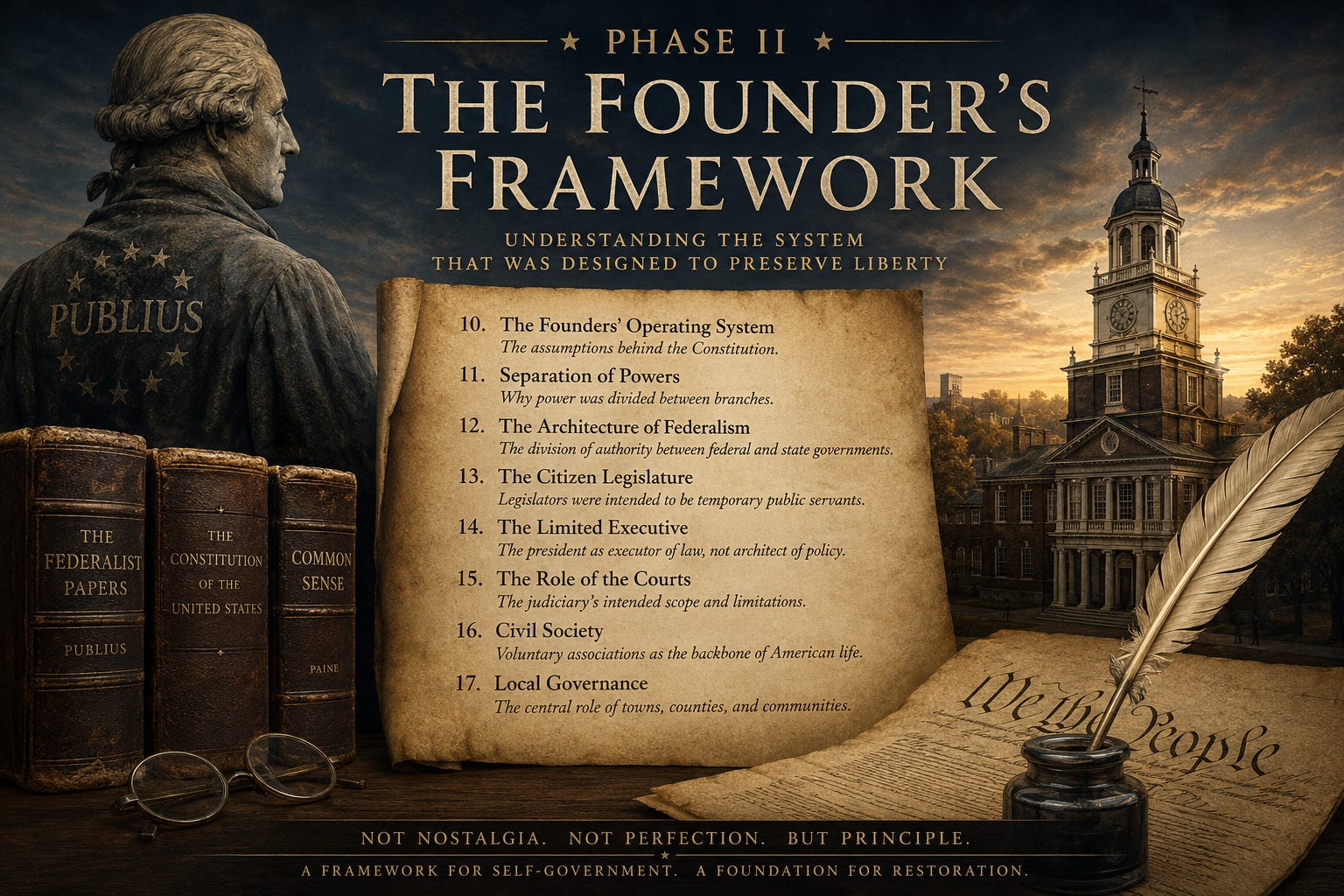
The Design Logic
Most Americans are taught what the Constitution says; far fewer are taught why is says it. The Founders didn’t accidentally divide power or limit government. Those choices were intentional responses to a specific understanding of human nature and the inherent dangers of authority.
The Central Question of Phase II
What kind of system is necessary to preserve liberty over time?
The Constitution was never just a legal document. It was a framework built on a set of core assumptions:
· Human nature is flawed: Power must be checked, not just entrusted.
Power naturally expands: It will fill every available vacuum unless resisted.
Centralization is self-protecting: Distance from people breeds detachment.
Liberty requires responsibility: Self-government is a muscle, not a given.
Whether someone agrees with every aspect of the founding era or not, these assumptions matter. Modern America has drifted far from many of them.
And you cannot restore balance to a system you do not understand.
The Roadmap: Phase II Restoration Papers
No. 10 | The Founders’ Operating System
The Philosophy Behind the Institutions
We’ll start with the foundation: the Founders’ views on human nature, virtue, and the deep-seeded distrust of centralized authority.
No. 11 | Separation of Powers
Efficiency is Not the Goal.
We’ll cover why the system was intentionally designed to slow itself down to prevent the concentration of power.
No. 12 | The Architecture of Federalism
The Division of Authority.
We’ll examine the original balance between federal and state power and how “management from a distance” changed our relationship with government.
No. 13 | The Citizen Legislature
Public Service vs. Political Class.
We’ll explore the evolution of Congress from a temporary duty into a permanent, professionalized institution.
No. 14 | The Limited Executive
Executor, Not Architect.
This will be a look at how the modern presidency has expanded far beyond its intended role as an administrator of law.
No. 15 | The Role of the Courts
Interpretation vs. Legislation.
We’ll cover why the judiciary was never meant to function as a “continuing constitutional convention.”
No. 16 | Civil Society
The Backbone of the Republic.
This will address why healthy societies depend on families, churches, and local associations – and what happens when government attempts to fill the vacuum they leave behind.
No. 17 | Local Governance
The Scale of Self-Government.
This paper will highlight why liberty is most fragile when decision-making is moved far away from the communities it affects.
Why This Matters Now
Many Americans sense that the system is fundamentally “off” – not just because of who is in power, but because of how the power itself is structured. People feel managed rather than represented.
Phase II is an attempt to revisit the original framework – not as a museum piece, but as a manual. Before we can reform our institutions, we must remember what they were built to do.
The Restoration Papers are not about left versus right. They are about a singular, urgent question:
Do free people still possess the will to govern themselves?
In Liberty,
Gary Mullins (Libertas)