

Preface
If Restoration Paper No. 8 exposes the illusion of representation, this companion essay reveals the machinery behind it… showing how campaign finance and incentive structures quietly redirect power away from the voter and into the system itself.
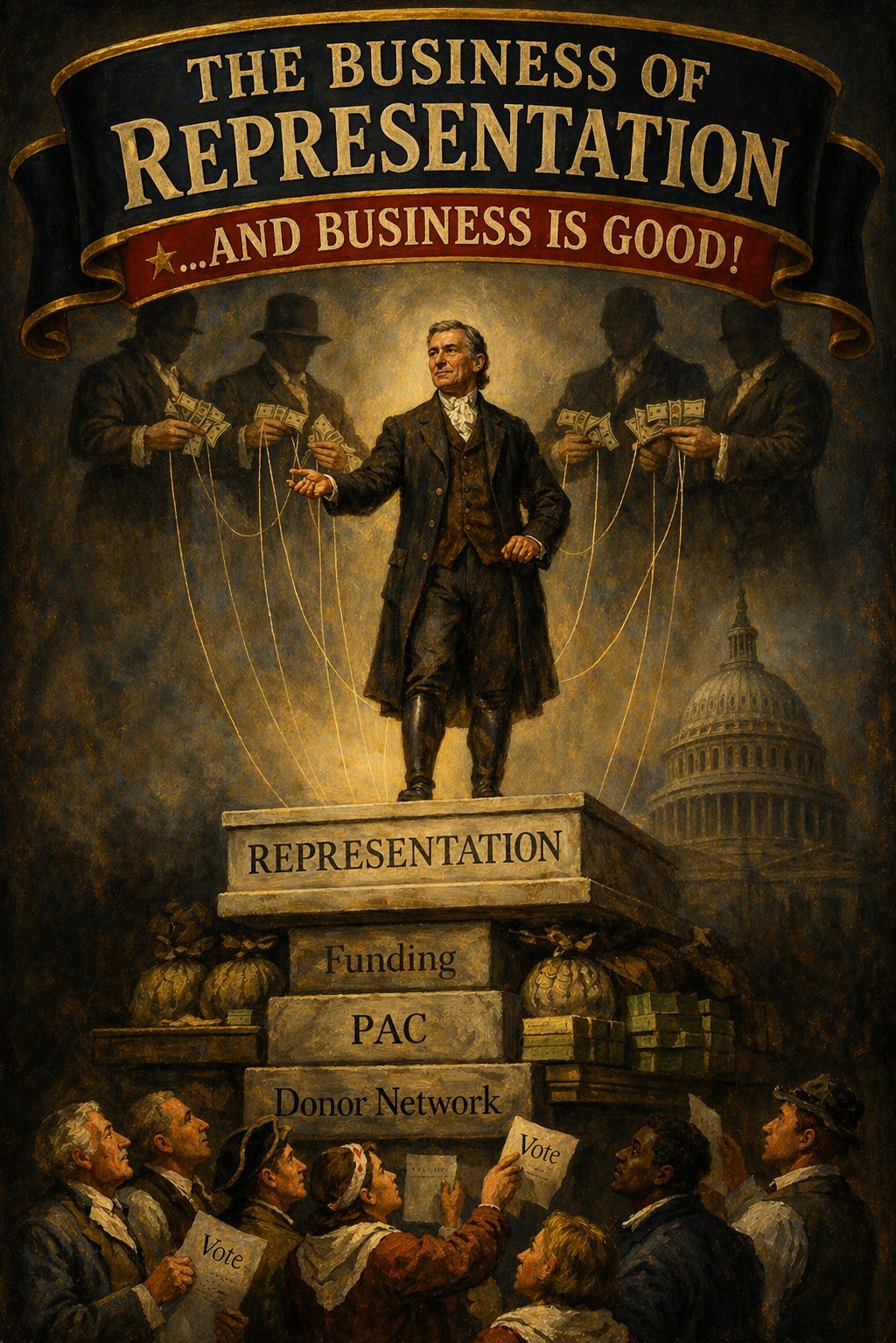
I. The Promise and the Fracture
The American republic was built on a simple, durable promise: those who make the laws should answer to the people who live under them.
In theory, representation wasn’t just a formality; it was a leash. It was designed to ensure that political power flowed upward from your kitchen table to the halls of Congress. The process was supposed to be a straight line:
The citizen votes.
The representative listens.
The policy changes.
For a time, that line stayed relatively straight. But today, we are living through a quiet crisis. While the “theater” of our democracy remains—the yard signs, the TV ads, and the voting booths—the engine under the hood has been swapped out.
The forces that decide who wins and what laws pass now operate in the shadows, long before you ever receive a ballot. To understand why Congress feels so disconnected from you, we have to look past the speeches and at the “pre-election.”
We have to talk about the Wealth Primary: a system where your “representative” is forced to spend more time auditioning for wealthy donors than talking to their own neighbors. In modern Washington, the most important “ballot” isn’t cast on Tuesday in November—it’s cast every time a donor signs a check.
II. The Wealth Primary
Before a candidate can represent you, they must first survive a gauntlet that has nothing to do with your needs. This is the “Wealth Primary”—an unofficial, high-stakes competition where viability is measured in dollars, not ideas.
Before you ever see a candidate’s name on a ballot, they must be “cleared” by donor networks and Political Action Committees (PACs). If the big-money “bundlers”—the people who collect checks from the ultra-wealthy—don’t believe a candidate can “hit their numbers,” that candidate is often dismissed by the media and the party before the public ever hears their name.
The “entry fee” for our democracy has skyrocketed:
The House: If you wanted to run to represent your neighbors today, you would likely need at least $2 million just to be taken seriously.
The Senate: That price tag jumps into the tens of millions. In the 2024 cycle, high-profile Senate races in states like Ohio and Pennsylvania saw total spending exceed $400 million and $300 million respectively.
This financial escalation has fundamentally changed what it means to be a representative. Running for office is no longer primarily an act of persuasion; it is an act of capital acquisition.
The result? Our leaders are no longer chosen for their plans for the community, but for their ability to serve as a fundraising engine. If a talented, competent citizen cannot acquire this massive amount of capital, they simply never reach the starting line. In this system, the “best and brightest” are replaced by the “best at asking for money.”
III. The Outsourcing of Representation
In the Founders’ original design, a representative’s survival was simple: Stay loyal to your neighbors, or they will fire you.
But today’s campaign finance system has quietly severed that cord. A House member from Kansas or a Senator from Ohio no longer relies solely on the people they represent. Instead, they are sustained by a vast, national “ATM” of wealthy donors and interest groups.
Recent data from the 2024 election cycle highlights a startling trend:
The “Out-of-District” Majority: In many high-profile races, over 80% of campaign funding comes from donors who live outside the state or district. In fact, some party leaders raise over 95% of their funds from national networks rather than their own voters.
The Fundraising “Treadmill”: This creates a grueling new daily routine. Members of Congress now spend 20 to 30 hours per week “dialing for dollars.” They often sit in private call centers just steps from the Capitol, spending more time listening to the concerns of a billionaire in a different time zone than they do in legislative hearings.
This isn’t a side hustle; it is the central function of the job.
When a representative spends four hours a day on the phone with wealthy donors, they aren’t just raising money – they are being “educated” on what those donors care about. This creates a structural misalignment. No explicit “pay-to-play” bribe is needed; the simple fact of financial dependence ensures that when local needs clash with national donor interests, the local voters often lose.
Actual representation has become the casualty of a never-ending quest for re-election funding.
IV. The VIP List – And You’re Not on It
Money in politics isn’t always a “bribe” for a specific vote. Instead, it’s a way to buy a permanent seat at the table where the laws are written. While the average voter only participates every two or four years, major donors and special interests are “in the room” every single day.
To understand how this works, look at the layers of funding in the 2024 election:
The Mega-Donors: Just 300 billionaires and their families poured over $3 billion into federal races—roughly 19% of all reported federal campaign contributions in the entire cycle. To match the impact of just one of these $10 million donations, it would take 100,000 average Americans giving what they can afford.
The “Dark Money” Shadow: Undisclosed spending in U.S. federal elections broke records in 2024, reaching an estimated $1.9 billion. This nearly doubled the previous record of $1 billion set in 2020. Because these groups obscure the origin of political spending, they create significant vulnerabilities for foreign interference, as the system becomes incapable of proving that contributions from adversaries like China or Russia are not present.
Institutional Players: Trade groups and PACs don’t just give money; they provide a candidate with “expertise” and staffing. They maintain long-term relationships that last decades, while the average voter’s influence often ends the moment they drop their ballot in the box.
This concentration of wealth creates a massive imbalance of presence.
Think of it like a guest list for a high-stakes meeting. You might have a great idea for your community, but you aren’t on the list. The person who just wrote a $10 million check, however, has the representative’s cell phone number.
Over time, this constant “presence” becomes influence. Influence then turns into an expectation that the laws will favor those who “kept the lights on” at campaign headquarters. In the end, policy is shaped not by what is most popular with voters, but by what is most acceptable to the funders.
V: The Information Advantage – The “Inside” Game
Once a candidate survives the “Wealth Primary” and takes their seat in Washington, a second, more personal phase begins. Public office doesn’t just grant the power to make laws; it grants a front-row seat to the future of the American economy.
Members of Congress are essentially the ultimate insiders. Every day, they have:
Early Access: They hear about upcoming regulations, defense contracts, or public health crises weeks—sometimes months—before the general public.
Proximity to Policy: They don’t just watch the news; they make the news. If a committee decides to subsidize green energy or tax big tech, those members know exactly which companies will win and lose.
While most Americans are banned from “insider trading,” the rules for Congress have historically been much looser. Even with the STOCK Act, the system remains incredibly profitable for those in power:
The Trading Machine: In recent years, members of Congress have executed thousands of trades annually, with transaction volumes regularly topping $100 million.
The “Congressional Alpha”: In 2024, lawmakers outperformed the S&P 500 significantly. While the average person’s 401(k) grew by roughly 24%, many politicians saw returns well above 30%, with some individual portfolios doubling in value in a single year. They don’t need a crystal ball when they hold the pen that writes the laws.
The Invisible Hand: Foreign and Anonymous Influence
There is a deeper layer to this problem—one that moves beyond personal profit and into national sovereignty. In a republic, authority is supposed to come from you, the citizen. But when money moves through “dark money” channels without a name or a face, that principle is destroyed.
Today, billions of dollars flow through nonprofits and shell organizations that never have to disclose who is signing the checks. This creates a “trust gap” that extends beyond our borders:
The Provenance Problem: Federal law prohibits foreign contributions, but the complexity of these networks makes enforcement a matter of guesswork.
Uncertainty of Authorship: When transparency is lost, the system cannot distinguish between a neighbor advocating for a park, a corporation protecting a tax break, or a foreign actor seeking to shape American policy from the shadows.
A republic cannot function if its citizens don’t know who is funding the government. Every dollar in politics needs a name and a face attached to it—not to stop people from participating, but to ensure that the person being “represented” is actually an American citizen.
VI: The Wealth Gap – Public Service as a Wealth Multiplier
The most telling indicator of how the system has changed isn’t just that lawmakers are rich – it’s how quickly they get rich once they arrive in Washington.
Today, over 70% of U.S. Senators are millionaires, compared to only about 7% of the general population. But the real story is in the rate of growth. While the median American household saw their net worth fluctuate or decline during recent economic shifts, the “typical” member of Congress saw their wealth grow significantly faster than the people they represent.
This “Congressional Alpha” – the ability to consistently beat the market – is fueled by several legal but exclusive income streams:
Beating the Market: In 2024, the average Democrat’s stock portfolio grew by 31% and the average Republican’s by 26%, both outperforming the S&P 500’s 24.9% gain. Some individual members even saw triple-digit returns, doubling their money in a single year while the rest of the country was just trying to keep up with the cost of groceries.
The Side Hustles: Beyond stocks, wealth is amplified through real estate holdings, lucrative book deals, and “spousal investments.” Because spouses are often not subject to the same strict transparency rules, these “family portfolios” can grow in industries the lawmaker directly regulates.
Individually, every one of these trades or deals might be legal. Collectively, they reveal a structural advantage.
Public office in America has shifted from a sacrifice of time to an amplification of wealth. When a system consistently rewards those in power with better financial outcomes than the people they serve, it stops being a “representative” body and starts looking like a separate economic class. This isn’t necessarily a conspiracy; it’s just the predictable result of a system where proximity to power equals proximity to profit.
VII: Case Signals – When the System Becomes Visible
Several high-profile cases have occasionally pulled back the curtain on Washington’s wealth machine. These aren’t just isolated scandals; they are “case signals” that show how the structure itself provides an unfair edge.
The COVID-19 Trades: In early 2020, Senators Richard Burr and Kelly Loeffler sold millions in stock after receiving private briefings on the coming pandemic – but before the public understood the danger. While the Department of Justice investigated both cases, they were ultimately closed without any charges.
The Tech “Crystal Ball”: Former Speaker Nancy Pelosi’s household has become famous for well-timed bets on “Big Tech” companies like Nvidia and Apple. In 2024 alone, her portfolio grew by over 70% - nearly triple the gain of the average American’s 401(k).
The High-Volume Traders: Members like Dan Crenshaw and Michael McCaul have faced scrutiny for executing hundreds of trades a year, often in sectors their committees oversee.
The “90-Minute” Advantage: In a more recent 2025 example, Rep. Marjorie Taylor Greene reportedly made a significant stock trade just 90 minutes before a major trade policy announcement that caused those same stocks to soar.
The most important detail in all these cases? None resulted in criminal charges.
Under current law, proving “insider trading” is incredibly difficult because lawmakers can argue they were simply following public news or “market intuition.” But when 86% of Americans across both parties now support a total ban on congressional stock trading, it’s clear the public sees a problem the law doesn’t.
The issue isn’t about whether these individuals are “criminals.” It’s that they are operating in an environment where information is power, and power is easily converted into cash. When the people who write the rules are also playing the game, the game is no longer fair.
VIII: The Closed Loop – How the System Sustains Itself
When you zoom out and look at both phases – how a candidate gets into office and how they behave once they’re there – you stop seeing a series of random events. Instead, you see a Self-Reinforcing Loop. It’s a machine designed to select, sustain, and reward a specific kind of representative.
Here is how the cycle completes itself:
The Buy-In (Wealth Primary): Before you ever hear a candidate’s name, they must prove they can raise millions. This ensures that only those comfortable in the world of high finance ever make it to the starting line.
The Tether (Dependency): Once in office, the need for “re-election insurance” keeps the representative tied to national donor networks. They spend 30 hours a week on the phone with the 1%, not the voters in their district.
The VIP Pass (Access): This role grants them “insider” status. They sit in the rooms where the future of the economy is decided – learning about new laws, tech breakthroughs, and defense contracts before anyone else.
The Payday (Compounding Wealth): Using that “informational proximity,” lawmakers can grow their personal portfolios at rates that leave the average American’s 401(k) in the dust.
The Fortress (Incumbency): That wealth and those donor relationships create a “war chest” that makes it nearly impossible for a regular person to challenge them. The system protects its own.
This is a closed loop.
It isn’t a system that simply “represents” the people; it is a system that selects participants who are good at raising money, sustains them with donor access, and rewards them with personal wealth.
For the average American, this means the “Outward Form” of democracy remains – you still get to vote – but the “Internal Mechanics” have been hollowed out. The representative isn’t really your voice in Washington; they have become a member of a separate economic class, governed by incentives that most citizens will never even see.
IX: The Friction – Why the Rules Never Change
Public sentiment on these issues is a rare moment of national agreement. In a country that feels split on almost everything, over 86% of Democrats and Republicans alike agree on one thing: Members of Congress should be banned from trading individual stocks.
Yet, year after year, reform efforts like the ETHICS Act or the Restore Trust in Congress Act stall out. This isn’t because the public is quiet; it’s because the system is designed to protect itself through “Incentive Alignment.”
The Foxes Guarding the Henhouse: To pass a law banning stock trading, you need the votes of the people who are currently beating the market by 30%. It is a “self-denying ordinance” – asking someone to voluntarily take a pay cut for the sake of ethics.
The “Watering Down” Strategy: Reform is rarely blocked by an angry speech. Instead, it is absorbed and diluted. Leaders might introduce a bill with great fanfare, only to pack it with “loopholes” that allow them to keep their current stocks or delay the rules for years.
The Transparency Trap: For decades, the “solution” was more transparency (like the STOCK Act). But as we’ve seen, seeing a trade happen doesn’t stop it from being unfair – it just lets us watch it in real-time.
This is the ultimate irony: the very people who attempt to reform the system must first survive the system. To get into a position of power to change the rules, you usually have to be an expert at following the old ones – collecting the checks and building the portfolios that the new rules would prohibit.
Reform is not failing because of a lack of awareness. It is failing because the system has become a closed circuit, where the participants, the funders, and the rule-makers all benefit from the status quo.
X: The Real Question – Is the System Working for You?
In the end, the most important thing to understand is that the problem isn’t a lack of “honesty” – it’s a problem of alignment.
We often get distracted by “gotcha” moments or scandals, but a system can be perfectly legal, totally transparent, and strictly managed – and still fail the people it was built to serve. The real question we should be asking isn’t: “Is anyone breaking the law?”
The real question is: “Does the law actually lead to representation?”
Right now, the evidence suggests the answer is no. When the system is working exactly as intended, we see:
A “Pre-Election” for the Rich: Most of the money comes from outside your district, meaning the representative is already “hired” by strangers before you even see their name.
A Full-Time Fundraising Job: The “work” of Washington is 30 hours of telemarketing for donors, leaving only the leftovers for your concerns.
A Personal Profit Center: Public service has become a proven way to grow personal wealth faster than the average American could ever dream.
This isn’t a sudden collapse or a violent coup. It is a steady drift.
Think of it like a compass that is off by just a few degrees. At first, you don’t notice the difference. But after a mile, you are in the woods; after ten miles, you are lost. Our republic hasn’t been “stolen” in the night; it has been redirected by a series of financial incentives that make it more profitable to listen to the few than to lead the many.
If we want a government that looks like us and lives like us, we have to stop asking if the politicians are following the rules and start asking if the rules are written for us at all.
XI: The Constitutional Roadblock — Why We Can’t Just “Pass a Law”
If the problem is structural, the solution cannot be “better people”—it must be better rules. But here is the hard truth: Under the current system, we aren’t allowed to fix the rules.
Because of current Supreme Court precedents (like Citizens United), political spending is legally treated as “protected speech.” This has created a Structural Paradox: The courts have essentially ruled that the people cannot limit the very money that is drowning out their voices. Efforts to stop out-of-district funding or corporate spending are often struck down before they even start.
The system is legally insulated from reform. If we want to reconnect representation to the community, we cannot take the “scenic route” through ordinary legislation that will just be overturned. We must take the direct route: We must change the foundation.
XII: The Representation Integrity Amendment
(A Framework to Restore the Republic)
To restore the link between the citizen and the representative, I propose a constitutional framework designed to return power to the kitchen table.
1. Power to the People, Not the Paper
The Principle: Rights belong to people, not corporations.
The Fix: This amendment clarifies that constitutional rights are for natural persons. While citizens remain free to express themselves, artificial entities (like corporations or unions) no longer have the right to dump unlimited money into elections.
2. Keeping Representation Local
The Principle: If you can’t vote for them, you shouldn’t be able to buy them.
The Fix: House candidates can only take money from people in their district. Senate candidates can only take money from people in their state. This ensures your representative is looking at you for support, not a billionaire three time zones away.
3. Ending the “Wealth Primary”
The Principle: One person’s wallet shouldn’t be louder than 100,000 voices.
The Fix: Establish a hard, uniform limit (e.g., $2,000) on what any one person can give. This prevents a tiny group of mega-donors from “pre-selecting” our candidates.
4. No More Shadows
The Principle: A republic cannot function on anonymous influence.
The Fix: “Dark Money” is abolished. Every dollar must have a name and a face attached to it. This creates a “firewall” against foreign interference – if the system can’t prove the money came from an American citizen, the money isn’t allowed in.
5. Returning Lawmaking to Lawmakers
The Principle: If you didn’t elect them, they shouldn’t be making the rules.
The Fix: This prevents Congress from “outsourcing” its power to unelected agencies. If a rule is going to affect your life, your elected representative must be the one to vote on it.
XIII: Conclusion – From Democracy to Enterprise
The American system hasn’t been destroyed; it has been remodeled.
The outward signs of a healthy democracy are all still there: the yard signs are colorful, the debates are loud, and the voting booths are open every November. Authority still officially flows through the ballot. But the engine driving those outcomes has shifted into a different gear.
We are living in a system where:
Money determines who is allowed to run.
Access determines who profits once they win.
Together, these forces have transformed our government from a representative body into something that resembles a private enterprise. It is a system that carefully selects its participants based on their ability to raise capital and then rewards them with personal wealth for remaining “aligned” with the network that put them there.
Until we restore the structural connection between the citizen, the representative, and the outcome, we must face a difficult reality:
We do not have a lack of elections. We have a lack of alignment.
Without that alignment, representation becomes a hollow shell. Instead of a government directed by the people, we are left with a system that manages the people – a closed circuit where the leaders and the funders thrive, while the average citizen is left wondering why their vote feels like a suggestion rather than a command.
The task of our generation is not simply to vote better. It is to restore the structure that gives voting its meaning. Because once re-election becomes the goal, representation becomes the casualty. And restoring representation requires more than participation – it requires correction.
In Liberty,
Gary Mullins (Libertas)
Sources & Data
The data and structural observations referenced in this essay are drawn from publicly available research, government disclosures, and nonpartisan analyses of campaign finance and congressional financial activity.
I. Campaign Finance & Election Costs
· OpenSecrets (Center for Responsive Politics): This is the gold standard for tracking the cost of every election cycle. They provided the data for the $14.8 billion total cost of the 2024 election and the average winning House campaign cost ($2.5–$2.8 million).
· Federal Election Commission (FEC): Official government repository for all campaign disclosures. We used their summary data to establish the massive scale of fundraising in the 2024 cycle.
· Axios - 2024 Ad Spending: Provided the breakdown of high-profile Senate race costs, specifically highlighting races in Ohio ($310M), Pennsylvania ($207M), and Montana ($205M).
II. Billionaire & Dark Money Influence
· Americans for Tax Fairness: Their 2026 report detailed the “100,000 to 1” ratio, showing that the average billionaire’s political giving ($10 million) equals the combined power of roughly 100,000 typical small donors.
· Brennan Center for Justice: Provided the $1 billion+ dark money figure for the 2024 cycle and explained how anonymous spending has increased by 6,000% since Citizens United.
· The New York Times (2026 Analysis): Found that 300 billionaires accounted for 19% of all reported federal donations in 2024 ($3 billion total).
III. Congressional Wealth & Stock Trading
· Unusual Whales (2024 Congressional Trading Report): This is the source for the “Congressional Alpha” statistics. It found that in 2024, Democrats averaged a 31% return and Republicans averaged 26%, both beating the S&P 500 (24.9%).
· Quiver Quantitative: Real-time data tracker for individual lawmaker trades, used for specific examples like Nancy Pelosi (70%+ returns) and high-volume traders like Dan Crenshaw and Michael McCaul.
· WAMU / Harris Poll (2026): Provided the current breakdown of congressional wealth, showing that 70% of U.S. Senators are millionaires, compared to only 7% of the general population.
· Center for Responsive Politics: Provided the personal financial activities of Members of Congress including net worth trends
· Business Insider: Congressional Stock Trading Database that discloses lawmaker trades and transaction tracking
IV. Representative Labor & Public Opinion
· Issue One (”Price of Admission”): This nonpartisan group provided the “20 to 30 hours per week” fundraising figure, documenting how much time lawmakers spend in party call centers.
· Rady School of Management (UCSD) - 2025 Study: The source for the 86% bipartisan consensus that Americans support a total ban on congressional stock trading.
· Pew Research Center: Public Trust in Government – providing trends in public confidence and institutional trust
· Gallop: Congressional Approval Ratings
· Data for Progress: Support for Congressional Stock Trading Ban
Legislative Framework & Ethics Laws
STOCK Act: Requires disclosure of financial trades by members of Congress and prohibits the use of non-public information for personal financial gain
Citizens United v. FEC: Expanded independent political spending rights for corporations and unions