

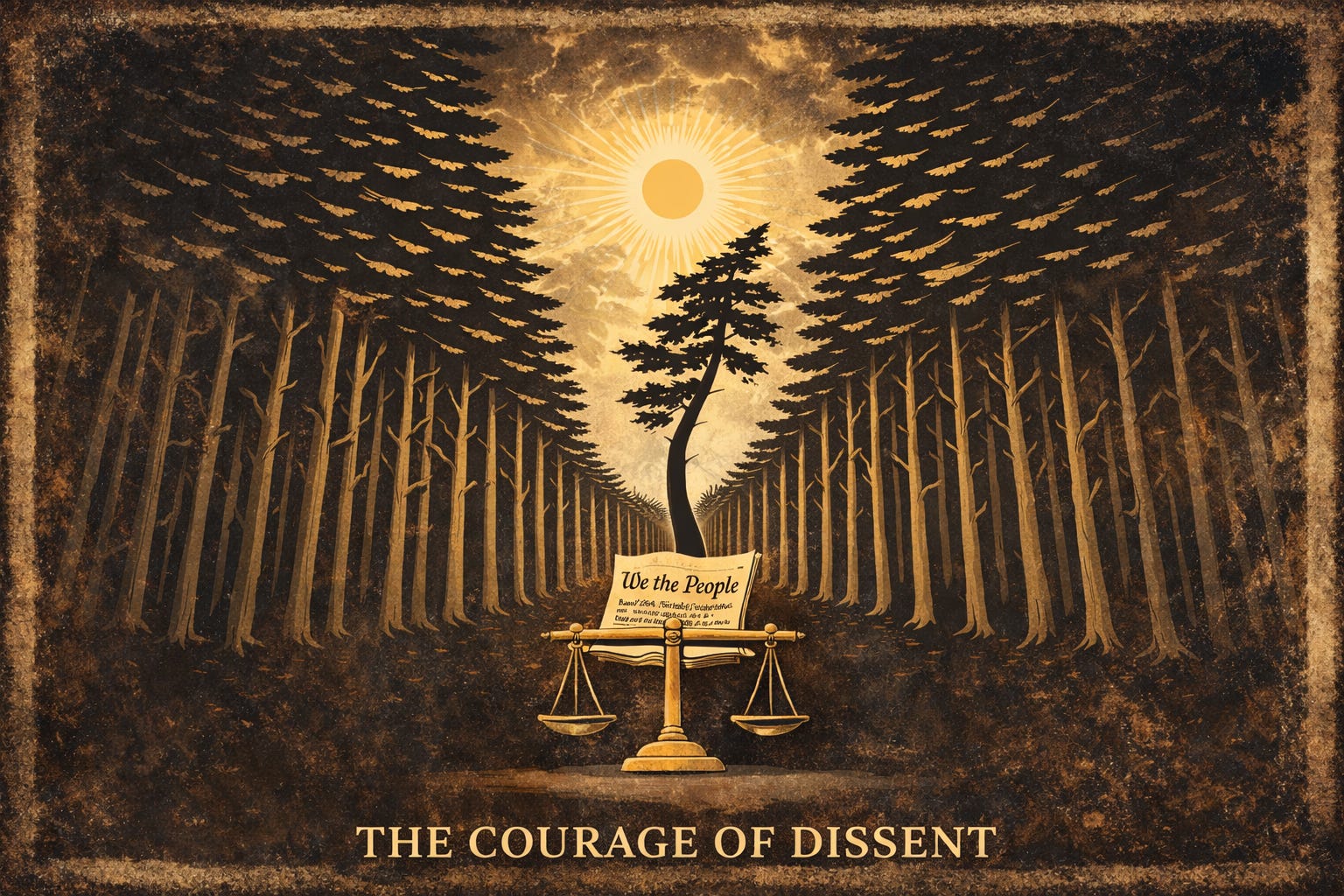
Introduction: The Word That Lost Its Meaning
“Patriot.”
It is one of the most powerful words in the American vocabulary. It is also one of the most abused.
Today, the word is often weaponized – not to inspire devotion to country, but to demand subservience to leadership. It is invoked to silence questions, dismiss dissent, and draw a line between those who “stand with us” and those branded as enemies.
But in a republic, patriotism was never meant to be a rubber stamp for authority. True patriotism isn’t measured by how loudly one cheers for those in power – but by the courage to question them in defense of the ideals they serve.
I. The Founders’ Expectation: Suspicion of Power
The American system was not built on trust in government; it was built on a calculated suspicion of it.
As James Madison wrote in Federalist No. 51, “If men were angels, no government would be necessary.” This was not cynicism – it was realism. The Founders understood that power, once granted, seeks its own expansion. It justifies its reach until it eventually escapes the limits placed upon it.
That is why they did not simply build institutions; they assigned a role to the individual. Madison called the people the “primary control” on the government – not a passive audience, but an active restraint.
Citizens would question power.
Not as a sign of disloyalty, but as a preservation of the Republic.
Not occasionally, but as a matter of duty.
II. The Modern Inversion: Patriotism as Compliance
Today, the Founders’ expectation has been inverted.
Questioning government action, especially in moments of crisis, is increasingly framed as a lack of resolve, or worse… disloyalty. Asking for justification is labeled “undermining.” Demanding constitutional clarity is dismissed as “obstruction.”
The accusation follows a predictable, toxic path:
If you question it, you must oppose it.
If you oppose it, you must be against your country.
This is not patriotism; it is the redefinition of patriotism into compliance.
Once this shift takes hold, the fundamental chemistry of a republic changes. The citizen is no longer a check on power – they become its defender, shielding the state from the very scrutiny that keeps it free.
III. War and the Pressure to Conform
This inversion of patriotism becomes most dangerous in matters of war. War compresses time, heightens emotion, and demands a singular, unquestioned unity. In this environment, the space for dissent – the very air a republic breathes – begins to disappear.
The pattern is as old as the Republic itself: a threat is declared, urgency is emphasized, and “unity” becomes a synonym for silence. Those who ask for clarity are accused of weakening the effort; those who ask for justification are accused of aiding the enemy.
But this is precisely when questioning matters most. War is where the cost of error is highest – measured in lives, national treasure, and long-term consequences that outlive any single administration.
To surrender our scrutiny at the moment the stakes are highest is not an act of patriotism. It is an abdication of our role as citizens. We do not support our country by blindfolded compliance; we support it by ensuring its actions remain worthy of the men and women who defend it.
IV. The Constitutional Standard: A Map for the Storm
The Constitution does not evaporate in times of tension – it becomes our only reliable anchor.
The Founders deliberately denied any single individual the power to declare war. They understood that the Executive, driven by the heat of the moment and the pull of “necessity,” is the branch most prone to conflict.
By vesting the war power in the legislature, they ensured that any move toward violence would first have to survive the friction of public debate and constitutional scrutiny.
If a conflict cannot withstand that scrutiny, it is not “justified” by urgency. It is rendered suspect by it.
A patriot does not fold the Constitution away when it becomes inconvenient or “inefficient” for the state. A patriot insists on it, especially then, knowing that a government that can bypass the law in a crisis will eventually find a reason to bypass it in the calm.
V. The False Choice: Reclaiming the Third Position
We are increasingly cornered by a false choice: Support the action, or you must support the enemy.
But a republic was never meant to operate within such a narrow, dangerous binary. It was designed for a third position:
- Support the country; question the decision.
- Reject the adversary abroad; demand clarity from the leaders at home.
- Honor the men and women in uniform; scrutinize the policies that put them in harm’s way.
These are not contradictions. They are the essential functions of a free person. To love your country is to want it to be right – and to ensure it is right, you must be willing to point out when it is wrong. This is not disloyalty; it is intellectual coherence. It is the refusal to trade the office of “Citizen” for the role of “Spectator.”
VI. The Real Meaning of Patriotism
Patriotism is not a performance. It is not a measurement of your slogans, your volume, or how quickly you align with the prevailing wind of authority.
A patriot does not measure loyalty by alignment – but by adherence to principle, especially when it is unpopular to do so. It is the courage to ask questions when silence is the only “safe” option.
A patriot understands that a free society depends on three non-negotiables:
Justification for every exercise of power.
Clarity for every national commitment.
Limits on every government action.
We do not demand these things because they are easy, or because we seek to obstruct. We demand them because they are essential. To love your country is to hold it to the highest standard, even, and especially, when its leaders would prefer you didn’t.
Conclusion: The Line That Cannot Be Crossed
There will always be moments when questioning power is framed as betrayal. There will always be pressure to conform – to accept the narrative, to align with the crowd, and to remain silent.
But that is precisely when the “line” matters most.
A patriot does not abandon their responsibility when it becomes difficult or unpopular. They fulfill it. They understand that true loyalty is not found in a rubber stamp for authority, but in a relentless commitment to the principles that define us.
In the end, we do not question our country to weaken it. We question it because we refuse to let it drift away from its soul
That is not dissent. That is patriotism.
The Publius Project exists to restore this essential understanding – that patriotism is not loyalty to power, but fidelity to the principles that limit it.
In Liberty,
Gary Mullins (Libertas)