

I. Introduction: A Republic Requires More Than Participation
A republic cannot survive on participation alone; it requires judgment. We are currently drowning in data but starved for the wisdom to weigh it.
While we have spent the last century rightly expanding access to the ballot, we have quietly neglected the one condition that gives that ballot meaning: the ability of the citizen to understand, evaluate, and direct the system they are participating in.
We have secured the right to vote, but we have lost the capacity to rule. A population that votes without understanding does not govern – it reacts.
As explored in Restoration Paper No. 7, this is the environment in which the Expert Class emerges.
When the citizen cannot evaluate complexity, authority naturally migrates to those who can. A citizenry that delegates its thinking eventually delegates its sovereignty. If we are to restore self-government, we must address whether the people are prepared to hold the power they claim.
II. The Problem: Participation Without Preparation
Modern civic education reflects a gradual lowering of expectations. The Expert Class did not seize the schoolhouse; they simply filled the silence left by a retreating curriculum. Today, civics is often reduced to a bureaucratic checklist of dates and definitions – teaching the mechanics of the machine while forgetting the purpose of the engine.
Students are asked to recall facts rather than wrestle with principles. This is not an education for a sovereign citizen; it is a training manual for a managed population. It teaches the citizen to wait for an expert’s interpretation rather than to read the law for themselves. We have maintained the architecture of the Republic – the buildings and the ballots – while evicting the spirit of inquiry that once inhabited them.
III. The Principle: Authority Requires Understanding
The Founders did not assume citizens would be technical experts, but they did assume citizens would be capable of judgment. Self-government requires the ability to ask the “Audit Questions” that serve as the guardrails of liberty:
Who has the authority to make this decision?
By what mechanism are they held accountable?
Is this action rooted in law – or merely in administrative policy?
Is this a matter of objective fact, or a value judgment disguised as expertise?
Without these questions, the citizen cannot govern; they can only defer. Once deference becomes the norm, authority no longer flows upward from the people – it settles permanently above them.
IV. The Proposal: A Standard of Civic Competence
If voting is the mechanism of authority, then civic competence must be its armor. I propose a shared Standard of Judgment – a baseline of constitutional literacy that restores the citizen’s ability to audit the Expert Class. We do not need more voters; we need more governors. Civic competence is the only antidote to the Caretaker State. To be competent is to no longer require a translator for your own laws.
V. The Curriculum of the Sovereign
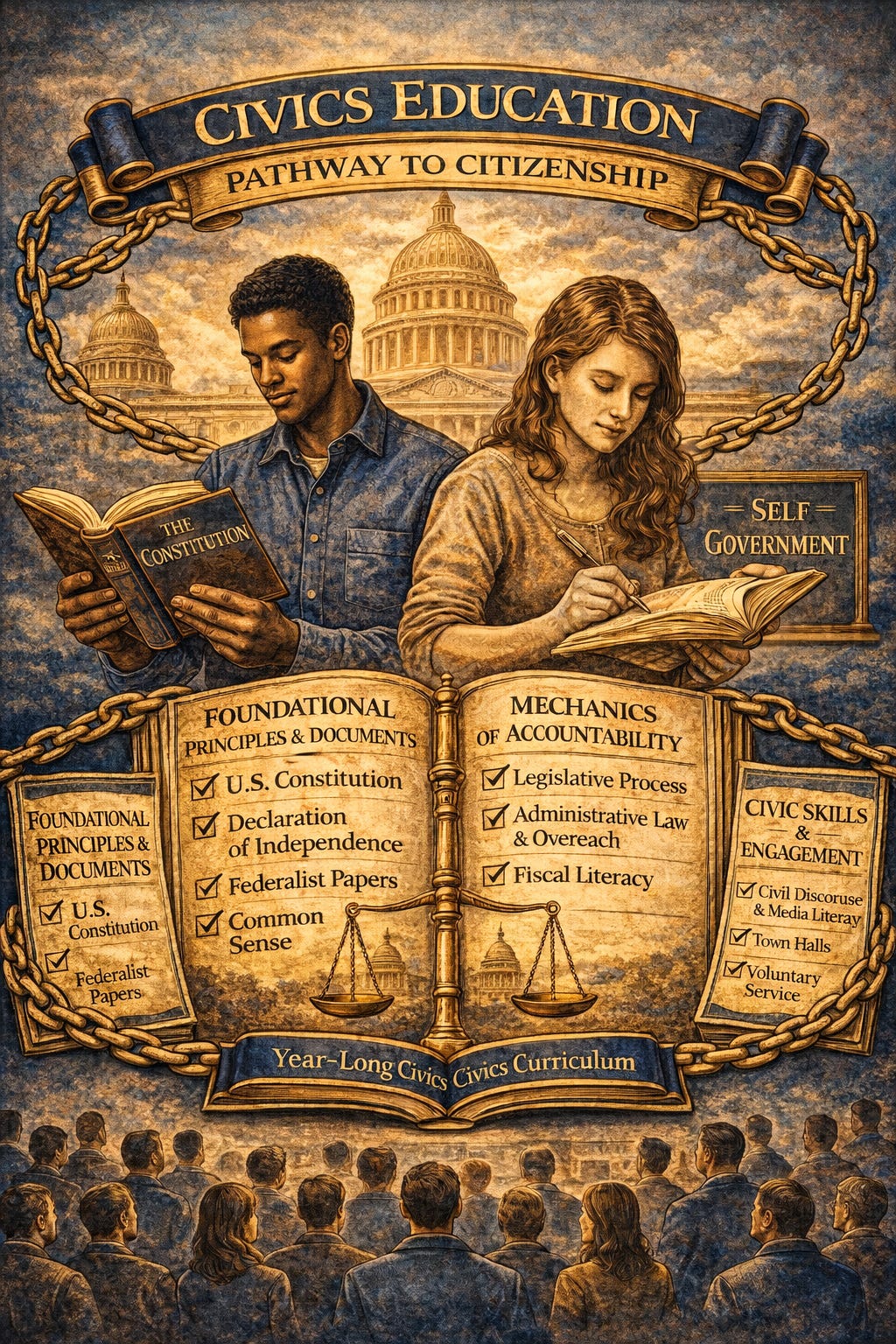
This is not an academic exercise; it is preparation for responsibility. The curriculum must rest on three pillars:
Foundational Principles & Limits of Authority: Students must engage with the Declaration, the Constitution, and the Federalist Papers – not as historical artifacts, but as operating frameworks. Without understanding limits, authority has none.
The Mechanics of Accountability: Citizens must distinguish between Legislative Law and Administrative Rule. They must recognize when their consent has been bypassed by an agency and understand the 10th Amendment as the key to reclaiming local sovereignty.
Civic Skills & Active Engagement: Citizens must develop the ability to analyze data, identify bias, and engage in civil disagreement. A citizen who cannot argue for their principles will eventually be told what they are.
VI. Addressing the Objection: The “Armor” vs. The “Gate”
The most serious objection is the history of “literacy tests” used for exclusion. However, this proposal is fundamentally different in intent and structure. Past tests were weapons of the state designed to ensure the citizen failed; this curriculum is a tool for the people to ensure the Republic succeeds.
To ensure this is not a barrier, the curriculum must be:
Universal, publicly funded, and transparent.
Implemented at the state and local levels to prevent a centralized Expert Class from seizing the curriculum.
Framed as training, not a tax. We do not ask a soldier to carry a rifle without training; we should not ask a citizen to carry the sovereign power of the ballot without the skill to defend it against manipulation.
VII. The Constitutional Challenge
This reform likely requires a Constitutional Amendment to remove it from the reach of the administrative state. While the Standard of Competence must be national, the Instruction and Oversight must remain with the States. This prevents a federal monopoly on truth and ensures an Ohioan understands the laws of Ohio as clearly as the laws of the Union. A policy can be manipulated by a bureaucracy, but an Amendment belongs to the people.
VIII. The Risk of Inaction
If we reject this path, participation will continue to expand while understanding continues to decline. The Expert Class will not “take” power; we will hand it over because we can no longer carry the weight of it. We will trade the burden of self-government for the ease of being overseen.
We will let experts decide our health, currency, and children’s futures not because we agree, but because we no longer know how to argue with them. The ballot will function like a customer satisfaction survey rather than a mandate. Authority does not abhor a vacuum; if the people are not competent to rule, the vacuum will be filled by managers of a failing estate.
IX. Conclusion: From Passive Participation to Active Self-Government
A republic is not built on trust; it is built on institutionalized suspicion. We do not trust those in power—we audit them. But an auditor who cannot read the books is useless.
To restore the Republic, we must first restore the Citizen. We must move beyond the ballot as a ritual and return to the ballot as a command.
In Liberty,
Gary Mullins (Libertas)