

If you’re anything like me, you’re tired of watching your hard-earned money vanish into a 70k page black hole called the federal tax code before you even have a chance to buy groceries. We’ve all been told the current system is simply just “the way it is,” but what if we could completely flip the script? What if we could keep 100% of our paychecks and the IRS all but completely disappeared?
In this special four-part series for the Publius Project, I’m breaking down the FairTax Act - not like an academic essay or a dry political debate, but like two neighbors talking around a fire pit while having a cold one and listening to some good music. Whether you’re skeptical about the math or ready for a radical change, this series is about exploring what happens when we stop letting the government monitor everything we earn and start focusing on a system that respects our privacy, our hard work, and our freedom.
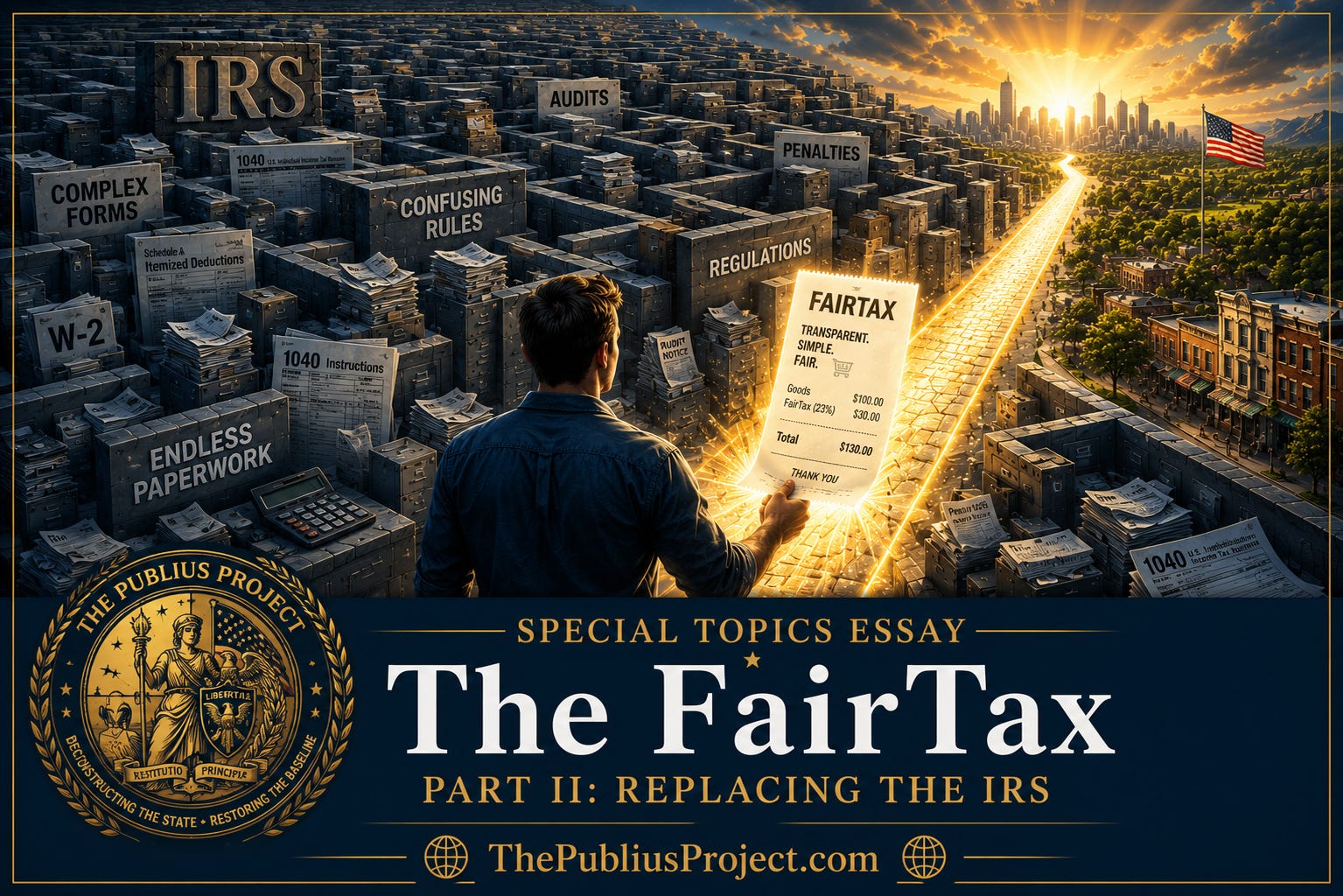
The Great Decoupling
For over a hundred years, our tax system has relied on a central enforcement body to watch the private earnings of every single American. That’s the Internal Revenue Service. Its massive size isn’t an accident; it’s the inevitable shadow cast by an income tax. Change the system, and the agency either has to fundamentally transform or disappear entirely.
“Why is the IRS so massive in the first place?”
The current tax code demands that the government verify how much we made, where we made it, and how we spent it. To do that, they have to have:
Intrusive oversight: Tracking every wage, investment, and side-hustle we possess.
Constant guessing games: Needing an army of nearly 80,000 employees just to manage a 70,000-page code.
Guilty until proven innocent: Running an adversarial system of audits and penalties that treats everyday citizens like persons of interest.
The IRS exists because an income tax literally cannot function without a high-resolution window right into our private financial life.
“Shutting down the enforcement machine.”
Under the FairTax Act, the core mission of the IRS simply evaporates. If income isn’t taxed, there’s no reason for 150 million Americans to file annual reports, and no reason for a federal agency to audit them.
The bill explicitly calls for dismantling the IRS after a transition period. And to make sure we don’t end up with a worst-of-both-worlds “hybrid” system, where Congress collects a sales tax and keeps an income tax, the Act has a built-in safety switch: if the 16th Amendment isn’t fully repealed within seven years, the FairTax automatically terminates.
“What happens to the tax industry?”
A simpler tax system would dramatically reduce the need for many of the compliance services that exist today. Tax preparation firms, compliance departments, and portions of the federal enforcement bureaucracy would likely shrink as millions of Americans no longer need to file annual income tax returns.
Supporters argue, however, that the underlying skills of accountants, auditors, financial professionals, and compliance specialists remain highly valuable throughout the economy. Rather than spending time navigating a complex tax code, many of these professionals could shift toward financial planning, business consulting, accounting, management, and other productive activities.
The broader question is whether a free society benefits when a significant share of its professional talent is devoted to tax compliance rather than creating value elsewhere in the economy. Supporters of the FairTax see this shift as a reallocation of human capital rather than a permanent loss of expertise.
“How do we actually collect the money?”
Instead of managing a massive federal bureaucracy, administration shifts to a localized, state-led model.
Most states already have the infrastructure to collect sales taxes. The FairTax simply tasks the states with collecting the federal portion and sending it to Washington, outsourcing the job back to the local level. To cover the paperwork costs, the federal government pays the states a 0.25% administrative fee. Retail businesses also get a 0.25% credit for acting as the primary collection points.
The massive footprint of the IRS is replaced by two tiny bureaus within the Treasury Department, the Excise Tax Bureau and the Sales Tax Bureau, just to keep an eye on the macro-level flow of funds.
“Sounds great, but what’s the catch?”
No reform this massive comes without friction, and critics raise real concerns that we have to answer honestly:
The senior double-tax worry: Retirees who spent decades paying income taxes often worry they would be taxed a second time when spending their savings under the FairTax. Supporters respond in several ways. First, retirement income from Social Security benefits, dividends, interest, and capital gains would no longer be subject to federal income taxation. Second, FairTax advocates argue that many current taxes embedded in consumer prices would disappear, reducing the actual increase in retail prices. Third, the monthly prebate and inflation adjustments to Social Security benefits are intended to shield lower-income seniors from the transition. Critics remain skeptical that these offsets fully compensate retirees, making this one of the most debated aspects of the proposal.
The black market risk: Critics warn that a visible 30% sales tax could encourage under-the-table transactions and tax avoidance. Supporters respond that many countries already operate with substantial consumption taxes and that modern retail systems are increasingly digital and automated. They also argue that large retailers are generally easier to audit than millions of individual taxpayers reporting wages, side income, and gig-economy earnings. While no tax system eliminates evasion entirely, supporters contend that the relevant question is not whether avoidance would exist, but whether it would be more severe than under the current income-tax system.
The business burden: While it frees 150 million citizens from filing taxes, it shifts compliance onto businesses. Retailers become the primary tax collectors, requiring smooth coordination between state and federal agencies, but since this is already being done a the local and state level, the transition should be relatively easy.
“The ultimate shift in American culture.”
The biggest impact of the FairTax isn’t administrative; it’s a cultural shift toward privacy. For the first time in a century, the government won’t require a list of our income sources or investments. Under a sales tax, the government sees the transaction, not the person. It cares what was bought, not who bought it.
The future of the IRS isn’t really about the agency itself; it’s about how much power we give the state to monitor our daily lives. By changing the system, we decouple financial privacy from civic duty. The FairTax is a clear declaration that our labor belongs to us – and the government’s reach ends where our personal choices begin.
In Liberty,
Gary Mullins (Libertas)