

If you’re anything like me, you’re tired of watching your hard-earned money vanish into a 70k page black hole called the federal tax code before you even have a chance to buy groceries. We’ve all been told the current system is simply just “the way it is,” but what if we could completely flip the script? What if we could keep 100% of our paychecks and the IRS all but completely disappeared?
In this special four-part series for the Publius Project, I’m breaking down the FairTax Act - not like an academic essay or a dry political debate, but like two neighbors talking around a fire pit while having a cold one and listening to some good music. Whether you’re skeptical about the math or ready for a radical change, this series is about exploring what happens when we stop letting the government monitor everything we earn and start focusing on a system that respects our privacy, our hard work, and our freedom.
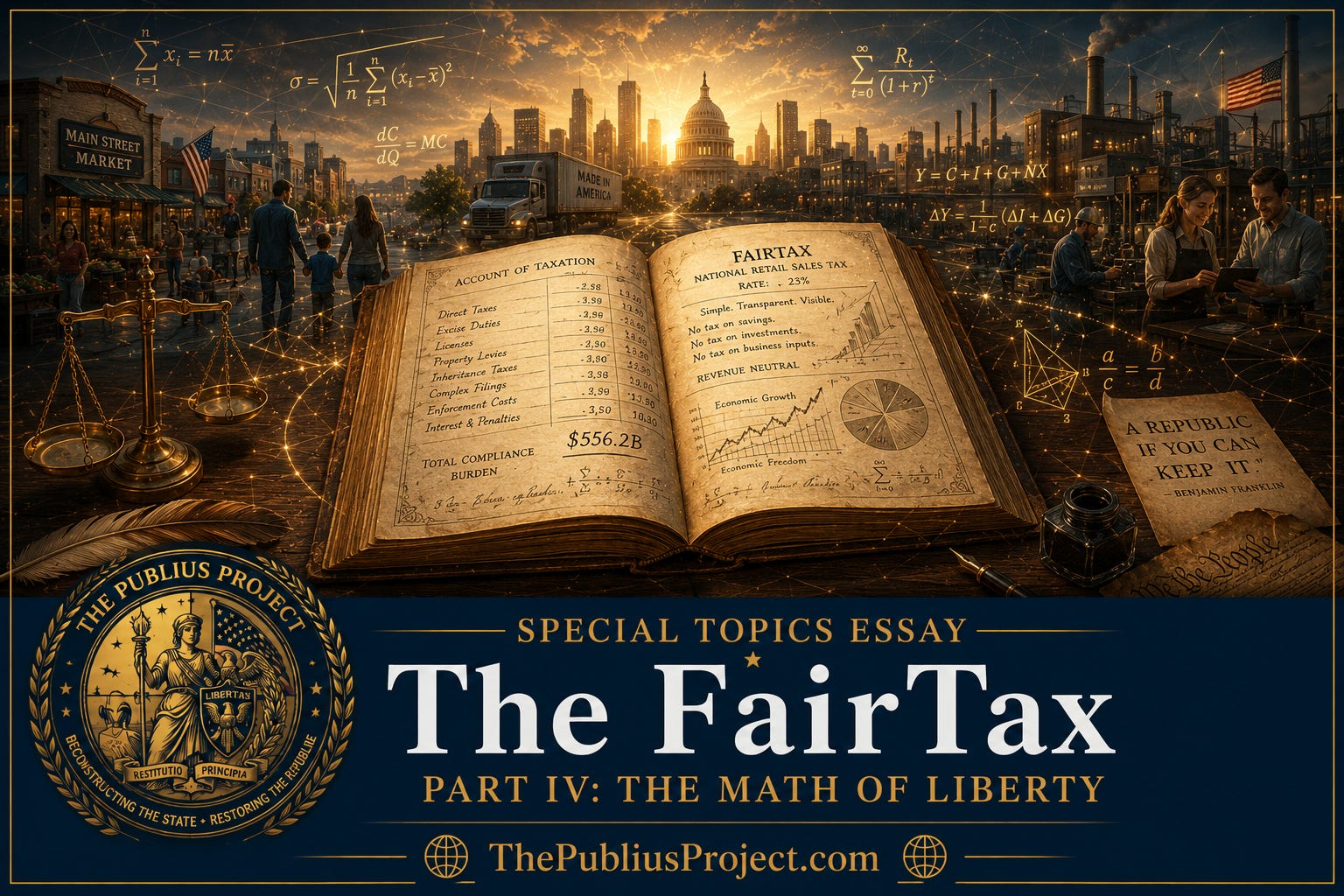
The most persistent debate around the FairTax isn’t about philosophy; it’s about basic arithmetic. For a reform this massive to work, it has to achieve “revenue neutrality,” meaning it must fund the essential functions of the federal government without driving us deeper into the national deficit.
Let’s look closely at the math and the conflicting arguments surrounding it.
“Why do some people say 23% and others say 30%?”
The first point of confusion for most folks is the rate itself. Proponents usually quote 23%, while critics cite 30%. Both are technically correct, they’re just looking at it from different angles:
The Tax-Inclusive Rate (23%): This is meant to match how we view current income tax brackets. If someone earn $100 today, the government takes roughly $23 off the top, leaving them with $77. In this view, the tax is 23% of the total chunk.
The Tax-Exclusive Rate (30%): This is what we actually see printed on a sales receipt. If an item costs $77, a 30% sales tax adds $23, bringing our total out-of-pocket to $100.
Now, critics from groups like the Tax Policy Center argue a 30% markup might not be enough. They suggest that once you account for potential tax evasion and the massive cost of sending out the monthly prebate, the rate might need to lean closer to a 46% tax-inclusive rate, which would look like an 85% markup at the cash register.
FairTax supporters dispute these higher-rate estimates. They argue that some analyses rely on assumptions about future exemptions, carve-outs, or political compromises that are not contained in the legislation itself. Supporters contend that the proper comparison is between the current tax code as written and the FairTax proposal as written, rather than between current law and a hypothetical modified version of the FairTax. Critics respond that political realities often force major tax legislation to evolve after enactment, making such assumptions reasonable when projecting long-term outcomes.
The Rate vs. The Spending
FairTax supporters argue that debates over the tax rate can sometimes obscure a more fundamental issue: federal spending. The FairTax does not determine how much money Washington spends; it determines how that money is collected. Under this view, a high FairTax rate is not evidence of a flawed tax mechanism so much as a reflection of the amount of revenue required to fund the existing federal government. One advantage of a visible consumption tax, supporters argue, is that it makes the true cost of government easier for citizens to see and evaluate.
“The ‘Boomtown’ Effect: Growth as a revenue source.”
FairTax supporters argue that tax policy does more than raise revenue, it influences how people work, save, invest, and spend. As a result, many FairTax projections incorporate “dynamic scoring,” which attempts to account for changes in economic behavior rather than assuming the economy remains unchanged after major tax reform.
Increased savings: By removing the tax penalty on savings and investments, capital stock can grow significantly, driving up productivity and overall economic consumption.
The efficiency dividend: Eliminating that $300 billion annual compliance drain (what we spend just to file taxes) injects that massive capital directly back into the productive economy.
A broader base: By capturing the underground cash economy and foreign tourists, the tax net expands, allowing a lower overall rate to generate the same total revenue.
“What happens to Social Security and Medicare?”
A major hurdle is making sure our critical safety nets stay solvent. Under the FairTax, traditional payroll taxes are completely abolished.
To fix this, the Act explicitly carves out a specific percentage of the total sales tax revenue to be automatically deposited right into the Social Security and Medicare trust funds. And because a national sales tax would initially raise the visible price of goods, the Act requires Social Security benefits to be indexed for inflation, making sure seniors’ purchasing power is fully protected during the transition.
Is the FairTax Regressive?
Critics often argue that consumption taxes are regressive because wealthier households typically spend a smaller percentage of their income than lower-income households. By measuring taxes as a percentage of income, the tax burden appears to fall more heavily on those who spend most of what they earn.
FairTax supporters challenge the premise itself. They argue that fairness should be measured against consumption rather than income. Under this view, income that is saved, invested, or donated is fundamentally different from income used for personal consumption. A consumption-based tax system taxes what individuals take out of the economy rather than what they contribute to it. Supporters contend that this approach rewards saving, investment, and charitable giving while imposing higher taxes on luxury consumption.
Whether fairness should be measured against income or consumption ultimately depends on one’s philosophy of taxation, making this one of the central debates surrounding the FairTax proposal.
“Let’s look at the counter-arguments honestly.”
While the vision is bold, the math faces plenty of skepticism from mainstream economists:
The revenue gap: The Brookings Institution warns that a 23% inclusive rate could add trillions to the national deficit over ten years if those economic growth projections turn out to be overly optimistic.
Evasion risks: High sales taxes in other countries have historically driven people toward under-the-table cash transactions. Critics argue a 30% markup creates a massive incentive for a retail black market.
The ‘stacked’ tax problem: There’s a major question regarding state and local sales taxes. In a state like California or New York, adding a 30% federal tax on top of a 10% local sales tax means a 40% total markup at the register, a number that might be politically and economically unsustainable for retail stores.
“Is it actually feasible?”
Whether the FairTax is feasible ultimately depends on how one evaluates the trade-offs, assumptions, and economic projections surrounding the proposal. Supporters see it as a simpler, more transparent system that rewards work, saving, and investment while broadening the tax base. Critics worry about transition costs, compliance challenges, and the uncertainty of large-scale economic forecasts.
Supporters have also begun making a newer argument tied to artificial intelligence and automation. If future technologies significantly reduce the amount of income earned through traditional labor, governments that rely heavily on taxing wages and earnings could face growing revenue challenges. Because the FairTax is tied to consumption rather than income, supporters argue it may prove more resilient in an economy where value creation increasingly comes from automation, AI systems, and capital-intensive production rather than human labor. Critics counter that the scale and timing of such changes remain highly uncertain.
The FairTax isn’t a magic wand; it’s a fundamental trade-off. It trades the privacy-evaporating income tax for the absolute visibility of a sales tax. It trades the complex mess of the IRS for the simplicity of the retail counter.
Ultimately, it asks us to make a choice: Which is more dangerous to a free people, a government that knows everything you earn, or a government that knows everything you spend?
In Liberty,
Gary Mullins (Libertas)