

Week Ending September 26, 2026
Most of us only hear about Congress through screaming cable news segments or social media clips designed to make us mad before we’re informed. The People’s Ledger is different. It’s a quick, clear look at what lawmakers are actually debating, funding, and changing – minus the political theater.

The House Is Gone. The Senate Worked. And Washington Is Racing the Clock.
The final weeks of September is Washington is always a little strange and this year is no different.
The House checked out over a week ago and won’t be back until after the midterms. Now somebody’s always there to “keep the lights on” through “pro forma” sessions, but nothing’s getting done on that side of the Capitol.
But, the Senate was still in town and they actually did some work last week.
They weren’t frantically trying to finish everything before the fiscal year ends this coming Wednesday, but they did log some real legislative work: confirming a federal judge, passing a couple of bipartisan security bills, advancing that major college sports package, and holding another dramatic, razor-thin vote on presidential war powers regarding the Iran war.
Meanwhile, outside of the Capitol, another end of year D.C. tradition is fast underway and has been for at least a month now.
Remember, the federal government fiscal year ends Wednesday, September 30th and all across the executive branch, agencies and offices holding what is known as “one-year-money” are staring down a deadline. Spend any unused funds before midnight or lose them back to the Treasury.
Welcome to the annual September spending dump.
1. The Big Story: One Chamber Left Standing
What happened
With the house gone, the Senate was the only game left in town. But, believe it or not, they actually did accomplish a few things before they pack their bags.
Judicial Confirmation: Confirmed Angela Colmenero, 50–47, to the U.S. District Court for the Southern District of Texas.
College Athletics: Voted 77–23 to advance an updated version of the Protect College Sports Act, closing debate and clearing the path toward a final vote.
Iran War Powers Showdown: In the week’s most consequential vote, the Senate came within a single vote of passing H. Con. Res. 89, a concurrent resolution telling the President to end unauthorized hostilities in Iran.
And then came the week’s biggest constitutional vote:
The War Powers Reality Check
The vote failed 49-50.
Four Republicans (Susan Collins, Lisa Murkowski, Rand Paul and Thom Tillis) joined Democrats and Independents in voting to reassert congressional authority. Democratic senator John Fetterman voted against it, while Senator Angela Alsobrooks didn’t vote.
But, even if it had passed, it wouldn’t have carried the force of law because it was a concurrent resolution, meaning it doesn’t get sent to the President for signature or veto. Following the Supreme Court’s INS v Chadha decision, such resolutions can’t legally compel the executive branch to pull back troops.
So, all it really means is the vote was essentially for show. If Congress really wanted to stop the war, they would pass a binding join resolution, deny formal authorization, or use its Article I power of the purse to cut off funding.
Why it matters
The Senate’s work this week just makes the House’s absence more noticeable. Americans need to know their government is working for them. They don’t need to see hundreds of laws being passed to verify that. Sometimes doing oversight is the job, or voting down something could also be the job at that time and that’s fine.
Debating presidential war powers matters vastly more than passing a dozen commemorative resolutions and at least for one week, the Senate treated its constitutional authority role seriously.
Who Wins or Loses
Likely Winners: Americans to some extent, because the Senate actually did its job this week. Additional winners include supporters of the Protect College Sports Act which appears to have wide support for the final vote, scheduled for Monday, September 28th. And it’s probably fair to say that President Trump and the Executive Branch won because the Senate declined to direct an end to the war with Iran.
Likely Losers: Anyone who wants more restraint put on presidential war powers; Americans to some extent again, but this time because the House wasn’t in session doing their job.
What to Watch For Next
The Senate returns Monday with the first vote scheduled to be the final passage of the Protect College Sports Act. After that, there are only a few days left before the Senate heads out of town also.
2. The Bills That Didn’t Make the Headlines
While national headlines focused on the United Nations General Assembly and campaign slogans, the Senate actually managed to pass a few significant bills:
S. 1962 – Secure Space Act of 2026
What It Does: Prohibits the Federal Communications Commission (FCC) from granting satellite licenses, earth-station access, or U.S. market authorization to companies linked to entities on the federal government’s security risk “Covered List.”
Why It Matters: If a foreign firm has already been flagged as a national security risk on earth, this bill ensures they can’t bypass those restrictions by operating through satellite communications networks overhead.
S. 3404 – Satellite Cybersecurity Act
What It Does: Directs federal agencies to assess and support the cybersecurity posture of commercial satellite systems.
Why It Matters: Commercial satellites carry vast amounts of financial, weather, navigation, and defense traffic. Orbiting infrastructure is no longer science fiction, it’s a critical national vulnerability.
H.R. 1721 – Critical Infrastructure Manufacturing Feasibility Act
What It Does: Directs the Commerce Department to identify critical infrastructure components reliant on foreign supply chains and evaluate whether domestic manufacturing is economically viable.
Why It Matters: In Washington, “studying whether the government should do something” is almost always the first step toward the government actually doing it. Keep an eye on where this goes.
Other Notable Passed Measures: The Senate also cleared targeted bills addressing aviation mental health, romance scams, illegal fishing enforcement, and tribal land rights.
3. Welcome to the September Spending Sprint
If you’ve been around the federal government long enough, you know what late September feels like.
Contract options are suddenly exercised. Purchase requests fly across desks. Money gets shuffled from account to account as offices scramble to buy whatever they can before midnight on September 30.
We call it the “Use It or Lose It” sprint. It isn’t just political rhetoric—the Government Accountability Office (GAO) uses the exact same phrase to warn about the wasteful spending incentives built into the federal budget.
Obligation vs. Outlay: How It Actually Works
To understand the year-end rush, you have to understand the difference between spending money and obligating it:
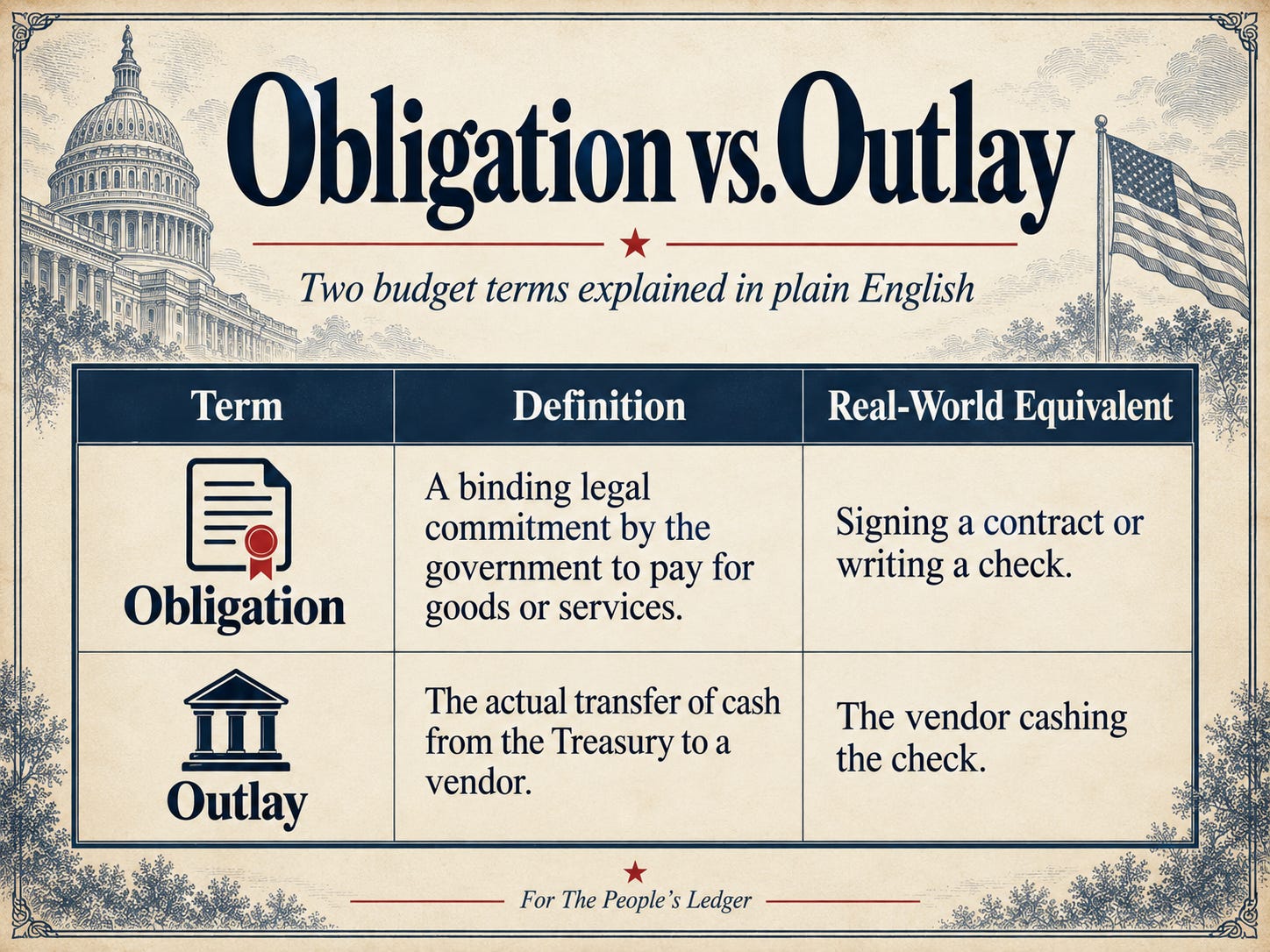
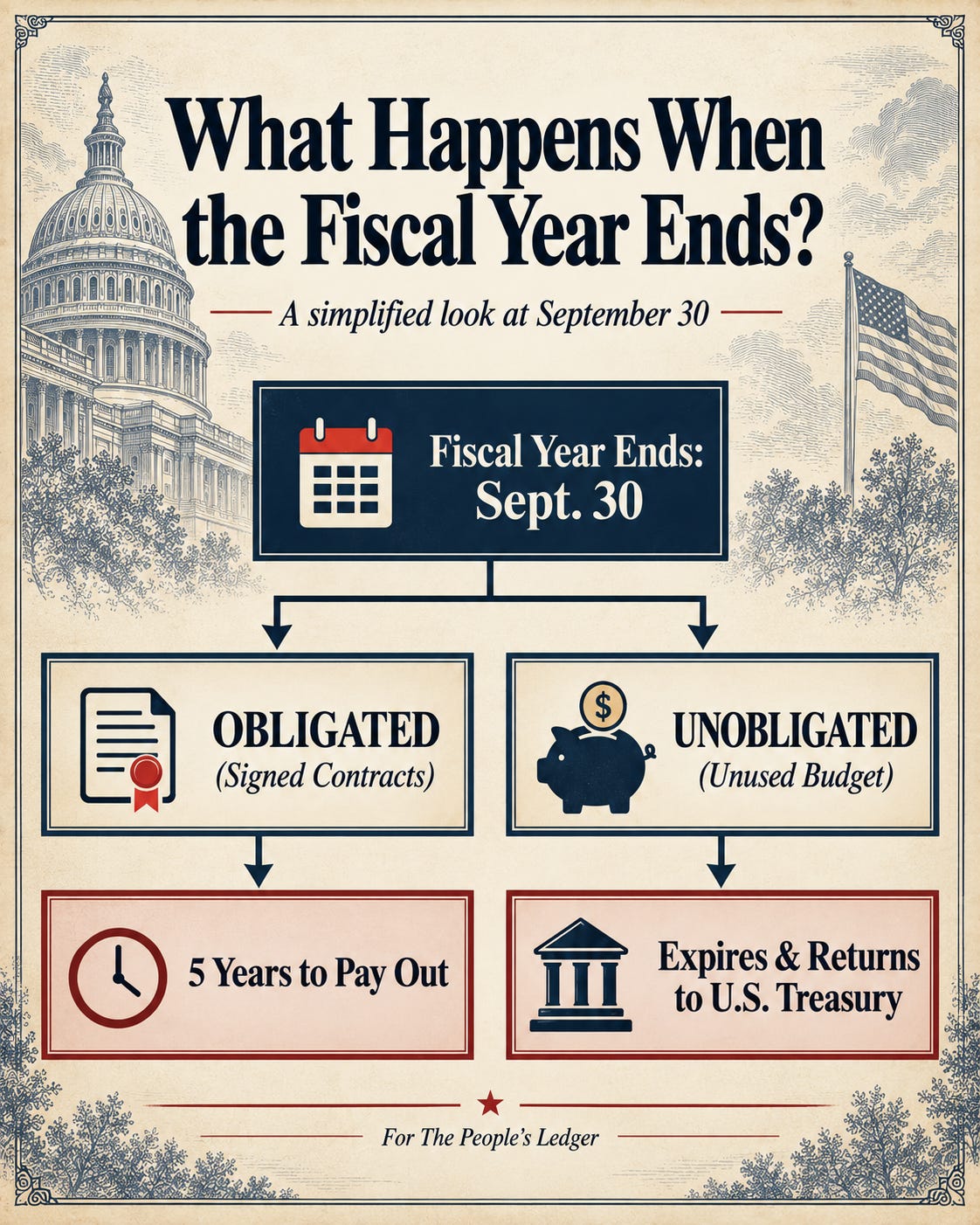
When “one-year money” expires on September 30th, an agency doesn’t have to cash every check before midnight. They just have to obligate the funds by signing a contract. Once obligated, they have up to five years to actually pay out the cash.
If they fail to obligate that money by September 30, the authority to use those funds disappears entirely. Hence: use it or lose it.
The Broken Incentive System
This mechanism creates a deeply flawed financial structure:
In Private Business: If a manager accomplishes a mission for $90 million instead of the budgeted $100 million, they save $10 million. They are rewarded for efficiency.
In the Federal Government: If a manager saves $10 million, that money isn’t celebrated. It becomes a crisis. The immediate fear is: “If we give this back, Congress will cut our budget by $10 million next year.”
Instead of asking “Does the taxpayer really need this?”, bureaucrats are forced to ask “How do we get this obligated before midnight?”
To be clear: not every September purchase is wasteful. Many agencies hold back money due to funding delays caused by Continuing Resolutions earlier in the year. But the underlying incentive structure actively rewards spending every last cent and penalizes fiscal restraint.
4. Coming to the House Floor This Week
The House
Nothing Substantive. The House will hold brief pro forma sessions to satisfy constitutional requirements, but no votes are scheduled until after the midterm elections.
The Senate
S. 4668 – Protect College Sports Act: What is expected to the be the final vote is scheduled for Monday evening around 5:30 p.m. EDT. If passed, the bill creates nationwide standards for athlete compensation, transfers, agent conduct, and healthcare. But, since the House is out, the bill will sit in limbo until November at the earliest.
5. Civil Liberties & Constitutional Power
49–50: The Senate Comes Within One Vote of the Iran Question
Thursday’s vote on H. Con. Res. 89 shows a profound institutional divide on Capitol Hill.
Article I of the Constitution explicitly grants Congress the power to declare war and fund military operations. Yet, for decades now, Congress continues to defer that power to the President.
So, by failing to pass a formal authorization or force a withdrawal, Congress leaves the executive branch in complete control of sustained foreign military actions.
6. Publius Take: Stop Punishing Government for Saving Money.
I know, it’s crazy. But seriously, it is so backwards the way Washington approaches taxpayer money.
Politicians spend all year giving speeches about government waste, but they cling to a system that forces federal employees to spend every dime by September 30th or face budget cuts next year.
Whether you believe the federal government should spend $1 trillion or $10 trillion, every taxpayer should agree on one basic principle:
The government should never spend money simply because a date on the calendar is about to expire.
Congress writes the laws. They control the purse strings. If the budget incentives are broken, it has the sole power to fix them:
Allow agencies to carry over a portion of saved operational funds into the next fiscal year.
Reward departments that return unused funds with operational flexibility rather than budget cuts.
Stop forcing managers to operate under perpetual Continuing Resolutions that compress a year’s worth of planning into a chaotic three-week September rush.
Doing the job means ensuring the government has what it needs to function – and not a single penny more.
7. The Bottom Line
The House’s lights are on, but nobody’s working. The Senate stayed in town, confirmed a federal judge, passed security bills, and brought war powers to a historic, razor-thin vote.
Give the Senate credit for actually legislating.
Now, Washington enters its favorite annual spectacle. The clock is ticking down to September 30, and billions of dollars in taxpayer authority are about to expire.
As the fiscal year closes, the metric shouldn’t just be how much Washington spent. The real question is:
How much did they spend because the public needed it – and how much did they spend just to beat the clock?
That’s the ledger every voter should be watching.
8. Sources & Further Reading
U.S. Senate — Floor Activity, September 22–24, 2026.
U.S. Senate — Roll Call 244, H. Con. Res. 89, September 24, 2026.
U.S. Senate — Protect College Sports Act floor schedule and votes.
U.S. House Republican Cloakroom — House schedule for September 28–October 2.
GAO — Budget Issues: Budget Uncertainty and Disruptions Affect Timing of Agency Spending.
GAO — A Glossary of Terms Used in the Federal Budget Process.
U.S. Code, 31 U.S.C. §§1552–1553 — expiration, closing and availability of fixed-period appropriations.
GovInfo — Continuing Appropriations and Extensions Act, 2027.
GovInfo — Secure Space Act and Satellite Cybersecurity Act.
GovInfo — Critical Infrastructure Manufacturing Feasibility Act.